
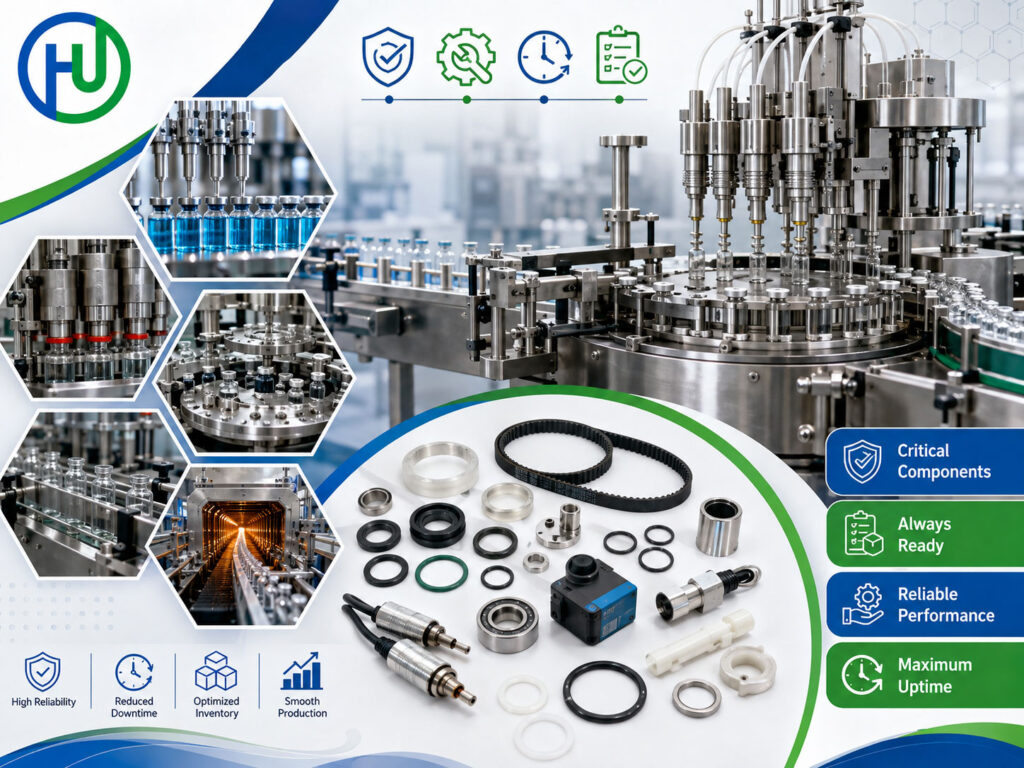
When a part fails on a vial filling machine, the difference between a short stop and a long shutdown often comes down to one question: is the replacement part on the shelf? If it is, a trained technician can usually restore production quickly. If it is not, the line may wait days or weeks for delivery, batches are delayed and customers are let down.
Yet keeping every possible part in stock is expensive and impractical. The goal is a smart spare parts inventory: the right parts, in the right quantities, stored correctly and easy to find when needed.
This guide explains how to build that inventory for vial filling machines and complete vial lines: how to classify parts, decide which are critical, which components to keep in stock for each machine section, how many to hold, how to store them under GMP and how to manage the inventory over time.
Why a Spare Parts Strategy Matters
| Without a Strategy | With a Strategy |
|---|---|
| Long downtime waiting for parts | Quick repairs from stock |
| Emergency orders and freight costs | Planned purchasing |
| Overstock of rarely used parts | Inventory matched to real needs |
| Wrong or unidentified parts | Clearly labelled, traceable parts |
| Quality risks from improvised repairs | Correct, approved replacements |
Step 1: Classify Your Spare Parts
Wear parts and consumables
Parts that wear out through normal use and are replaced regularly, such as seals, O-rings, tubing, needles, belts and crimping rollers. Usage is predictable.
Critical (insurance) spares
Parts that rarely fail but would stop production for a long time if they did, and which have long lead times, such as servo motors, drives, gearboxes or custom machined components.
Change parts
Format parts for each vial size, such as star wheels, guides and stoppering parts. Spare sets protect against damage during changeovers.
General spares
Standard items such as fuses, fasteners, fittings and common sensors that can often be bought locally.
Step 2: Assess Criticality
For each part, consider:
- Impact of failure – does it stop the line, reduce output or only affect a minor function?
- Lead time – how long does it take to obtain a replacement?
- Failure likelihood – how often does it wear or fail?
- Availability – is it a standard catalogue item or a custom part?
- Quality impact – could improvising without it affect product quality?
A simple matrix helps:
| Short Lead Time | Long Lead Time | |
|---|---|---|
| Stops production | Keep a small stock | Keep in stock (high priority) |
| Does not stop production | Buy when needed | Consider stocking if failure likely |
Parts that stop production and have long lead times are your top priority.
Step 3: Essential Components by Machine Section
Dosing system
- Piston pumps – seals, O-rings, valves, and for critical lines, complete spare pump sets so a pump can be swapped and the worn one serviced offline
- Peristaltic systems – tubing sets (often a regular consumable), pump head rollers and tubing clamps; see the peristaltic based liquid filling machine
- Manifolds and connectors – gaskets and fittings
Filling needles and nozzles
- Spare needles for each size used
- Needle holders and seals
- Nitrogen purge needles and gas filters where used
Stoppering system
- Stopper bowl wear parts and track sections
- Pick-up heads or fingers
- Vacuum cups or grippers where applicable
- Stopper presence sensors
Vial transport
- Star wheels and guides (spare sets for frequently used formats)
- Infeed worm or scroll
- Turntable parts and drive belts
- Bearings and couplings
Drives and motion
- Belts and timing belts
- Bearings for main shafts and transfer mechanisms
- Gearbox spares or complete gearboxes for critical drives (based on lead time)
- Servo motors and drives for critical axes, where lead times are long
Electrical and controls
- Vial, stopper and level sensors
- Proximity switches and photoelectric sensors
- Fuses, relays and contactors
- Power supplies
- Safety interlock switches
- Backup copies of PLC and HMI software (stored securely)
Pneumatics and utilities
- Solenoid valves
- Pneumatic cylinders for critical functions
- Filters and regulators
- Tubing and push-in fittings
- Vacuum pump spares where used
Machines such as the Automatic Servo Based Vial Filling Machine, the Two Head Liquid Vial Filling Stoppering Machine and the liquid vial filling machine with rubber stoppering come with supplier recommendations for spares.
Spares for the Rest of the Vial Line
| Machine | Typical Spares to Stock |
|---|---|
| Vial washer | Spray nozzles, pumps or pump seals, filters, grippers, belts |
| Sterilizing tunnel | Heater elements, fan motors or bearings, HEPA filter gaskets, belt or chain parts, temperature sensors |
| Cap sealer | Crimping rollers or heads, cap bowl parts, belts, sensors |
| External washer | Nozzles, brushes, drying blower parts |
| Inspection machine | Lamps or light sources, rollers, belts |
| Labeller | Peel plates, pressure rollers, wrap belts, sensors, coder parts |
Examples of line equipment include the Automatic Linear Vial Washer, the linear vial washer, the rotary vial washing machine, the sterilizing tunnel for ampoules and vials, the vial cap sealing machine, the Automatic Eight Head Vial Cap Sealing Machine, the automatic external vial washing machine and the visual ampoule and vial inspection machine. For integrated solutions such as the automatic liquid vial filling line, a coordinated spares list across all machines simplifies inventory management.
Step 4: Decide How Many to Keep
Stock levels depend on:
- Usage rate – how many are used per month or year
- Lead time – how long replenishment takes
- Number of identical machines – shared spares across machines reduce total stock needed
- Criticality – higher for parts that stop production
- Shelf life – elastomers and some electronic parts can degrade in storage
A simple approach for wear parts: keep enough to cover usage during the replenishment lead time, plus a safety margin. For critical insurance spares, one unit is often sufficient unless several identical machines depend on it.
An illustrative reorder point example
Suppose a particular pump seal is used at a rate of about 4 per month, the supplier’s lead time is 2 months, and you want a safety margin of 2 seals. The reorder point would be:
4 seals per month × 2 months + 2 safety seals = 10 seals
When stock falls to 10, a new order is placed. This example is illustrative only; use your own usage, lead time and safety margin figures.
Step 5: Store Spares Correctly
Poorly stored spares can fail when they are finally needed. Good practice includes:
- Clean, dry, organised storage with controlled temperature where needed
- Clear labelling – part number, description, machine, location
- Protection from damage – especially for precision parts and needles
- Shelf-life control for elastomers, tubing and lubricants – first in, first out
- Electrostatic protection for sensitive electronic parts
- Segregation of product contact parts so they are kept clean and identified for their intended use
GMP considerations
- Product contact parts must be of the correct, approved specification
- Parts used in aseptic areas may need cleaning and sterilisation before installation
- Traceability of critical parts, such as material certificates for product contact components
- Like-for-like replacement versus changes: using a different part may require change control
- Records of parts used in maintenance activities
For design and documentation features that support GMP, read our cGMP compliance guide: essential features for sterile vial filling machinery. Significant part changes may affect qualification; see automatic vial filling equipment validation: IQ, OQ and PQ explained.
Commissioning Spares vs Operating Spares
Spare parts needs change over the life of a line:
- Commissioning spares – parts likely to be needed during installation, start-up and early production, when adjustments and minor failures are more common. Suppliers often recommend a commissioning kit.
- Operating spares – parts for routine maintenance and protection against breakdowns during normal production, based on wear rates and criticality.
- Long-term spares – parts for major overhauls and protection against obsolescence later in the machine’s life.
Planning for all three avoids gaps at the start and surprises later.
Spare Parts Kits by Maintenance Task
Grouping parts into kits makes maintenance faster and reduces the risk of missing items:
| Kit | Typical Contents |
|---|---|
| Pump service kit | Seals, O-rings, valve parts for one pump |
| Needle kit | Spare needles, holders and seals for one vial format |
| Stoppering kit | Pick-up parts, vacuum cups, track inserts |
| Crimping kit | Crimping rollers or head parts, springs |
| Sensor kit | Most common sensors and mounting parts |
| Annual service kit | All parts scheduled for annual replacement |
Kits can be prepared in advance and issued with the work order, so technicians have everything they need before the machine is stopped.
Step 6: Manage the Inventory Over Time
- Use a maintenance or inventory system to record stock, usage and reorder points
- Review usage regularly and adjust stock levels
- Link spares to the maintenance plan – planned replacements should draw from stock that is then replenished
- Learn from failures – add parts that fail unexpectedly to the stock list
- Watch for obsolescence – suppliers may discontinue components; plan replacements or upgrades in advance
Spares management goes hand in hand with preventive maintenance; read vial filling machine maintenance: 7 best practices to prevent unscheduled downtime.
Step 7: Work with Your Machine Supplier
Your machine supplier can help by providing:
- Recommended spare parts lists for commissioning and for longer-term operation
- Part numbers and drawings for easy identification
- Lead time information for each part
- Spare parts kits for common maintenance tasks
- Advice on upgrades when parts are improved or discontinued
- Fast dispatch for urgent needs
Agree in advance how urgent orders will be handled, so you know what to expect when a critical part is needed quickly. For plants with several machines from the same supplier, a consolidated spares agreement, covering stocking, pricing and delivery times, can simplify purchasing and reduce the total inventory you need to hold on site.
Common Spare Parts Mistakes
- Keeping no critical spares because the machine is new
- Overstocking rarely used parts while missing frequently used ones
- Poor labelling, so parts cannot be found or identified
- Ignoring shelf life of seals and tubing
- Using non-approved substitutes for product contact parts
- Not updating the list after machine modifications
For a broader view of downtime causes, read maximizing efficiency in pharmaceutical filling lines: understanding common causes of downtime. If you also run ampoule lines, see the ampoule filling machine maintenance checklist.
Frequently Asked Questions
Which vial filler spare parts are most important to keep in stock? Parts whose failure would stop production and that have long lead times, plus regularly used wear parts such as seals, tubing, needles and crimping rollers.
How many spare parts should I keep? Enough wear parts to cover usage during the replenishment lead time plus a safety margin, and usually one of each critical insurance spare.
Do spare parts need special storage under GMP? Product contact parts should be stored clean, identified and of the approved specification, with shelf life and traceability controlled.
Can I use generic parts instead of original parts? Only if they meet the approved specification. Using a different part may require change control, especially for product contact components.
How often should the spare parts list be reviewed? At least yearly, and after any significant failure, modification or change in production pattern.
Need a spare parts list for your vial filling line? Contact our team or send an inquiry with your machine models and we will recommend the right spares.