
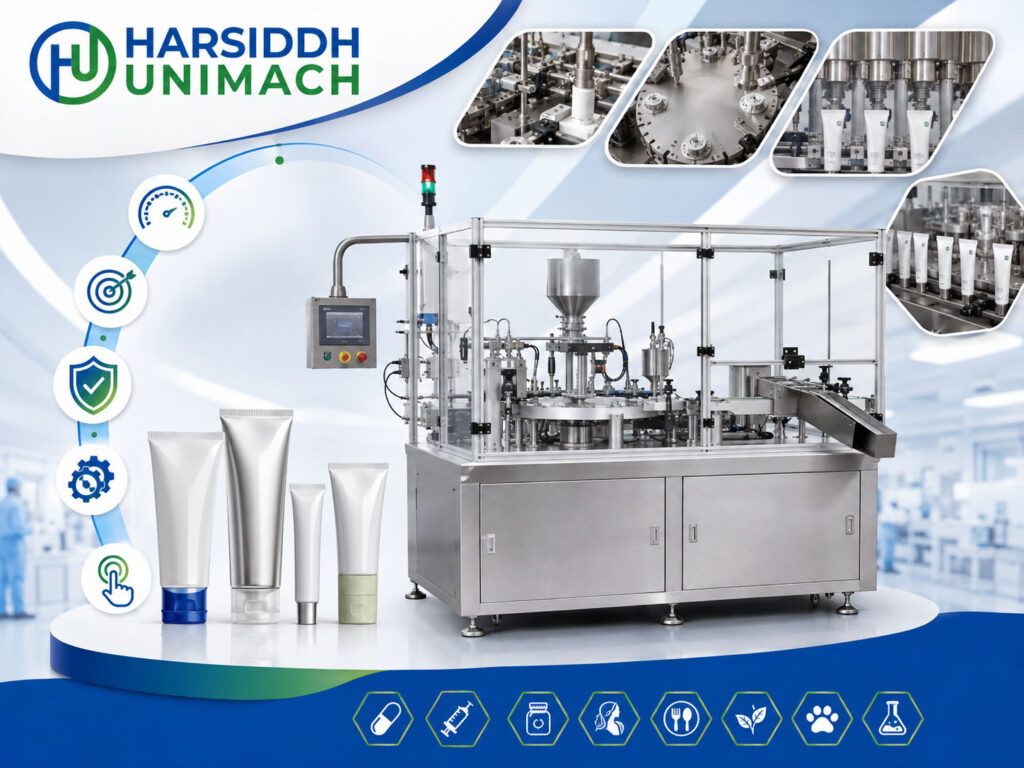
Tubes are one of the most popular packs for creams, ointments, gels, toothpaste and many cosmetic and personal care products. As demand grows, many manufacturers find that their tube filling line becomes the bottleneck. Orders wait, overtime increases and the packing team struggles to keep up.
A high-speed tube filling machine can transform that situation, but speed alone is not the full answer. True packaging efficiency comes from combining faster machines with reliable sealing, quick changeovers, low reject rates and a well-balanced line.
In this article, we explain what makes a tube filling machine “high speed”, which technologies deliver higher output, how to keep quality high as speed increases, and practical steps to improve the overall efficiency of your tube packaging operation. For the basic working principle of tube filling, start with our tube filling machine working principle.
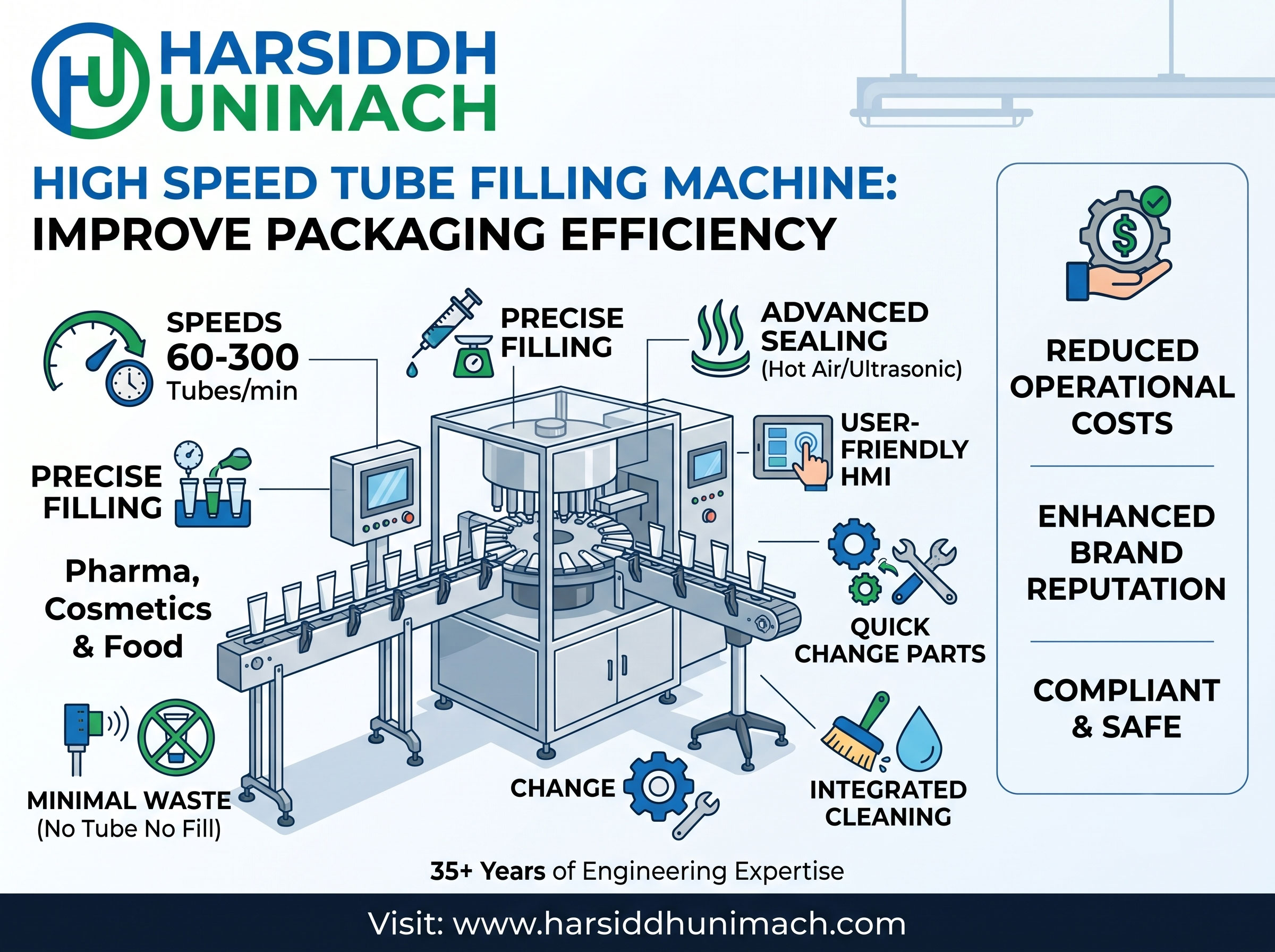
What Limits Tube Filling Speed?
Before increasing speed, it helps to understand what holds it back. On a rotary tube filler, each station performs its task while the turret is stationary. Output is limited by the slowest station in the cycle:
| Station | What Can Limit Speed |
|---|---|
| Tube loading | Manual loading, slow magazine feed, tube jams |
| Orientation | Time to find the eye mark |
| Filling | Product viscosity, fill volume, nozzle size, need to avoid air |
| Heating (plastic/lami tubes) | Time needed to soften the inner layer |
| Sealing and cooling | Time for the seal to fuse and set |
| Folding and crimping (aluminium) | Number of folds and mechanical cycle time |
| Coding and trimming | Mechanical cycle |
| Ejection | Handling to the next machine |
High-speed machines address these bottlenecks through design and technology.
Technology 1: Multi-Head Filling
The simplest way to raise output is to fill more tubes per cycle. A double head machine fills two tubes at each index, roughly doubling output compared with a single head machine on a similar footprint, without needing each station to work faster.
- Automatic Single Head Tube Filling Machine – small and medium output
- Automatic Double Head Tube Filling Machine – higher output
- Automatic single head tube filling machine (HTF-40A)
- Automatic double head tube filling machine (HTF-70A)
Technology 2: Servo-Driven Dosing
Servo-driven piston pumps allow:
- Digital fill volume setting without mechanical adjustment
- Optimised dosing profiles – faster delivery in the middle of the fill and controlled start and finish, reducing fill time while preventing air entrapment
- Precise synchronisation with tube lift and nozzle movement
- Recipe storage for quick product and size changes
See the servo based piston filling machine for an example of servo dosing technology.
Technology 3: Automatic Tube Feeding
On many lines, the operator loading tubes by hand becomes the bottleneck. High-speed machines use:
- Large tube magazines that hold more tubes and need refilling less often
- Automatic tube loading from the magazine into the holders
- Tube presence sensors that stop filling if a holder is empty
Reliable tube feeding also depends on tube quality: consistent dimensions and properly fitted caps reduce jams.
Technology 4: Faster, Consistent Sealing
Plastic and lami tubes
Hot-air sealing systems with powerful, well-controlled heaters soften the tube’s inner layer quickly and evenly. Efficient cooling of the sealing jaws sets the seal faster, allowing a shorter cycle. Temperature and air flow controls keep seal quality consistent at speed. For details, read our plastic tube filling and sealing machine working principle. See the Automatic Lami Tube Filling Machine and the automatic lami tube filling machine.
Aluminium tubes
Folding and crimping stations with robust mechanics and precise adjustment deliver consistent crimps at higher speeds. See the Automatic Aluminum Tube Filling Machine, the automatic aluminium tube filling machine (HTF-40AL) and the tube filling, crimping and batch coding machine.
Technology 5: Product Conditioning
Viscous products fill more slowly. Conditioning the product can shorten fill times and improve accuracy:
- Jacketed hoppers keep products at a consistent, suitable temperature
- Slow stirrers keep products uniform without adding air
- De-aerated product from manufacturing prevents air pockets that slow filling and cause light fills
For semi-solid products such as ointments, read our ointment filling machine working principle.
Technology 6: Quick Changeover Design
On multi-product lines, changeovers often cost more output than slow running. High-efficiency machines reduce changeover time with:
- Tool-less change parts for tube holders, nozzles and sealing jaws
- Colour-coded parts for each tube size
- Recipe recall for fill volume, heating, sealing and coding settings
- Easy-access hoppers and pumps for quick cleaning
Technology 7: Integrated Coding, Trimming and Inspection
Coding and trimming integrated into the filler avoid separate operations. Sensors can check:
- Tube presence
- Eye mark orientation
- Fill presence
- Seal quality indicators (on some systems)
Automatic rejection of faulty tubes keeps the line running while removing defects.
Keeping Quality High at High Speed
Running faster can expose weaknesses that were hidden at lower speeds. Watch for:
| Risk at Higher Speed | Cause | Solution |
|---|---|---|
| Light fills or air pockets | Dosing too fast, product not de-aerated | Optimised dosing profiles, product conditioning |
| Product on seal area | Poor cut-off, nozzle withdrawing too fast | Better cut-off, synchronised nozzle movement |
| Weak or leaking seals | Insufficient heating or cooling time | Adequate heating capacity and jaw cooling |
| Misaligned seals | Orientation not completed | Fast, reliable eye mark sensors |
| Tube jams | Poor tube quality, worn holders | Consistent tubes, maintained change parts |
Increase speed in steps, checking fill weight and seal quality at each step, rather than jumping straight to maximum.
Single Head vs Double Head Tube Fillers
| Feature | Single Head | Double Head |
|---|---|---|
| Tubes filled per cycle | One | Two |
| Relative output | Standard | Higher, on a similar footprint |
| Change parts | Fewer | More (two sets of nozzles and holders per station) |
| Changeover time | Shorter | Slightly longer |
| Best suited to | Smaller batches, many products | Larger batches, fewer products |
| Investment | Lower | Higher |
For plants with a mix of large and small orders, a common approach is to run high-volume products on a double head machine and keep a single head or semi-automatic machine for smaller batches and new products.
How Tube Type Affects Speed
| Tube Type | Sealing Method | Speed Considerations |
|---|---|---|
| Plastic (PE) tubes | Hot air and jaw sealing | Heating and cooling time; tube wall thickness matters |
| Laminated tubes | Hot air and jaw sealing | Laminate structure affects heating time |
| Aluminium tubes | Folding and crimping | Number of folds and mechanical cycle time |
Matching sealing settings to the exact tube specification is essential for running fast without seal failures. Changes in tube supplier or material should always be followed by seal testing.
Improving Efficiency Beyond the Filler
Balance the line
A high-speed filler is wasted if downstream machines cannot keep up. Tube lines often include:
- Tube labelling where tubes are not pre-printed; see our tube labeling machine working principle and the labeling machines on Harsiddh Engineering
- Cartoning with leaflets
- Shrink wrapping or case packing
Each machine should run slightly faster than the filler so it never becomes the bottleneck. Short buffers between machines absorb brief stoppages.
Plan material supply
Make sure tubes, caps, cartons and leaflets are staged before production starts. Material shortages are a common and avoidable cause of downtime.
Measure performance
Track output, stoppages, changeover times and rejects. Overall Equipment Effectiveness (OEE) shows where time and product are being lost and where improvements will have the most effect.
Train operators
Skilled operators set up machines faster, spot problems earlier and recover from stoppages quickly.
Hygiene and GMP at Higher Speeds
Faster production must not come at the cost of hygiene or compliance. For pharmaceutical and cosmetic tubes, high-speed fillers should still offer smooth, cleanable product contact parts, quick dismantling of hoppers, pumps and nozzles, and clear separation between the product zone and drives. Batch codes must remain legible, fill weights must stay within limits and every change to settings should be documented. Higher output also means more product is affected if something goes wrong, so in-process checks of fill weight, seal quality and coding should be carried out at defined intervals throughout each batch.
A Quick Efficiency Checklist
- Bottleneck station or machine identified
- Tube quality and cap fitting consistent
- Tubes, caps, cartons and leaflets staged before the shift
- Dosing profiles optimised for each product
- Heating and cooling settings verified for each tube type
- Changeover parts prepared and organised
- Downstream machines balanced with buffers
- Output, stoppages and rejects recorded every shift
When to Upgrade to a High-Speed Tube Filler
Consider upgrading when:
- Your current filler regularly limits output
- Overtime or extra shifts are needed to meet demand
- Manual tube loading or slow sealing limits speed
- Changeovers take too long for your product mix
- Reject rates are high and difficult to reduce
For smaller operations or new products, semi-automatic machines such as the semi-automatic plastic tube filling machine can still play a useful role alongside a high-speed line, for trial batches and small orders.
Browse our full range of tube filling machines and the cream and ointment filling machines.
Maintenance for High-Speed Tube Fillers
Higher speeds mean more cycles per shift and faster wear. A disciplined maintenance routine protects output:
- Daily – clean nozzles, hopper and sealing jaws; check tube holders; verify eye mark sensor
- Weekly – inspect piston seals, valves and heating elements; check cooling water flow
- Monthly – inspect cams, drives and bearings; check folding and crimping jaws for wear
- Ongoing – keep a stock of critical spares such as seals, heater elements, sensors and tube holders
Record stoppages and their causes so recurring problems can be fixed at the root rather than repeatedly repaired.
Estimating the Value of Higher Output
To judge whether a faster machine or efficiency improvements are worthwhile, estimate:
- Additional good tubes per shift from higher speed, fewer stoppages and faster changeovers
- Labour savings from automatic feeding and less manual handling
- Reduced overtime or fewer extra shifts
- Lower product and tube waste from fewer rejects
Compare these benefits with the investment and running costs. Using your own production data gives the most reliable picture.
Practical Steps to Improve Tube Packaging Efficiency
- Measure current output, stoppages, changeover times and rejects.
- Identify the bottleneck station or machine.
- Fix quick wins – tube quality, material staging, operator training.
- Optimise settings – dosing profiles, heating, cooling, speeds.
- Reduce changeover time – prepare parts in advance, standardise procedures.
- Balance the line – match downstream machines and add buffers.
- Upgrade where needed – multi-head, servo dosing, automatic feeding.
- Review regularly and repeat.
Frequently Asked Questions
What makes a tube filling machine high speed? Multi-head filling, servo dosing, automatic tube feeding, fast and consistent sealing, quick changeovers and integrated coding and inspection.
Is a double head tube filler twice as fast as a single head? It fills two tubes per cycle, so output can be close to double on a similar footprint, depending on product and settings.
How do I keep seal quality at higher speeds? Ensure adequate heating and cooling capacity, keep the seal area free of product, and increase speed gradually while checking seals.
What else improves tube packaging efficiency? Balancing downstream machines, staging materials, reducing changeover time, measuring performance and training operators.
When should I upgrade my tube filler? When it regularly limits output, causes overtime, or cannot meet changeover or quality targets.
Ready to increase your tube filling output? Contact our team or send an inquiry with your products, tube types and output targets.