
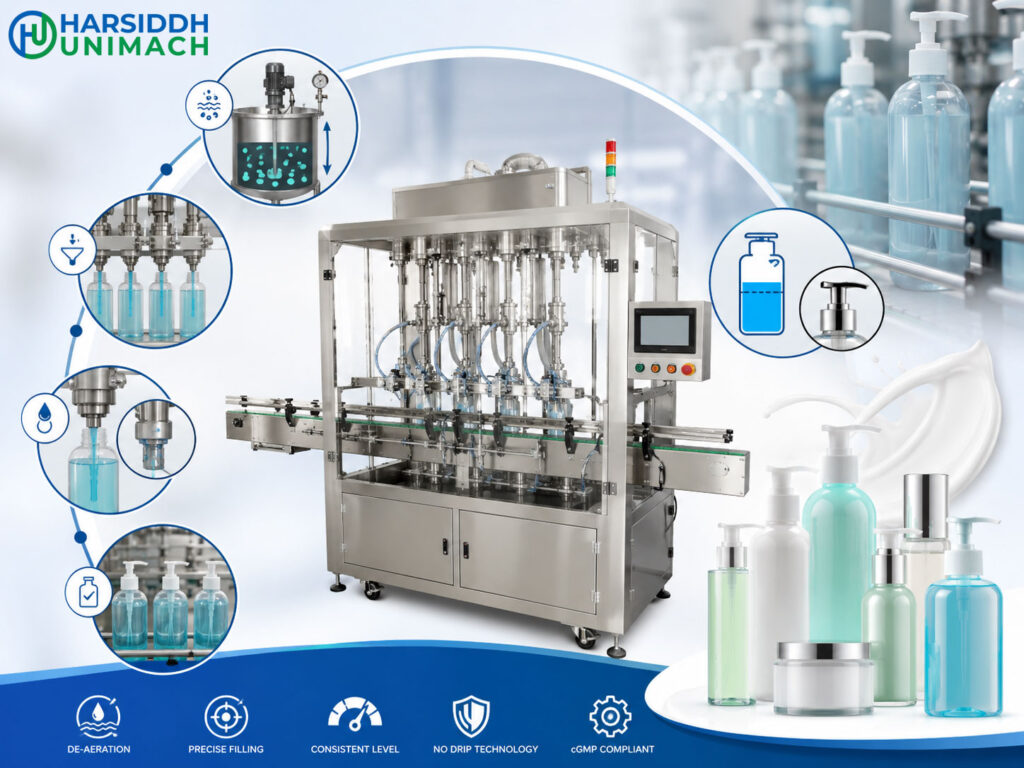
Body lotions, hand washes, shampoos, conditioners, calamine lotion, sunscreen lotions, liquid soaps and sanitiser gels all share something important: they are viscous liquids. They pour, but slowly. They can foam if handled roughly. They string and drip from nozzles. And they are usually sold in plastic bottles with pumps, flip-top caps or screw caps, often in large volumes and many sizes.
A lotion filling machine is built to handle exactly this kind of product. It needs to deliver an accurate dose of a thick, sometimes foamy liquid quickly, without splashing, overfilling or leaving drips on the bottle neck.
In this article, we explain the working principle of lotion filling machines: how lotions behave, how piston and servo fillers measure each dose, how bottles are handled and filled, how pumps and caps are applied downstream and how to set up and troubleshoot a lotion line.
How Lotions Behave During Filling
Lotions sit between thin liquids and creams. They can be oil-in-water emulsions (body lotions), surfactant solutions (shampoos, hand washes) or suspensions (calamine lotion).
| Property | What It Means for Filling |
|---|---|
| Medium to high viscosity | Too thick for simple gravity filling; needs positive displacement |
| Foaming tendency | Surfactant products foam when splashed, causing overflow and false levels |
| Stringing | Product forms tails from the nozzle, dripping on necks and labels |
| Shear sensitivity | Some emulsions thin or separate if pumped too hard |
| Suspended solids | Suspensions must be kept uniform in the hopper |
| Temperature dependence | Viscosity changes with room or product temperature |
For thicker semi-solids, read our cream filling machine working principle. For thin liquids in bottles, see our guide to the bottle filling machine working principle.
The Core Working Principle: Volumetric Piston Filling
Most lotion fillers work on the volumetric piston principle:
- The piston retracts inside a precision cylinder, drawing lotion from the hopper through a valve.
- The valve switches to the outlet.
- The piston advances, pushing exactly the same volume through the nozzle into the bottle.
Because each stroke displaces a fixed volume, the fill is repeatable even when viscosity changes slightly. Fill volume is set by the piston stroke length.
Servo-driven piston fillers
On servo machines, each piston is driven by a servo motor rather than a pneumatic cylinder or cam. This brings several benefits for lotions:
- Fill volume set digitally from the control panel
- Programmable speed profile, slow start, fast middle, slow finish, to reduce foaming and splashing
- Independent fine adjustment of each head on multi-head machines
- Stored recipes for each product and bottle size
Other dosing methods
- Gear pump or lobe pump fillers – deliver lotion continuously; the dose is controlled by pump revolutions or time. Useful for larger volumes.
- Flow meter fillers – measure the volume passing through a meter; suited to some thinner products.
- Overflow (level) fillers – fill to a constant level rather than a constant volume, used mainly for thin, clear liquids where a uniform level in transparent bottles matters.
For most lotions, piston filling is the usual choice, with pump fillers as the main alternative for larger volumes.
Main Components of a Lotion Filling Machine
- Infeed conveyor – brings empty bottles from the unscrambler.
- Bottle stopper gates or star wheel – hold a group of bottles under the nozzles during filling.
- Product hopper or buffer tank – stores lotion above the pumps, with a level sensor and, for suspensions, a slow stirrer.
- Piston pumps – one per filling head.
- Rotary or check valves – switch each pump between suction and discharge.
- Filling nozzles – often diving nozzles that move down into the bottle and rise during filling.
- Drip tray or nozzle cut-off – catches or prevents drips between fills.
- Bottle sensors – “no bottle, no fill” and bottle count.
- Control panel – HMI for volume, speed, number of heads and recipes.
- Outfeed conveyor – carries filled bottles to capping.
Step-by-Step: How a Lotion Filling Machine Works
Step 1: Bottle feeding
Empty bottles are fed onto the conveyor, usually by a bottle unscrambler such as our Automatic Bottle Unscramblers or the bottle unscrambler on Harsiddh Engineering. Bottles travel upright towards the filling station.
Step 2: Bottle indexing
On a linear multi-head filler, entry and exit gates hold a group of bottles, say four, six or eight, directly under the nozzles. Sensors confirm every position is occupied. On rotary fillers, bottles are carried continuously in star wheel pockets under moving nozzles.
Step 3: Nozzle diving
The nozzles descend into the bottles, often almost to the bottom. Starting the fill near the bottom is the single most effective way to prevent foaming, because the lotion enters below its own surface rather than splashing onto it.
Step 4: Filling
The pistons push lotion through the nozzles. As the bottles fill, the nozzles rise at a matched speed, keeping their tips just below the rising liquid. On servo machines, the piston speed follows a profile: gentle at first while the nozzle tip is uncovered, faster once the tip is submerged, and gentle again near the end.
Step 5: Cut-off and drip control
When the stroke ends, the nozzle must stop flowing immediately. Lotion fillers use:
- Suck-back – a small reverse movement of the piston that draws product back into the nozzle
- Positive shut-off nozzles – a valve closes at the nozzle tip
- Drip trays – swing under the nozzles between fills to catch any residual drops
Clean cut-off keeps bottle necks and threads dry, which matters for cap fitting, induction sealing and label adhesion.
Step 6: Release
The nozzles rise clear of the bottles, the exit gate opens and the filled bottles move out. The next group enters and the cycle repeats.
Step 7: Weight checks
Operators check fill weights at regular intervals, often by weighing sample bottles from each head. On servo machines, individual heads can be fine-tuned from the HMI.
Machine Options for Lotion Filling
Automatic lotion and cosmetic fillers
Linear multi-head piston fillers designed for lotions, gels and viscous cosmetics. See the Automatic Lotion Filling Machine, the lotion and gel filling machine, the Automatic Cosmetic Bottle Filling Machine and the cosmetic bottle filling machine.
Volumetric bottle fillers
Suit lotions with moderate viscosity as well as oral liquids and syrups. See the volumetric liquid bottle filling machine.
Monoblock filling and capping
Filling and capping on one frame, saving space and reducing bottle transfers. See the liquid bottle filling and capping machine (monoblock).
Browse all liquid filling machines on Harsiddh Unimach.
Downstream: Pumps, Caps, Seals and Labels
Applying pumps and dispensing caps
Lotion bottles often use lotion pumps, trigger sprayers or flip-top caps. These are tall or irregular closures, so they are best applied with pick-and-place capping, where each closure is gripped, placed squarely and tightened to torque. See the Automatic Six Head Pick and Place Type Screw Capping Machine and read our pick and place capping machine working principle.
For standard screw caps on a flexible line, an inline capper such as the linear capping machine is another option.
Induction sealing
Where a foil seal is needed under the cap, for example on lotions that travel or are sold through e-commerce, bottles pass through an induction sealing machine.
Labelling
Cosmetic lotion bottles are often flat or oval with front and back labels. See the Automatic Front and Back Sticker Labeling Machine and the double side flat bottle sticker labeling machine. Round bottles can use the labeling machines for round bottles.
A Typical Lotion Filling Line
- Bottle unscrambler
- Air cleaning (optional)
- Multi-head piston lotion filler
- Pick-and-place pump or cap application
- Induction sealing (optional)
- Front and back labelling
- Batch coding
- Packing
Balancing speeds across the line is important. The filler, capper and labeller should run at matched rates with short conveyor buffers between them.
Key Settings and Their Effects
| Setting | What It Controls | Effect If Wrong |
|---|---|---|
| Piston stroke | Fill volume | Under- or over-filled bottles |
| Piston speed profile | Flow into the bottle | Foaming, splashing, slow output |
| Nozzle diving depth | Where filling starts | Foam if too shallow, nozzle touching bottom if too deep |
| Nozzle rise speed | Keeping tip just below surface | Foam if too slow to submerge, air if too fast |
| Suck-back amount | Clean cut-off | Drips if too little, air in nozzle if too much |
| Number of heads in use | Output | Mismatch with downstream machines |
| Gate timing | Bottle positioning | Bottles misaligned under nozzles |
| Hopper level | Steady pump suction | Air drawn into pumps when low |
Troubleshooting Common Lotion Filling Problems
| Problem | Likely Cause | Corrective Action |
|---|---|---|
| Foam overflowing the bottle | Filling from the top, piston too fast | Use diving nozzles, slow the start of the fill |
| Drips on bottle necks | Weak suck-back, no drip tray | Increase suck-back, use shut-off nozzles or drip tray |
| Fill variation between heads | Worn seals, air in one pump | Service pumps, bleed air, fine-tune heads |
| Light fills overall | Air in lotion, low hopper level | De-aerate product, keep hopper level up |
| Stringing tails | Viscous, stringy product | Use shut-off nozzles, adjust cut-off timing |
| Bottles knocked over | Gate timing or conveyor speed wrong | Adjust gates and speed, check guides |
| Product thinning or separating | Excessive shear | Larger valves and nozzles, slower piston |
| Labels not sticking | Product on bottle surface | Improve cut-off and drip control |
Changeover Between Products and Bottle Sizes
Lotion plants often run many products, fragrances and pack sizes on the same filler, so changeover speed has a direct effect on output. A typical changeover involves:
- Emptying and cleaning the hopper, pumps, valves and nozzles, using quick-release clamps where fitted
- Changing nozzles to suit the new bottle neck and product
- Adjusting guides, gates and conveyor rails for the new bottle size
- Setting the fill volume, either by adjusting the piston stroke or by recalling a stored recipe on servo machines
- Setting nozzle diving depth and rise speed for the new bottle height
- Running trial bottles and checking fill weight from each head before production
Clearly labelled change parts, height scales and written settings sheets make changeovers faster and more repeatable. When switching between products with strong fragrances or colours, a thorough flush and clean prevents carry-over into the next batch.
Maintenance Tips
- Inspect piston seals, valves and O-rings regularly.
- Clean hopper, pumps, valves and nozzles thoroughly between products, especially when changing fragrances or colours.
- Check that diving nozzle movement is smooth and aligned.
- Verify bottle sensors and gate operation.
- Keep nozzle sets and change parts labelled for each bottle size.
- Record fill weights per head to spot wear early.
How to Choose a Lotion Filling Machine
- Product range – viscosity, foaming tendency, solids and shear sensitivity
- Fill volume range – from small travel sizes to large family packs
- Output – number of heads, linear or rotary
- Dosing method – pneumatic piston, servo piston or pump
- Bottle shapes and sizes
- Changeover frequency – recipes, quick-release parts
- Downstream integration – capping, sealing and labelling
- Hygiene and documentation – especially for medicated lotions
Frequently Asked Questions
What is the working principle of a lotion filling machine? A piston pump draws a fixed volume of lotion from a hopper and pushes it through a nozzle into the bottle. The piston stroke sets the fill volume, and a cut-off device prevents drips.
How do lotion fillers prevent foaming? By using diving nozzles that fill from near the bottom of the bottle, rising with the liquid, combined with gentle speed profiles at the start and end of the fill.
Are servo fillers better for lotions? Servo fillers allow digital volume setting, speed profiles and per-head adjustment, which helps with foamy and viscous products and speeds up changeovers.
Which capping machine suits lotion pumps? Pick-and-place cappers are well suited to lotion pumps and other tall or irregular closures.
Can a lotion filler also fill creams and gels? Often yes, within its viscosity range, with suitable nozzles and settings.
Planning a lotion filling line? Contact our team or send an inquiry with your product, bottle and output details.