
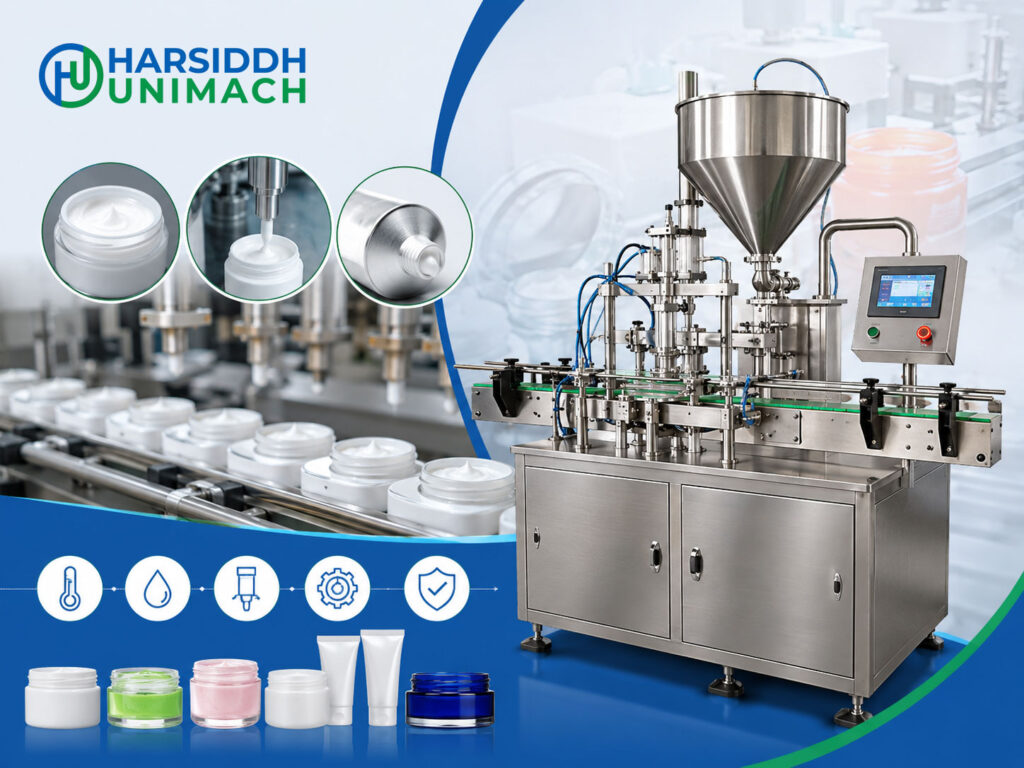
Ointments are among the most common pharmaceutical dosage forms. Antibiotic, antifungal, steroid, analgesic and eye ointments are prescribed and sold every day, and most of them reach the patient in a small aluminium tube. Behind each tube is a filling process that has to cope with a thick, sticky, often temperature-sensitive product and still deliver the correct quantity, cleanly, with no air pockets and no product on the seal.
An ointment filling machine is designed around those challenges. In this article, we explain how ointments behave during filling, how the machine stores, conditions and doses the product, how it fills and seals tubes and jars, and what settings and GMP features matter most. We also cover common problems and how to choose the right machine.
For a general guide to tube handling, sealing and coding, see our tube filling machine working principle. This article focuses on the product side: what makes ointment filling different and how the machine handles it.
What Makes Ointments Difficult to Fill?
Ointments are semi-solid preparations, typically with a greasy or oily base such as petrolatum, paraffin or other bases, sometimes with water-in-oil emulsions. Their behaviour during filling is very different from liquids.
| Property | What Happens During Filling |
|---|---|
| High viscosity | Product does not flow on its own; it must be pushed by a pump |
| Shear-thinning | Viscosity drops when the product is moved, then recovers at rest |
| Temperature sensitivity | Small temperature changes alter viscosity and fill weight |
| Stickiness | Product clings to nozzles and walls, causing “tails” |
| Air entrapment | Air pockets cause light fills and poor appearance |
| Suspension of actives | Some ointments contain dispersed solids that must stay uniform |
| Sterility (eye ointments) | Must be filled under aseptic conditions |
A good ointment filling machine manages each of these properties so that every tube or jar receives the same dose.
Ointments compared with creams, gels and pastes
- Ointments usually have greasy bases and little or no water.
- Creams are emulsions with a higher water content and a lighter texture. See our cream filling machine working principle.
- Pastes contain a high proportion of solids and are stiffer. See our paste filling machine working principle.
- Gels are typically clear, water- or alcohol-based semi-solids.
The same basic machine can fill all of these, but hopper conditioning, pump design and nozzle choice vary with the product.
Main Components of an Ointment Filling Machine
- Product hopper – stainless steel, often with a heating jacket (water or electric) to keep the ointment at the right filling temperature.
- Stirrer or agitator – slow-moving, to keep the product uniform and at an even temperature without whipping air into it.
- Hopper level sensor – controls automatic top-up from a transfer pump or vessel.
- Piston dosing pump – the heart of the machine, measuring each dose by piston displacement.
- Rotary or slide valve – switches the pump between drawing from the hopper and discharging to the nozzle.
- Filling nozzle – sized to the tube or jar, with a cut-off device.
- Container handling – a rotary tube turret, or a conveyor and indexing system for jars.
- Sealing or closing station – folding and crimping for aluminium tubes, heat sealing for lami tubes, capping for jars.
- Coding station – embosses batch and expiry details on tube seals.
- Control panel – sets fill volume, speed, temperature and interlocks.
Step-by-Step: How an Ointment Filling Machine Works
Step 1: Product transfer and conditioning
The ointment is manufactured in a mixing vessel and transferred to the filling machine hopper, either manually in closed containers or through a transfer pump. In the hopper, the heating jacket holds the product at a controlled temperature at which it flows reliably through the pump but is not so warm that it separates or degrades. The correct filling temperature is defined during product development.
A slow stirrer keeps the product uniform. For ointments with suspended actives, this helps prevent settling; for all ointments, it keeps the temperature even throughout the hopper.
Step 2: Container presentation
Tubes: Empty tubes, caps already fitted, are loaded cap down into holders on an indexing turret. Each tube is rotated so that its printed eye mark faces the correct direction, which aligns the seal with the artwork.
Jars: Empty jars are placed on a conveyor, spaced and indexed under the filling nozzle.
Step 3: Drawing the dose
The rotary valve connects the pump cylinder to the hopper. The piston moves back, drawing a measured volume of ointment into the cylinder. Because ointments are thick, the pump inlet is designed with large, smooth passages so the cylinder fills completely without cavitation. Some machines also apply slight pressure in the hopper or use a feed screw to help push viscous products into the pump.
The piston stroke length sets the fill volume. Increasing the stroke increases the dose.
Step 4: Bottom-up filling
The valve switches to connect the cylinder to the nozzle. For tubes, the nozzle descends close to the cap end. As the piston moves forward and pushes ointment out, the tube holder lowers (or the nozzle rises) so that the nozzle tip stays just below the rising product surface.
This bottom-up filling prevents air from being folded into the product and keeps the inner walls near the open end clean, which matters for the seal.
For jars, the nozzle may fill from near the bottom and rise, or fill from above with a pattern that gives a smooth, level surface.
Step 5: Cut-off
Ointments are sticky and tend to leave a tail when the nozzle withdraws. Machines use one or more of the following:
- Suck-back – the piston pulls back slightly at the end of the stroke to draw product back into the nozzle
- Shut-off valve – a valve at the nozzle tip closes sharply
- Air blow – a short burst of air cuts the product at the nozzle tip
A clean cut-off is essential. Any product on the tube’s inner wall near the open end will weaken or contaminate the seal.
Step 6: Sealing or closing
- Aluminium tubes – the open end is flattened, folded several times and crimped tightly. This mechanical seal needs no heat, which suits most ointments well.
- Lami and plastic tubes – hot air melts the inner layer and jaws press the walls together. See our plastic tube filling and sealing machine working principle for this process.
- Jars – a lid is placed and screwed on, for example on an Automatic Jar Capping Machine.
Step 7: Coding and discharge
Batch number, manufacturing date and expiry date are embossed into the tube seal. The finished tube is ejected onto a conveyor and moves on to cartoning, where a leaflet is often added.
Why Aluminium Tubes Are Common for Ointments
Pharmaceutical ointments are very often packed in aluminium tubes because:
- Aluminium is an effective barrier to light, oxygen and moisture
- The tube does not spring back after squeezing, so air is not drawn back in, protecting the remaining product
- An internal lacquer protects the product from contact with the metal
- The crimped seal requires no heat
Eye ointments are frequently packed in small aluminium tubes with a fine nozzle tip, filled under aseptic conditions.
Machines for Ointment Filling
Semi-automatic aluminium tube filling and sealing
The operator loads tubes manually; the machine fills and folds or crimps them. Suits small batches, hospital pharmacies and start-ups. See the Semi-Automatic Aluminum Tube Filling and Sealing Machine, the semi-automatic aluminium tube filling machine and the semi-automatic aluminium tube filling and sealing machine.
Automatic aluminium tube filling machines
Fully automatic rotary machines that load, orient, fill, fold, crimp and code aluminium tubes. See the Automatic Aluminum Tube Filling Machine and the automatic aluminium tube filling machine (HTF-40AL).
Tube filling, crimping and coding machines
Compact machines combining filling, crimping and batch coding. See the Tube Filling, Crimping and Batch Coding Machine and the tube filling, crimping and batch coding machine.
Automatic machines for lami and plastic tubes
For ointments and creams in laminated or plastic tubes, see the automatic single head tube filling machine (HTF-40A), the automatic double head tube filling machine (HTF-70A) and the automatic lami tube filling machine.
Jar filling
Ointments and balms are sometimes filled into jars using piston fillers on a conveyor line. The lotion and gel filling machine is an example of a piston filler used for viscous products in containers.
Browse our ointment and cream filling machines and the cream and ointment filling machines range.
Key Settings and Their Effects
| Setting | What It Controls | Effect If Wrong |
|---|---|---|
| Hopper temperature | Product viscosity | Fill weight drift, stringing, separation |
| Stirrer speed | Uniformity and temperature | Air entrapment if too fast, settling if too slow |
| Piston stroke | Fill volume | Under- or over-filled tubes |
| Piston speed | How smoothly product moves | Air pockets, splashing, incomplete cylinder fill |
| Nozzle size | Flow and cut-off | Tails, slow filling, splashing |
| Nozzle rise or tube lowering speed | Bottom-up filling | Air pockets, product on tube walls |
| Cut-off method and timing | Clean end of dose | Product on seal area |
| Folding and crimp pressure | Aluminium seal security | Leaks, unattractive crimps |
Controlling Fill Weight
Because the piston pump measures volume, fill weight depends on the product’s density, which is affected by temperature and trapped air. To keep fill weights consistent:
- Keep hopper temperature stable throughout the batch
- De-aerate the product during manufacture where needed, and avoid stirring air into it
- Keep the hopper level within a set range
- Check fill weights at regular intervals and trend the results
- Inspect piston seals and valves, since wear causes gradual weight loss
GMP and Hygiene Requirements
For pharmaceutical ointments, the filling machine should offer:
- Product contact parts in suitable stainless steel or approved materials, with smooth, polished finishes
- Easy dismantling of hopper, pump, valves and nozzles for cleaning
- No dead zones where product can collect
- Guarding with interlocks and “no tube, no fill” logic
- Documentation supporting installation and operational qualification
Eye ointments and other sterile ointments require aseptic filling, sterilisable contact parts and suitable room classification. Always confirm requirements against your own quality procedures and the current applicable guidelines.
Troubleshooting Common Ointment Filling Problems
| Problem | Likely Cause | Corrective Action |
|---|---|---|
| Light fills | Air in product, cylinder not filling fully, worn seals | De-aerate, slow piston draw, service pump |
| Fill weight drifting | Hopper temperature changing, level falling | Stabilise temperature, control level |
| Product tails on nozzle | Weak cut-off | Adjust suck-back, valve or air blow |
| Product on tube seal area | Poor cut-off, nozzle withdrawing too fast | Improve cut-off, adjust nozzle movement |
| Leaking crimps | Too few folds, low crimp pressure, product in fold | Adjust folding, improve cut-off |
| Air pockets visible | Filling from the top, piston too fast | Use bottom-up filling, slow piston |
| Separation in hopper | Excessive temperature or long hold time | Lower temperature, reduce hold time |
| Product too stiff to pump | Hopper too cool | Raise temperature within the product’s range |
Maintenance Tips
- Inspect piston seals, valves and O-rings regularly.
- Clean the hopper, pump and nozzles thoroughly between batches and products.
- Calibrate hopper temperature controllers.
- Check folding and crimping jaws for wear and alignment.
- Keep change parts for each tube size labelled and stored together.
- Trend fill weights to catch gradual changes early.
How to Choose an Ointment Filling Machine
- Product – viscosity, base type, temperature sensitivity, suspended solids
- Container – aluminium, lami or plastic tubes, or jars
- Fill volume range
- Output – semi-automatic, single head or double head
- Temperature control – heated hopper and stirrer requirements
- Sterility – standard or aseptic filling
- GMP and documentation
- Integration with cartoning and labelling
Frequently Asked Questions
What is the working principle of an ointment filling machine? A piston pump draws a measured volume of ointment from a temperature-controlled hopper and pushes it through a nozzle into the tube or jar from the bottom up. The dose is cut off cleanly and the container is sealed, crimped or capped.
Why are hoppers heated for ointment filling? Heating keeps the ointment at a viscosity where it flows reliably through the pump, giving consistent fill weights.
Why are most pharmaceutical ointments filled in aluminium tubes? Aluminium is a strong barrier, does not suck air back after squeezing and is sealed by crimping without heat.
What causes light fills in ointment tubes? Usually air in the product, incomplete filling of the pump cylinder, or worn piston seals.
Can the same machine fill ointments and creams? Yes, in most cases, with adjustments to temperature, pump speed and nozzle size.
Planning an ointment filling line? Contact our team or send an inquiry with your product details, tube type and fill volumes.