
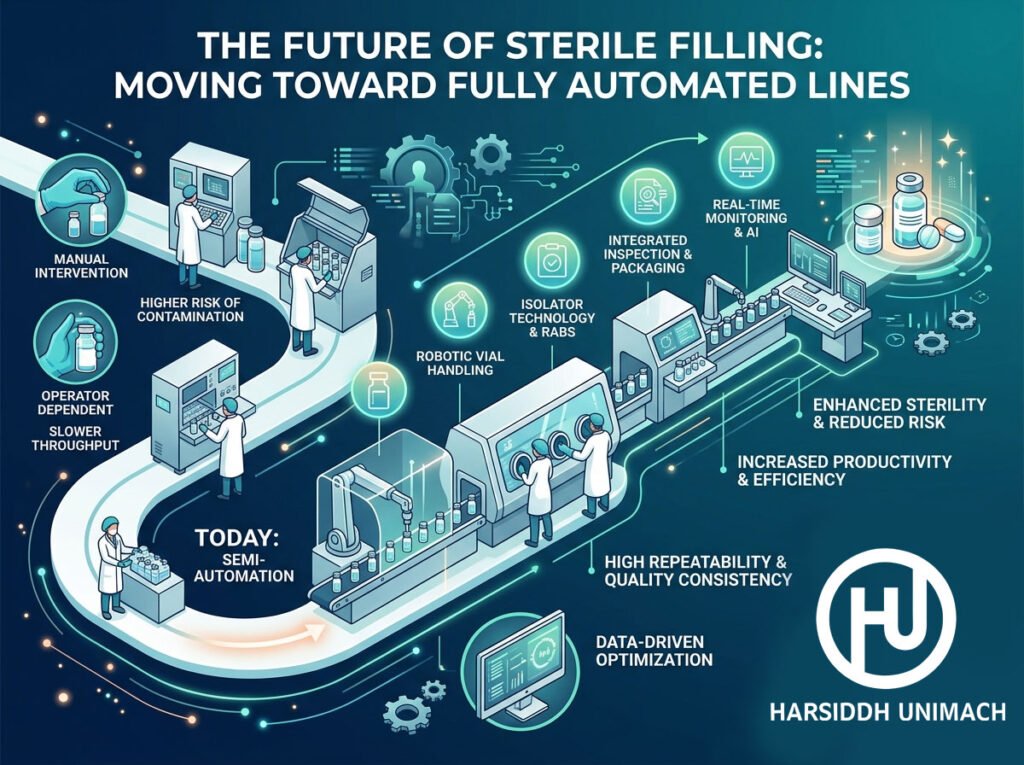
Sterile filling has always been the most unforgiving step in injectable manufacturing. A tablet with a cosmetic defect can be caught at inspection and rejected; a vial contaminated during filling can end up in a patient’s bloodstream. That reality is pushing pharmaceutical manufacturers — from global multinationals to fast-growing formulation units in India — toward one clear destination: fully automated sterile filling lines, where human intervention in the critical zone is the exception rather than the rule.
In this guide, we look at why the industry is moving in this direction, what a modern automated line actually consists of, the technologies making it possible, and how plants can plan the transition in practical, affordable stages.
Why Sterile Filling Is Moving Toward Full Automation
People are the biggest contamination risk
In any aseptic suite, operators remain the largest source of particles and microorganisms — even when fully gowned. Every manual intervention, whether clearing a jammed vial, adjusting a nozzle or topping up a stopper bowl, briefly opens a window for contamination. Training and gowning discipline reduce the risk, but they can never eliminate it. Automation addresses the problem at its root: instead of teaching people to be more careful inside the Grade A zone, it removes the need for them to be there at all.
Regulatory expectations have tightened
The revised EU GMP Annex 1, which came into force in August 2023, placed the Contamination Control Strategy (CCS) at the centre of sterile manufacturing and clearly favours barrier technologies, automated systems and minimal human contact. The US FDA’s guidance on aseptic processing carries a similar message. For manufacturers exporting to regulated markets, a line that depends heavily on manual handling is becoming harder to defend during audits. Our cGMP compliance guide for sterile vial filling machinery explains the machine-level features inspectors now expect to see.
Products are more valuable — and more sensitive
Biologics, vaccines, peptides and high-potency injectables cost far more per millilitre than traditional generics, and many are sensitive to oxygen, shear stress and temperature. A single lost batch can wipe out months of margin. Automated lines with precise dosing, gentle container handling and controlled environments protect that value far better than manual or semi-automatic processes can.
Labour, consistency and scale
Skilled aseptic operators are difficult to recruit and retain, and even the best operator has an off day. Automated systems repeat the same motion with the same accuracy across every shift, every batch and every site. For plants scaling up injectable output, that consistency is often worth as much as the speed.
What a Fully Automated Sterile Filling Line Looks Like
A fully automated line is not one machine. It is a synchronised sequence of stations, each passing containers to the next without manual transfer, all controlled from a central system. A typical liquid vial line includes the following stages.
1. Container washing
Vials enter the line through an automatic washer that cleans them inside and out using alternating jets of purified water, WFI and filtered compressed air. Linear and rotary designs are both common, chosen according to output and floor space. You can compare options in our range of vial washing machines.
2. Depyrogenation and sterilisation
Washed vials then move through a hot-air tunnel that dries, sterilises and depyrogenates them before cooling them under unidirectional airflow. Because containers travel straight from the washer into the tunnel and on to the filler, there is no manual handling and no exposure to the surrounding room. See our sterilizing tunnel for ampoules and vials and the wider sterilizers range.
3. Filling and stoppering
This is the heart of the line. Servo-driven nozzles dive into the vial, dispense an accurate dose and retract as the liquid rises, minimising foaming and splashing. Stoppers are then fed, oriented and inserted automatically, with no-vial-no-fill and no-stopper detection preventing waste. The Automatic Injectable Liquid Vial Filling and Stoppering Machine is a good example, and you can compare all options in our vial filling machines category.
4. Capping and crimp sealing
Stoppered vials move to a capping machine that places aluminium flip-off seals and crimps them with controlled force — critical for container closure integrity. Too little force risks leaks; too much can crack the vial neck or deform the stopper. Multi-head machines such as the Automatic Eight Head Vial Cap Sealing Machine keep pace with high-speed fillers while maintaining consistent seal quality.
5. Inspection
Sealed vials are inspected for particles, fill level, cracks and cosmetic defects. Modern inspection machines use controlled lighting, container rotation and, increasingly, camera-based systems to give consistent, documented results. Explore our inspection machines and the visual ampoule and vial inspection machine.
6. Labelling, coding and serialization
Finally, vials are labelled, coded and — for many markets — serialized for track-and-trace. Automatic labelling machines integrated with printing and vision verification close the loop, ensuring that every unit leaving the line can be traced back to its batch, line and time of production.
When these stations are engineered as one synchronised unit — as in our Automatic Liquid Vial Filling Line (Compact Line) — the result is a smaller footprint, fewer transfer points and far less operator involvement. Monoblock designs that combine filling, stoppering and capping on one base frame take this integration even further.
The Key Technologies Driving the Shift
Servo motion control
Servo motors have replaced cams and mechanical linkages across modern filling equipment. They allow fill volumes, nozzle speeds and diving profiles to be changed from the HMI rather than with spanners, which means faster changeovers, better accuracy and repeatable recipes. The same principles now apply across vial, ampoule, syringe and powder filling machines.
Precision dosing systems
The choice of dosing pump shapes both accuracy and cleanability. Peristaltic pumps keep the product inside single-use tubing, which simplifies cleaning and suits high-value or potent products. Piston pumps offer excellent accuracy across a wide viscosity range and are well proven in high-volume production. View our peristaltic based liquid filling machine and servo based piston filling machine to compare the two approaches.
Barrier technology: RABS and isolators
Restricted Access Barrier Systems (RABS) and isolators physically separate the operator from the open product. Interventions, when they are needed, are made through glove ports rather than open doors. Combined with automation, barrier technology is the backbone of a modern contamination control strategy. We explore this trend in the rise of RABS and isolators in modern vial filling machines.
Inert gas protection
Oxygen-sensitive formulations need nitrogen purging before, during and after filling to protect stability and shelf life. Automated lines control gas flow consistently, container after container, so residual oxygen levels stay within specification across the whole batch rather than depending on operator technique.
Controls, data and data integrity
Today’s lines run on PLC and HMI platforms with recipe management, user access levels, alarm logs and electronic batch reports. Where required, systems can be designed to support data integrity expectations such as audit trails and secure electronic records. This turns the filling line into a source of reliable process data rather than paper records.
Predictive maintenance and AI
Sensors that monitor vibration, motor load, fill weight trends and reject rates make it possible to spot problems before they stop the line. Artificial intelligence is beginning to analyse this data to predict failures and optimise settings automatically. For a sterile operation, every avoided breakdown is also an avoided intervention in the clean area.
Automation Across Every Sterile Container Format
The move to full automation is not limited to liquid vials:
- Ampoules: Integrated washing, sterilising, filling and sealing lines bring the same benefits to glass ampoules. Browse our injectable ampoule filling line category or the high-speed eight head vertical ampoule filling and sealing machine.
- Pre-filled syringes: Demand for ready-to-administer formats is growing quickly, and automated syringe filling and stoppering with vacuum or mechanical placement is becoming standard.
- Sterile dry powder: Antibiotics and other powder injectables require accurate dosing of fine, sometimes poorly flowing material — a task where servo-controlled powder wheels clearly outperform manual methods.
- R&D and clinical batches: Automation is not only for large volumes. Pilot-scale machines let teams develop processes on equipment that behaves like commercial production, making scale-up far smoother.
The Business Case for Automated Sterile Filling
Automation requires a higher initial investment, but the returns build up across several areas:
- Higher OEE: fewer stoppages, faster changeovers and stable speeds increase real output, not just rated output.
- Lower product loss: accurate dosing and fewer rejects matter most when every vial is expensive.
- Reduced labour dependency: fewer operators are needed in classified areas, reducing gowning, training and monitoring costs.
- Lower compliance risk: fewer interventions mean fewer deviations, investigations and potential batch failures.
- Sustainability: less product waste, optimised water and energy use, and fewer rejected containers.
To run the numbers for your own plant, follow our guide on how to calculate filling machine ROI.
Challenges on the Road to Full Automation
Moving to a fully automated line is not without hurdles, and planning for them early prevents expensive surprises:
- Capital investment: a complete line is a major purchase. A phased approach (below) spreads the cost while delivering early benefits.
- Validation effort: every automated station needs documented IQ, OQ and PQ. Choosing a supplier who provides qualification documentation and factory acceptance testing saves months.
- Changeover complexity: multi-product plants need format parts and recipes that change quickly and reliably, ideally without tools.
- Cleaning and sterilisation: automated equipment must be designed for easy, validated cleaning, with smooth surfaces, minimal dead legs and quick-release product-contact parts.
- Skills shift: operators become technicians who supervise, troubleshoot and interpret data, so training plans need to evolve too.
A Practical Roadmap: Automating in Stages
Few plants replace everything at once. A staged approach works well, especially for growing manufacturers:
- Map your interventions. Record every time an operator enters or touches the critical zone, and why. This becomes the baseline for your contamination control strategy.
- Automate the highest-risk step first. Filling and stoppering is usually where open product is most exposed, so upgrading to an automatic, servo-driven filler delivers the biggest risk reduction.
- Connect washing and sterilising. Linking the washer and tunnel to the filler removes manual container transfer — one of the most common sources of contamination and breakage.
- Add downstream automation. Automatic capping, inspection, labelling and serialization complete the line and improve traceability.
- Layer on barriers and data. Add RABS or isolators, integrated monitoring and electronic batch records as the line matures.
Before you invest, compare suppliers on output, accuracy, changeover time, documentation support and after-sales service — not just price.
How Harsiddh Unimach Can Help
Harsiddh Unimach Pvt. Ltd. designs and manufactures complete injectable processing solutions — from washing and sterilising to filling, sealing, capping, inspection and labelling. Whether you need a single upgrade or a turnkey line, our engineering team can help you plan a solution that fits your products, output targets and compliance roadmap. Learn more about Harsiddh Engineering or see the full range of vial filling machines for liquid vials.
Frequently Asked Questions
What is a fully automated sterile filling line? It is an integrated set of machines — washing, depyrogenation, filling, stoppering, capping, inspection and labelling — that processes containers continuously with minimal manual handling, controlled from a central system.
Why is automation important for sterile filling? Operators are the largest contamination source in aseptic areas. Automation reduces interventions in the critical zone, improves dose accuracy and consistency, and supports compliance with modern GMP expectations such as EU GMP Annex 1.
Is full automation only for large pharmaceutical companies? No. Compact lines and phased upgrades allow small and mid-sized manufacturers to automate the highest-risk steps first and expand over time.
Which filling technology is best for sterile injectables? It depends on the product. Peristaltic systems suit high-value and potent products because of single-use product paths, while servo piston systems provide high accuracy across a wide viscosity range.
How long does it take to validate an automated filling line? Timelines vary with line complexity and documentation readiness. Supplier-provided IQ/OQ documentation and factory acceptance testing can significantly shorten the overall qualification schedule.
Ready to plan your automated sterile filling line? Contact our team or send an inquiry to discuss your requirements.