
Introduction
In sterile pharmaceutical manufacturing, the vial filling machine sits at the most sensitive point of the entire production line — the moment where a liquid or lyophilized product meets its final primary container. No matter how precise your dosing pumps are or how advanced your vial filling machines may be, none of that precision matters if the equipment itself is a source of microbial or particulate contamination.
Cleaning and sterilization aren’t a once-a-week housekeeping task on an aseptic filling line — they are a documented, validated, and repeatable process that directly determines whether a batch passes or fails quality release. This guide walks through the practical realities of keeping a vial filling machine clean and sterile, the difference between cleaning and sterilization, the equipment and protocols involved, and how to build a maintenance routine that keeps your line audit-ready.
Why Cleaning and Sterilization Deserve Special Attention
Every vial filling line handles product-contact surfaces — filling needles, dosing pumps, product tanks, tubing, and stoppering bowls — that sit in direct contact with a sterile injectable product. A single lapse in cleaning validation can lead to:
- Microbial contamination that triggers a batch rejection or, worse, a product recall
- Endotoxin (pyrogen) carryover from incomplete depyrogenation
- Cross-contamination between different products or batches run on the same line
- Failed regulatory audits and delayed product launches
Regulatory bodies including the US FDA, WHO, and EU GMP guidelines all require documented, validated cleaning procedures for any equipment that contacts sterile products. This is why cleaning and sterilization protocols are treated with the same engineering rigor as the filling process itself — not as an afterthought.
Cleaning vs. Sterilization vs. Depyrogenation: Know the Difference
These three terms are often used loosely on the plant floor, but each addresses a distinct risk:
- Cleaning removes visible soil, product residue, and particulate matter from equipment surfaces. It is a mechanical and chemical process, typically using water, detergents, or solvents.
- Sterilization eliminates or destroys viable microorganisms (bacteria, fungi, spores) to a defined sterility assurance level, typically using steam, dry heat, or chemical sterilants.
- Depyrogenation goes a step further and destroys bacterial endotoxins (pyrogens) that can remain even after sterilization, since endotoxins are heat-stable and require significantly higher temperatures — usually 250°C or above for a defined dwell time — to be inactivated.
A vial filling line has to address all three, in sequence, because a vial can be perfectly sterile and still carry enough residual endotoxin to fail a pyrogen test.
The Standard Cleaning and Sterilization Workflow
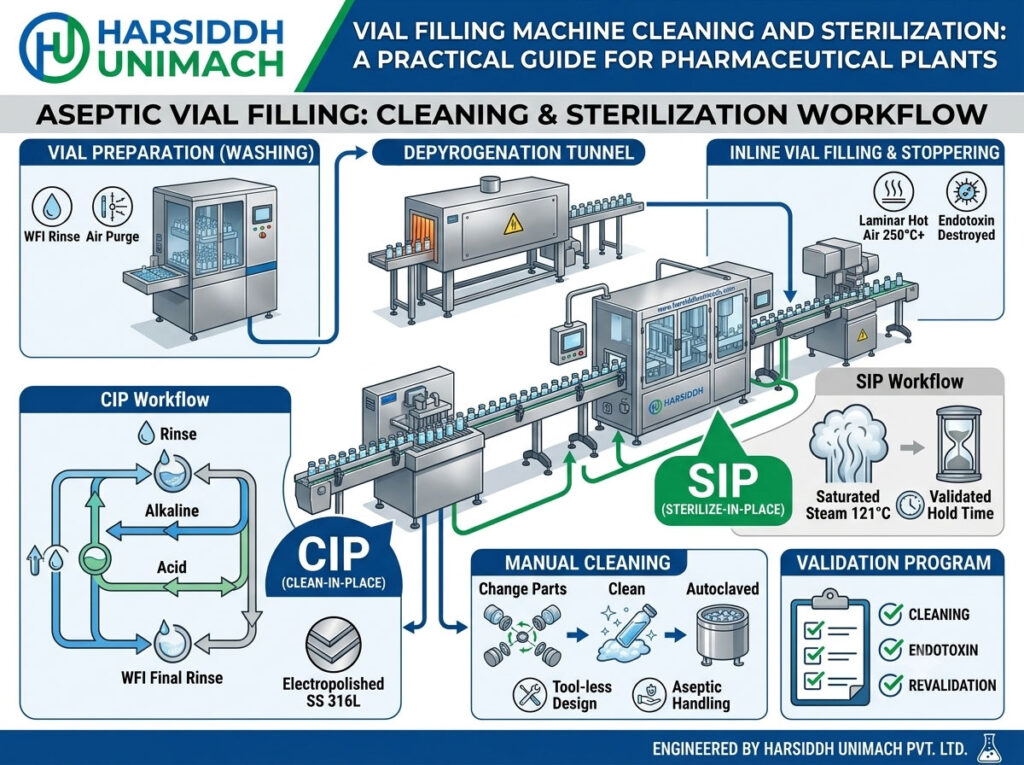
1. Container Preparation: Washing Before Filling
Before a vial ever reaches the filling station, it passes through a dedicated vial washing machine that runs it through multiple cycles of water and compressed air. A well-designed washing sequence typically includes:
- An initial high-pressure recycled water wash to remove gross particulate matter
- A final rinse using Water for Injection (WFI) quality water
- A sterile compressed air purge using HEPA-filtered air to remove residual moisture
For a deeper breakdown of rotary versus linear washer designs and how to choose between them, see our guide on Rotary vs Linear Vial Washing Machines.
2. Depyrogenation Tunnel: Heat-Based Sterility Assurance
After washing, vials move directly into a depyrogenation tunnel — typically integrated inline with the washer and filling machine to avoid any exposed handling step. The tunnel uses laminar hot air, generally maintained above 250°C, to both sterilize the glass surface and destroy bacterial endotoxins before the vial reaches the filling zone. This inline integration is a standard feature on our Injectable Liquid Vial Filling Lines, where the washer, tunnel, and filler operate as a single synchronized unit under continuous laminar airflow.
3. Clean-in-Place (CIP) for Product-Contact Parts
Once a production run ends — or when switching products — the product tank, transfer piping, filling manifold, and dosing pumps require a Clean-in-Place cycle. A properly engineered CIP system typically runs through:
- Pre-rinse: Removes bulk residual product before any chemical is introduced.
- Alkaline wash: Breaks down organic residues, proteins, and product films.
- Intermediate rinse: Removes alkaline detergent residue.
- Acid wash (where applicable): Neutralizes mineral deposits and any remaining biofilm.
- Final rinse with WFI: Ensures no chemical or detergent residue remains on product-contact surfaces.
Because CIP effectiveness depends heavily on machine design, equipment with zero dead-leg piping, electropolished SS 316L surfaces, and minimal crevices dramatically reduces the risk of residue pockets that standard cleaning cycles can miss.
4. Sterilize-in-Place (SIP)
After CIP, product-contact parts that will remain sterile until the next batch — tanks, filling manifolds, and tubing — typically undergo a Sterilize-in-Place cycle using pressurized saturated steam, generally targeting 121°C for a validated hold time. SIP is what allows a filling line to move from one aseptic batch to the next without physically disassembling every component for autoclaving.
5. Manual Cleaning of Non-CIP Components
Not every part of a vial filling line can be cleaned in place. Change parts such as star wheels, vial guides, stoppering bowls, and filling needles often require manual disassembly, cleaning in a designated wash area, and either autoclaving or dry-heat sterilization before reassembly. This is where a machine’s changeover design matters — modular, tool-less change parts significantly reduce both cleaning time and the risk of incorrect reassembly.
Designing for Cleanability: What to Look for in a Vial Filling Machine
If you’re evaluating new equipment or upgrading an existing line, cleanability should be a design criterion from day one, not an operational afterthought. Key features to look for include:
- SS 316L contact parts with a mirror-polished, electropolished finish to prevent rouging and biofilm formation
- Zero dead-leg piping so no cleaning fluid or product residue can pool in unreachable corners
- Minimal, tool-less change parts for faster and more consistent manual cleaning between formats
- CIP/SIP-compatible tank and piping design, with spray balls positioned to achieve full 360° internal coverage
- “No Vial – No Fill” sensor systems, which reduce spillage and keep the filling zone cleaner during normal operation
Building a Cleaning and Sterilization Validation Program
Regulatory auditors don’t just want to see a clean machine — they want to see documented proof that the cleaning process itself is validated and repeatable. A robust program typically includes:
- Cleaning Validation Protocol: Defines acceptance criteria for residue limits (chemical and microbial) on product-contact surfaces, using swab and rinse sampling methods.
- Worst-Case Product Selection: Identifies the hardest-to-clean product formulation run on the line, since validating for the worst case typically covers all other products.
- Analytical Testing: TOC (Total Organic Carbon) analysis, HPLC, or microbial bioburden testing to confirm residue and contamination levels fall within acceptance limits.
- Endotoxin Testing: LAL (Limulus Amebocyte Lysate) testing to confirm the depyrogenation tunnel is consistently achieving the required 3-log reduction in endotoxin levels.
- Requalification Schedule: Periodic revalidation, especially after any equipment modification, product change, or extended downtime.
This documentation ties directly into the broader Installation Qualification (IQ), Operational Qualification (OQ), and Performance Qualification (PQ) framework that should accompany every piece of aseptic processing equipment. For more on how validation protocols apply across pharmaceutical packaging machinery, see our post on Compliance in Pharmaceutical Packaging Machinery.
Recommended Cleaning and Sterilization Schedule
While exact frequencies should always be set by your own validated Standard Operating Procedures, a typical schedule structure looks like this:
| Task | Frequency |
|---|---|
| Vial washer nozzle inspection and cleaning | Daily / start of shift |
| CIP cycle for product tank and piping | End of each batch / product changeover |
| SIP cycle for filling manifold | Before each new aseptic batch |
| Depyrogenation tunnel temperature mapping | Quarterly, or per validation schedule |
| Manual cleaning of change parts (star wheels, guides) | Every changeover |
| Full line deep clean and inspection | Weekly or per SOP |
| Cleaning validation swab testing | Per validated schedule, and after any deviation |
Common Mistakes That Compromise Sterility
Even well-designed equipment can fail if cleaning practices aren’t followed with discipline. The most common issues we see on the plant floor include:
- Incomplete rinse cycles that leave detergent or alkaline residue, which can react with the next product batch
- Spray ball misalignment in CIP tanks, leaving shadowed areas that never get contacted by cleaning fluid
- Skipping depyrogenation tunnel requalification after a maintenance event, assuming the temperature profile hasn’t changed
- Manual change parts stored improperly between uses, reintroducing contamination after they’ve already been cleaned
- Inconsistent nozzle maintenance on vial washers, leading to uneven wash coverage on containers
Many of these issues are also linked to downstream quality escapes that only get caught at the visual and automated inspection stage — which is why a strong inspection process should be treated as the last line of defense, not the primary control.
Why Equipment Design Matters as Much as Procedure
A cleaning SOP can only be as good as the machine it’s written for. Equipment with hidden crevices, mixed-metal contact parts, or non-standardized change parts will always be harder to validate and more prone to residue carryover, regardless of how rigorous your procedure is on paper. This is why, at Harsiddh Unimach Pvt. Ltd., cleanability is built into the mechanical design of every filling and washing system we manufacture — from the Automatic Injectable Liquid Vial Filling and Stoppering Machine to our full range of rotary and linear washing systems.
Why Choose Harsiddh Unimach Pvt. Ltd.
With decades of engineering experience serving pharmaceutical, biotech, and veterinary manufacturers, Harsiddh Unimach Pvt. Ltd. builds vial filling and washing systems designed from the ground up for cleanability, validation, and regulatory compliance:
- cGMP-Compliant Construction: SS 316L contact parts, electropolished finishes, and zero dead-leg piping across our filling, washing, and stoppering equipment.
- Integrated Aseptic Lines: Washing, depyrogenation, filling, and stoppering stations synchronized into a single monoblock system to minimize manual handling and contamination risk.
- Full Validation Documentation: Every machine ships with complete DQ, IQ, OQ, and PQ protocols to support your regulatory audits.
- Modular, Tool-Less Change Parts: Designed to reduce cleaning and changeover time without compromising sterility assurance.
Conclusion
Cleaning and sterilization aren’t a single step in vial filling operations — they’re a continuous discipline that spans container washing, depyrogenation, CIP/SIP cycles, manual part cleaning, and ongoing validation. The equipment you choose plays a direct role in how easy — or how difficult — that discipline is to maintain consistently. Investing in machinery engineered specifically for cleanability pays off not just in audit readiness, but in fewer batch rejections and a more reliable production schedule.
Talk to Our Engineering Team
Planning a new aseptic vial filling line, or looking to upgrade your washing and sterilization capabilities? Explore our complete range of Vial Filling Machines and Washing Machines, or get in touch directly:
Harsiddh Unimach Pvt. Ltd. Website: www.harsiddhunimach.com Email: info@harsiddhunimach.com