
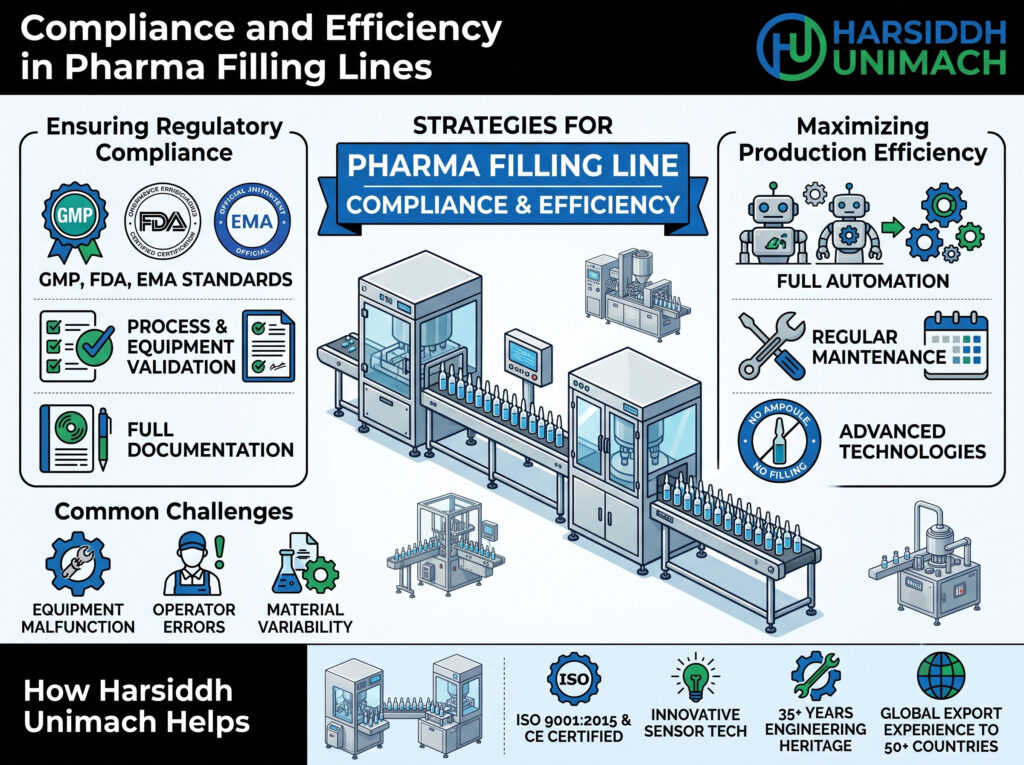
Pharmaceutical manufacturers often feel pulled in two directions. Quality and regulatory teams want every step controlled, checked and documented. Production teams want the line running faster, with fewer stops and less waste. It is easy to assume that more compliance means less efficiency, and that a faster line must cut corners.
In reality, the best filling lines are both compliant and efficient, and the two goals support each other. A line that is well designed, well maintained and run by trained people produces fewer rejects, fewer deviations and fewer investigations. That saves time and money while protecting patients.
This article sets out practical strategies for ensuring compliance and efficiency in pharmaceutical filling lines. It focuses on how to run and improve a filling line day to day. For the requirements packaging machinery itself must meet, see our companion article on the importance of compliance in pharmaceutical packaging machinery.
Why Compliance and Efficiency Belong Together
Consider what happens when a filling line has a problem. A weight check fails, a stopper is missing or a label is skewed. The line stops, product is quarantined, a deviation is raised, an investigation follows and a batch may be delayed or rejected. Every compliance failure is also an efficiency failure.
The reverse is also true. Efficiency problems often create compliance risk. Frequent jams lead to manual interventions, which in a sterile area increase contamination risk. Rushed changeovers lead to missed line clearance steps. Worn machines drift out of specification and fill inaccurately.
The goal is therefore right first time: doing each step correctly the first time, with no rework. The strategies below are all ways of moving closer to that goal.
| Compliance Problem | Efficiency Impact |
|---|---|
| Fill weight out of limits | Rejects, line stops, investigation |
| Line clearance failure | Batch hold, possible recall |
| Unvalidated change | Deviation, revalidation, delay |
| Manual intervention in sterile zone | Contamination risk, possible batch loss |
| Missing or incomplete records | Batch release delayed |
| Poorly maintained equipment | Unplanned downtime, drift in quality |
Strategy 1: Start With the Right Line Design
Many compliance and efficiency problems begin at the purchasing stage. A line that does not suit the product, containers or batch sizes will struggle no matter how well it is run.
Key points to get right:
- Match the filling principle to the product. Thin liquids, viscous liquids and powders need different dosing systems. An automatic liquid syrup filling machine suits oral liquids, while an automatic rotary dry syrup powder filling machine handles powders for reconstitution.
- Size the line for realistic demand. A line that is too small runs flat out with no time for maintenance; a line that is too large wastes capital and space.
- Integrate the line. Machines with matched speeds and smooth transfers avoid the jams, tipping and buffer problems that cause stops. Integrated systems such as an automatic liquid vial filling line, an automatic ampoule filling line or an automatic dry syrup powder filling line are designed as one system.
- Design for cleaning and changeover. Hygienic surfaces, quick-release parts and easy access save time every day and reduce contamination risk.
- Write a clear URS. A User Requirement Specification that covers products, containers, speeds, compliance and documentation needs gives the supplier a clear target.
Strategy 2: Use Automation to Reduce Variability and Human Error
People are skilled, but they are also variable. Automation helps by making critical steps consistent and repeatable.
Useful automation features include:
- Servo-driven dosing and motion, where fill volumes and machine movements are set by recipe rather than manual adjustment. An automatic servo based vial filling machine is one example.
- No-container, no-fill and no-container, no-stopper functions, which prevent spillage and waste.
- Automatic reject systems that remove faulty containers without operator handling.
- Recipe management with access levels, so only authorised people can change critical settings.
- Alarm and event logs that record what happened and when, supporting investigations and batch records.
Automation should match the operation’s needs. A small clinical or pilot line may not need the same level of automation as a high-volume commercial line, but the critical quality steps should still be controlled.
Strategy 3: Build Strong SOPs and Training
Even the best machine depends on the people running it. Clear Standard Operating Procedures (SOPs) and good training are essential for both compliance and efficiency.
Writing Effective SOPs
- Write procedures in simple, step-by-step language that operators can follow on the shop floor.
- Include photographs or diagrams for complex steps, such as fitting change parts or setting stopper tracks.
- Cover start-up, operation, in-process checks, changeover, cleaning, line clearance and shutdown.
- Review and update SOPs whenever the machine or process changes.
Training That Works
- Train operators on both how and why. People who understand the reason for a step are less likely to skip it.
- Use hands-on training at the machine, not only classroom sessions.
- Confirm competence before operators work independently, and record it.
- Provide refresher training and cross-train staff so the line does not depend on one person.
Strategy 4: Make Changeovers Fast and Controlled
Changeovers between products or formats are a major source of lost time and a high-risk point for mix-ups. Improving them helps both goals at once.
Practical steps:
- Separate internal and external work. Prepare parts, tools, components and documents while the line is still running the previous batch.
- Use format-specific, marked change parts so the wrong part cannot easily be fitted.
- Standardise the sequence with a checklist so every changeover follows the same steps.
- Build line clearance into the procedure, with a second-person check before the new batch starts.
- Record settings for each format so the line is set correctly the first time.
For detailed methods, see our guide on vial filling machine changeover best practices.
Strategy 5: Prevent Breakdowns With Planned Maintenance
Unplanned downtime hurts efficiency, and worn equipment hurts compliance. A planned maintenance programme protects both.
- Preventive maintenance: service the machine at set intervals according to the manufacturer’s recommendations, replacing wear parts such as seals, gaskets and pump components before they fail.
- Condition monitoring: watch for early signs of trouble, such as unusual noise, vibration, drifting fill weights or more frequent jams.
- Calibration: keep instruments such as balances, sensors and temperature probes calibrated so measurements can be trusted.
- Spare parts: keep critical spares in stock so repairs are quick.
- Maintenance records: document all work, as these records may be reviewed during inspections.
Our article on vial filling machine maintenance best practices to prevent unscheduled downtime covers this in more detail, and many of the same principles apply to other filling machines.
Strategy 6: Control Quality During the Run, Not Just at the End
Finding a problem at the end of a batch is expensive: the whole batch may be affected. In-process controls catch problems early, when they are cheaper to fix.
Typical in-process controls on filling lines include:
| Control | What It Checks | Why It Helps |
|---|---|---|
| Fill weight or volume checks | Dose accuracy | Detects drift before many containers are affected |
| Closure checks | Stopper placement, cap seal, torque | Prevents leaks and integrity failures |
| Visual checks | Particles, defects, fill level | Catches visible defects early |
| Label checks | Presence, position, batch and expiry coding | Prevents labelling errors |
| Environmental monitoring | Air quality in controlled areas | Confirms the filling environment is under control |
Set clear limits and actions: what the operator should do if a check is out of limits, who must be informed and how the affected product is handled. Trend in-process data over time to spot gradual drift before it becomes a failure.
Strategy 7: Measure Performance With OEE
You cannot improve what you do not measure. Overall Equipment Effectiveness (OEE) is a widely used way to measure filling line performance. It combines three factors:
- Availability: the share of planned time the line is actually running
- Performance: how fast it runs compared with its ideal speed
- Quality: the share of output that is good, first time
OEE = Availability × Performance × Quality
Illustrative example (not performance data for any machine): if a line runs 85% of planned time, at 90% of ideal speed, and 98% of its output is good, its OEE is 0.85 × 0.90 × 0.98 ≈ 0.75, or about 75%.
The value of OEE is not the single number but what it reveals. Low availability points to breakdowns and slow changeovers. Low performance points to minor stops and reduced speeds. Low quality points to rejects and rework, which are often compliance-related. Tracking OEE by shift, product and cause helps you focus improvement where it matters.
For a closer look at what causes lost time, read our article on understanding common causes of downtime in pharmaceutical filling lines.
Strategy 8: Strengthen Documentation and Data Integrity
Batch release depends on complete, accurate records. Missing signatures, unclear entries or gaps in data can delay release even when the product is good.
Ways to improve:
- Design batch records that follow the actual process and are easy to complete.
- Record data at the time the activity is performed, not afterwards.
- Use machine data such as counts, alarms and recipes to support records where possible.
- Where electronic records are used, make sure appropriate controls such as user access and audit trails are in place, as defined by your QA team.
- Review records promptly, so errors are corrected while details are fresh.
Good documentation is also an efficiency tool: faster review means faster batch release.
Strategy 9: Keep the Line in a Validated State
A filling line is qualified through IQ, OQ and PQ before routine use. Our guide to automatic vial filling equipment validation and IQ, OQ and PQ explains the process. After qualification, the challenge is keeping the line in that validated state:
- Change control: assess any change to equipment, parts, software, materials or process before making it.
- Periodic review: review equipment performance, deviations and maintenance history at set intervals.
- Requalification when needed: after significant changes or as your quality system requires.
Uncontrolled “quick fixes” may save minutes today but can cause deviations, investigations and revalidation later.
Strategy 10: Investigate Problems and Improve Continuously
Every deviation, reject trend or breakdown is a chance to learn. A strong Corrective and Preventive Action (CAPA) process turns problems into lasting improvements.
- Find the root cause, not just the symptom. Tools such as “5 Whys” or fishbone diagrams help.
- Fix the cause, for example by changing a part design, improving an SOP or adding a check.
- Check effectiveness to confirm the problem does not return.
- Share learning across shifts and lines.
Combine CAPA with regular improvement reviews based on OEE and quality data. Small, steady improvements add up to large gains over time.
Strategy 11: Protect the Filling Environment
For sterile products, the filling environment is critical. Containers prepared on a linear vial washing machine and depyrogenated in a sterilizing tunnel for ampoules and vials must stay protected until they are filled and closed.
- Minimise manual interventions in the critical zone.
- Design the line so routine tasks can be done without breaking protection.
- Follow gowning, cleaning and environmental monitoring procedures strictly.
- Close containers quickly after filling, for example with integrated filling and stoppering on a liquid vial filling machine with rubber stoppering or by flame-sealing on an automatic eight head ampoule filling and sealing machine.
For non-sterile products such as oral liquids and eye drops, hygiene and contamination control still matter. Lines such as an automatic eye and ear drop filling line or a liquid bottle filling and capping monoblock reduce handling by combining steps. Choosing reliable capping machines also helps ensure secure, consistent closures.
Strategy 12: Work Closely With Your Equipment Supplier
Your machine supplier can be a valuable partner in both compliance and efficiency:
- Involve the supplier early when writing the URS.
- Use the Factory Acceptance Test (FAT) to confirm performance and train key staff before delivery.
- Ask for complete documentation to support qualification.
- Arrange operator and maintenance training at installation.
- Keep in touch for spare parts, service and upgrades as your needs change.
A Quick Self-Assessment
Use these questions to see where your filling line stands:
- Does the line suit your products, containers and volumes?
- Are critical steps automated or otherwise well controlled?
- Are SOPs clear, current and followed?
- Are operators trained, with competence recorded?
- Are changeovers standardised and timed?
- Is maintenance planned, with critical spares in stock?
- Are in-process controls catching problems early?
- Do you track OEE and act on the results?
- Are records completed accurately and reviewed promptly?
- Is change control applied to every change?
- Do deviations lead to effective CAPA?
Any “no” is a place to start improving.
Frequently Asked Questions
Does more compliance always mean lower efficiency? No. Well-designed controls prevent errors, rejects and investigations, which saves time. Poorly designed controls can slow a line, so the aim is effective controls, not more paperwork.
What is a good OEE for a pharmaceutical filling line? It varies widely with product, line type and batch sizes. The most useful comparison is with your own past performance and the causes behind the losses.
Where should we start improving? Start with the biggest losses shown by your data, such as long changeovers, frequent breakdowns or a high reject rate.
Can older machines be made more efficient and compliant? Often, through upgrades, better maintenance, improved SOPs and training. Any change should go through change control.
Talk to Harsiddh About Your Filling Line
Harsiddh Unimach manufactures filling machines and complete lines for injectables, oral liquids, powders, eye drops and more, designed for consistent performance, easy cleaning and quick changeovers, with documentation to support your qualification. Our team can review your current line or new project and suggest practical ways to improve both compliance and efficiency.
Contact us through our contact page or share your requirements through our inquiry form.