
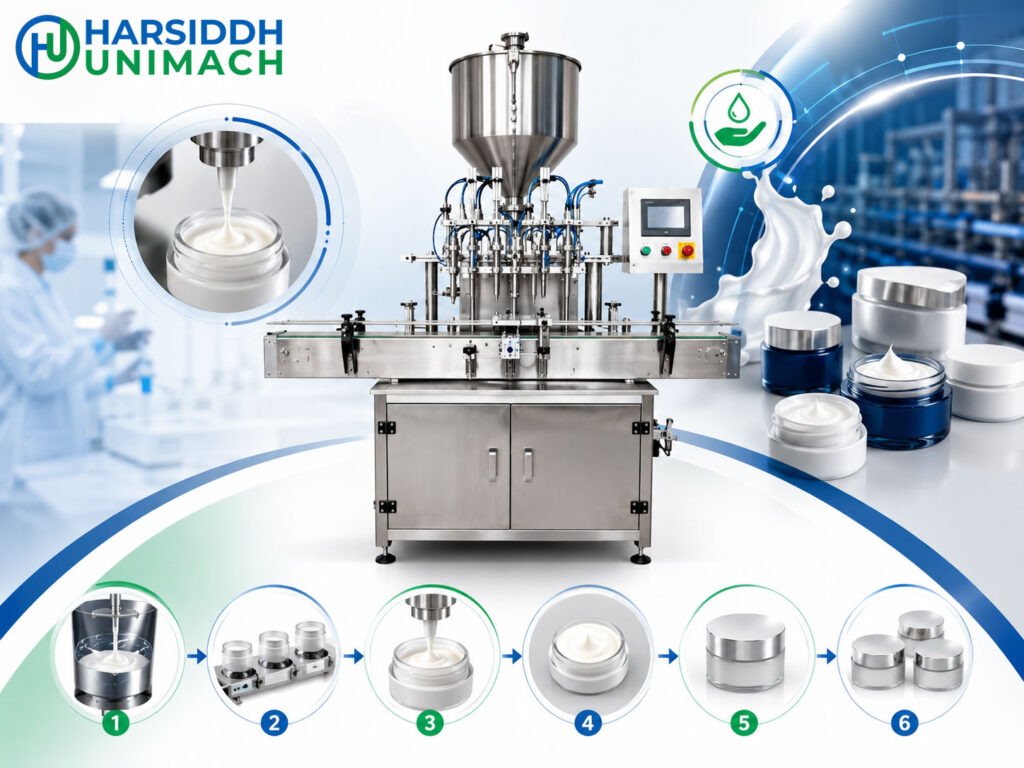
Face creams, moisturisers, sunscreens, hand creams, medicated creams, hair creams and body butters are filled every day by the million. They arrive in tubes, jars, pump bottles and airless dispensers, and customers expect every one to look perfect when they open it: a smooth, level surface in the jar, no air bubbles, no smears on the rim and exactly the quantity printed on the pack.
Making that happen is the job of the cream filling machine. Creams are emulsions, delicate mixtures of oil and water held together by emulsifiers. They are thicker than lotions but lighter than ointments, and they can be damaged by too much shear, heat or air. A cream filler therefore has to dose accurately while treating the product gently.
In this article, we explain the working principle of cream filling machines: how creams behave, how the dose is measured, how creams are filled into tubes, jars and bottles, which settings matter and how to solve common problems.
What Makes Creams Different to Fill?
Creams are semi-solid emulsions, either oil-in-water (most cosmetic creams) or water-in-oil (richer, heavier creams). Compared with other products:
| Product | Typical Texture | Main Filling Concern |
|---|---|---|
| Lotion | Pourable, low to medium viscosity | Splashing, foaming |
| Cream | Soft semi-solid emulsion | Air entrapment, shear damage, surface finish |
| Ointment | Greasy, often stiffer | Temperature control, stringing |
| Paste | Stiff, high solids | Pumping force, nozzle blockage |
| Gel | Clear, jelly-like | Visible air bubbles |
If you fill the neighbouring products too, see our guides to the lotion filling machine working principle, the ointment filling machine working principle and the paste filling machine working principle.
Key properties of creams
- Shear sensitivity – excessive mixing or high-speed pumping can thin the cream or even break the emulsion, causing separation.
- Air sensitivity – air folded into a cream shows as bubbles, voids or a dull surface and reduces the weight in each pack.
- Temperature sensitivity – creams thin when warm and thicken when cool; some are filled warm and set as they cool.
- Surface appearance – in jars especially, the finished surface is part of the product’s appeal.
- Stickiness – creams cling to nozzles and container rims if the cut-off is poor.
The Core Working Principle: Positive Displacement
Almost all cream fillers use positive displacement: a fixed volume is mechanically pushed out on each cycle. The most common mechanism is the piston pump.
- A piston moves back inside a cylinder, drawing cream in from the hopper through a valve.
- The valve switches.
- The piston moves forward, pushing the same volume out through the nozzle into the container.
Because the piston displaces a fixed volume each time, the dose is very repeatable, and the stroke length sets the fill volume.
Servo-driven pistons
On modern machines, a servo motor drives the piston. This allows:
- Precise stroke length for accurate volume
- Programmable speed profiles, slow at the start, faster in the middle, slow at the end, to reduce air and splashing
- Stored recipes for each product and container
- Quick, repeatable changeovers
Other pump types
For some creams, especially very shear-sensitive ones or very large volumes, rotary lobe pumps, gear pumps or progressive cavity pumps may be used. These still work on the positive displacement principle but deliver product continuously, with the dose set by time or revolutions.
Main Components of a Cream Filling Machine
- Product hopper – stainless steel, sometimes jacketed for heating or cooling, with a lid to protect the product.
- Slow stirrer – keeps the cream uniform without whipping in air.
- Hopper level sensor and feed – keeps the level within a band, often fed from a vessel by a transfer pump.
- Piston pump and valve – measures and delivers each dose.
- Filling nozzle – sized to the container opening, with a cut-off device.
- Container handling system – a rotary turret for tubes, or a conveyor with indexing for jars and bottles.
- No-container, no-fill sensor – prevents product being dispensed with no container present.
- Closing station – tube sealing, jar capping or bottle capping.
- Control panel – sets volume, speed, temperature and recipes.
How a Cream Filling Machine Works: Step by Step
Step 1: Transfer from the manufacturing vessel
After mixing and homogenising, the cream is transferred to the filling machine. Gentle transfer is important: a low-shear pump or pressure transfer avoids thinning or aerating the cream. Many plants fill directly from a holding vessel connected to the filler’s hopper.
Step 2: Hopper conditioning
In the hopper, a slow stirrer keeps the cream uniform. If the cream is filled warm, the hopper jacket maintains the correct temperature. If it is filled at room temperature, the jacket may not be used. The hopper level is kept steady so that the pump draws product consistently.
Step 3: Container positioning
The container is positioned under the nozzle:
- Tubes are held cap down in turret holders and oriented by eye mark
- Jars are indexed under the nozzle on a conveyor
- Bottles are positioned under the nozzle, sometimes with a diving nozzle that enters the neck
Step 4: Drawing the dose
The valve connects the pump cylinder to the hopper, and the piston retracts to draw a measured volume. The piston draws at a controlled speed, because drawing too fast can pull air into the cylinder or cause incomplete filling with thick creams.
Step 5: Dispensing
The valve switches and the piston pushes the cream into the container. How the cream is placed depends on the container:
- Tubes – bottom-up filling: the nozzle starts near the cap end and rises as the tube fills, keeping the open end clean for sealing.
- Jars – the nozzle may start low and rise, or the jar may rotate slightly during filling to create a smooth, swirled or level surface.
- Bottles – a diving nozzle fills from near the bottom and rises, reducing air.
Step 6: Cut-off
At the end of the dose, a cut-off device stops the cream sharply: a nozzle shut-off valve, a short piston suck-back or an air blow. A good cut-off leaves no tail on the nozzle and no drip on the container rim or tube end.
Step 7: Closing
- Tubes are sealed by hot air and jaws (plastic and lami) or folded and crimped (aluminium)
- Jars receive lids and are capped, for example on an Automatic Jar Capping Machine, sometimes with an inner disc or foil
- Bottles are fitted with pumps or caps and may be induction sealed on an induction sealing machine
Step 8: Inspection and packing
Filled containers are checked for fill weight, appearance and closure, then labelled and packed.
Filling Creams into Tubes
Tubes are the most common pack for medicated and many cosmetic creams. Tube filling machines combine the piston filler with tube loading, orientation, sealing, coding and trimming on one rotary turret.
- Automatic Single Head Tube Filling Machine on Harsiddh Unimach
- Automatic single head tube filling machine (HTF-40A)
- Automatic double head tube filling machine (HTF-70A)
- Automatic lami tube filling machine
- Semi-automatic plastic tube filling machine
For the complete tube process, read our tube filling machine working principle.
Filling Creams into Jars and Bottles
Jars are popular for face creams, body butters and premium cosmetics; pump bottles and airless dispensers for lighter creams. These containers are filled on linear or rotary piston fillers.
- Automatic Cosmetic Bottle Filling Machine and the cosmetic bottle filling machine
- Automatic Lotion Filling Machine and the lotion and gel filling machine, which suit lighter creams and viscous liquids
After filling, jars and bottles move to capping. See the capping machines for glass and PET bottles.
Browse our ointment and cream filling machines and the cream and ointment filling machines range.
Key Settings and Their Effects
| Setting | What It Controls | Effect If Wrong |
|---|---|---|
| Piston stroke | Fill volume | Under- or over-filled containers |
| Piston draw speed | How completely the cylinder fills | Air in dose, light fills |
| Piston dispense speed | Flow into the container | Splashing, air entrapment, poor surface |
| Nozzle size | Flow rate and shear | Shear damage if too small, poor cut-off if too large |
| Nozzle position and rise | Bottom-up filling | Air pockets, product on walls or rims |
| Cut-off method | Clean end of dose | Tails, drips, contaminated seals |
| Hopper temperature | Viscosity | Fill weight drift, stringing |
| Stirrer speed | Uniformity | Air entrapment if too fast, separation if too slow |
Protecting Cream Quality During Filling
- Minimise shear – use large-bore valves and nozzles, moderate piston speeds and low-shear transfer pumps.
- Avoid air – de-aerate during manufacture where needed, keep hoppers covered, fill bottom-up and avoid fast stirring.
- Control temperature – keep the cream within its specified filling range.
- Limit hold time – long periods in the hopper can lead to separation or microbial risk for some products.
- Keep it clean – smooth, polished contact surfaces and thorough cleaning between batches.
For pharmaceutical creams, contact parts, cleaning and documentation should meet GMP expectations. Always confirm requirements against your own quality procedures and applicable guidelines.
Cosmetic vs Pharmaceutical Cream Filling
The filling principle is the same in both industries, but priorities differ:
| Aspect | Cosmetic Creams | Pharmaceutical Creams |
|---|---|---|
| Main containers | Jars, pump bottles, airless packs, tubes | Mostly tubes, some jars |
| Appearance focus | Very high, especially jar surface finish | Important, but secondary to dose and closure |
| Fill accuracy | Must meet declared quantity | Must meet declared quantity and batch specifications |
| Documentation | Batch records and quality checks | Full GMP documentation and qualification |
| Changeovers | Frequent, many fragrances and shades | Fewer products, strict cleaning validation |
| Typical closures | Lids, pumps, caps | Sealed tubes, caps, tamper evidence |
Cosmetic plants often value quick changeovers and surface finish; pharmaceutical plants put more weight on cleaning validation, documentation and traceability. A well-chosen machine can serve both, as long as these needs are defined at the start.
Troubleshooting Common Cream Filling Problems
| Problem | Likely Cause | Corrective Action |
|---|---|---|
| Light or variable fills | Air in cream, piston draw too fast, worn seals | De-aerate, slow draw, service pump |
| Bubbles visible in jars | Air entrapment, filling from too high | Fill bottom-up, slow dispense |
| Uneven surface in jars | Nozzle position, dispense speed | Adjust nozzle height and speed profile |
| Cream thinning or separating | Excessive shear or temperature | Larger nozzle, slower pump, check temperature |
| Drips on rim or tube end | Poor cut-off | Adjust suck-back, valve or air blow |
| Leaking tube seals | Cream on seal area | Improve cut-off and bottom-up filling |
| Fill weight drift over batch | Hopper temperature or level changing | Control temperature and level |
| Pump not priming | Cream too thick or hopper level too low | Adjust temperature, keep hopper level up |
Maintenance Tips
- Inspect piston seals, valve seals and O-rings regularly.
- Clean hoppers, pumps, valves and nozzles thoroughly between batches.
- Check temperature controllers and stirrer drives.
- Keep nozzle sets and change parts organised for each container.
- Trend fill weights to catch gradual wear.
How to Choose a Cream Filling Machine
- Product – viscosity, emulsion type, shear and temperature sensitivity
- Containers – tubes, jars, pump bottles or airless dispensers
- Fill volume range
- Output – semi-automatic, single head or multi-head
- Pump type – piston or other positive displacement pump
- Hopper features – heating, cooling, stirring
- Changeover needs – number of products and container sizes
- Hygiene and GMP requirements
Frequently Asked Questions
What is the working principle of a cream filling machine? A piston pump draws a measured volume of cream from a hopper and pushes it through a nozzle into a tube, jar or bottle. The stroke length sets the fill volume, and a cut-off device stops the flow cleanly.
Why are piston fillers used for creams? They handle thick, semi-solid products and deliver a repeatable volume each cycle.
How do you avoid air bubbles in creams? By de-aerating the product, keeping the hopper covered, using a slow stirrer, filling bottom-up and controlling piston speed.
Can the same machine fill creams and lotions? Often yes, with changes to nozzle size, speed and settings, as long as the pump suits both viscosities.
What causes cream to separate during filling? Usually excessive shear from small nozzles or high pump speeds, or excessive temperature.
Looking for a cream filling machine for tubes, jars or bottles? Contact our team or send an inquiry with your product and container details.