
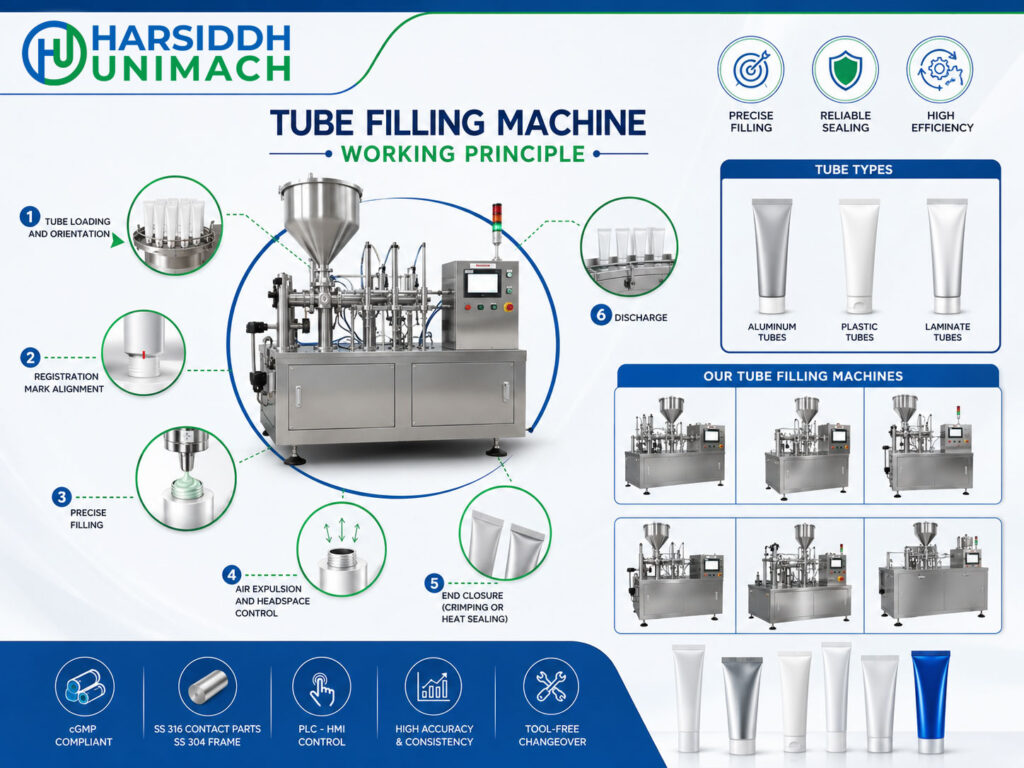
Ointments, creams, gels, toothpaste, adhesives, lotions and many cosmetic products all share the same familiar package: the tube. A tube is hygienic, portable, protects the product from air and light, and lets the user squeeze out exactly what is needed. For manufacturers, though, a tube is an unusual container. It arrives open at the bottom and closed at the top, so it is filled from the “wrong” end and then sealed shut with a crimp or heat seal that must be strong, neat and leak-free.
The tube filling machine handles this entire sequence automatically. In this article, we explain the working principle of tube filling machines: how tubes are loaded and oriented, how the product is dosed, how plastic, laminated and aluminium tubes are sealed, how coding is applied and which machine types suit different outputs. We also cover key settings, common problems and how to choose the right machine.
Types of Tubes and Why They Matter
The type of tube decides how the machine seals it, so it is the first thing to understand.
| Tube Type | Material | Sealing Method | Typical Products |
|---|---|---|---|
| Aluminium (collapsible) | Aluminium, usually internally lacquered | Mechanical folding and crimping | Pharmaceutical ointments, eye ointments, some adhesives, colour pastes |
| Laminated (lami) | Multilayer laminate with a barrier layer | Heat sealing (hot air or other heating) | Toothpaste, creams, gels, cosmetics |
| Plastic | PE or similar polymers | Heat sealing | Cosmetics, lotions, gels, personal care |
Aluminium tubes do not spring back after squeezing, so air is not drawn back in, which helps protect sensitive products. Plastic and laminated tubes recover their shape and give a premium appearance with large printable areas.
For a detailed look at plastic tubes specifically, read our article on the plastic tube filling and sealing machine working principle.
The Basic Principle
Every automatic tube filling machine performs the same sequence on each tube:
- Load an empty tube, cap end down, into a holder
- Orient the tube so its print faces the correct direction
- Clean the inside with air (on many machines)
- Fill a measured dose of product through the open end
- Seal the open end, by heat for plastic and lami tubes or by folding for aluminium tubes
- Code and trim the sealed end
- Eject the finished tube
On most machines, tubes travel on a rotary indexing turret with a number of tube holders. The turret moves one position at a time, and each station performs one operation while the tube is stationary.
Main Components of a Tube Filling Machine
- Tube magazine or hopper – holds empty tubes and feeds them into the holders.
- Tube holders (cups) – carry each tube, cap down, around the turret.
- Indexing turret – rotates the holders from station to station.
- Tube pushing device – presses each tube firmly into its holder.
- Orientation (registration) station – rotates the tube until a sensor reads the eye mark on the tube.
- Air cleaning nozzle – blows dust from inside the tube before filling.
- Product hopper – often jacketed for heating or cooling, with a stirrer for some products.
- Dosing pump – usually a piston pump with a rotary valve.
- Filling nozzle – enters the tube and withdraws as it fills.
- Sealing station – hot air heads and jaws for plastic and lami tubes, or folding and crimping jaws for aluminium tubes.
- Coding and trimming station – embosses the batch code and trims the sealed end.
- Ejection station – removes finished tubes onto a conveyor or into a cartoner.
- Control panel – sets speed, fill volume, sealing parameters and “no tube, no fill”.
Step-by-Step: How a Tube Filling Machine Works
Step 1: Tube loading
Empty tubes are placed in the magazine with their caps already fitted. The tubes drop or are pushed one at a time into the holders on the turret, cap end down and open end up. A pusher presses each tube fully into its holder so its height is consistent for the later stations.
Step 2: Orientation
Tubes are printed all round or on one face, and the seal and code must line up with the artwork. At the orientation station, the tube is rotated while a photo sensor looks for a printed eye mark. When the mark is detected, rotation stops. This means the crimp or seal will always sit at the same position relative to the print.
Step 3: Air cleaning (optional)
A nozzle descends into the tube and blows filtered air to remove dust or loose particles. Some machines also use a short vacuum to extract them.
Step 4: Filling
The filling nozzle descends into the tube, close to the bottom near the cap. The piston pump draws a set volume of product from the hopper through a rotary valve, then the valve switches and the piston pushes the product out through the nozzle.
As product enters, the nozzle rises steadily, staying just below the product surface. This bottom-up filling reduces trapped air and keeps product off the tube’s inner wall in the sealing area.
At the end of the stroke, a cut-off stops the product cleanly. Depending on the product, this may be an air blow, a shut-off valve or a small suck-back of the piston. A clean cut-off is critical: any product left on the inside of the open end will weaken the seal.
The fill volume is adjusted by changing the piston stroke. For heat-sensitive or viscous products, the hopper may be jacketed to keep the product at the right temperature, and a stirrer may keep it uniform.
Step 5: Sealing
This is where the process differs most between tube types.
Plastic and lami tubes: heat sealing
- Heating – hot air is blown onto the inside of the tube’s open end through a heating nozzle, softening the inner layer. A cooling ring often protects the area just below to stop heat travelling into the product or the print.
- Pressing – sealing jaws close and press the softened walls together, fusing them into a single seal.
- Cooling – cooled jaws or a cooling station set the seal so it does not open.
The quality of the heat seal depends on air temperature and flow, heating time, jaw pressure and the tube material. Settings are tuned for each tube supplier and size.
Aluminium tubes: folding and crimping
- Flattening – jaws flatten the open end of the tube.
- Folding – the flattened end is folded over on itself, typically two or three times depending on the required seal.
- Crimping – the fold is pressed tightly to lock it. A saddle fold pattern or crimp pattern may be pressed in for strength and appearance.
Aluminium folding is a purely mechanical process with no heat, which suits pharmaceutical ointments and heat-sensitive products.
Step 6: Coding and trimming
A coding station embosses the batch number, manufacturing date and expiry date into the sealed end. For plastic and lami tubes, a trimming station cuts the seal to a neat, straight edge, sometimes with a decorative profile.
Step 7: Ejection
Finished tubes are pushed up out of their holders and onto an outfeed conveyor, into a collection tray or directly into a cartoning machine. Empty holders continue round to the loading station.
Types of Tube Filling Machines
Semi-automatic tube filling machines
The operator loads each tube by hand and the machine fills it; sealing or crimping may be done on the same machine or separately. These suit small batches, R&D and start-ups.
- Semi-automatic plastic tube filling machine
- Semi-automatic aluminium tube filling machine
- Semi-automatic aluminium tube filling and sealing machine
Automatic single head tube filling machines
A rotary turret machine with one filling nozzle. The workhorse for most small and medium pharmaceutical and cosmetic lines. See the Automatic Single Head Tube Filling Machine and the automatic single head tube filling machine (HTF-40A).
Automatic double head tube filling machines
Two filling nozzles fill two tubes per index, roughly doubling the output of a single head machine with a similar footprint. See the Automatic Double Head Tube Filling Machine and the automatic double head tube filling machine (HTF-70A). For more on higher-output tube lines, read high-speed tube filling machine: improve packaging efficiency.
Aluminium tube filling machines
Fitted with folding and crimping stations instead of heat sealing. See the Automatic Aluminum Tube Filling Machine and the automatic aluminium tube filling machine (HTF-40AL).
Lami tube filling machines
Fitted with hot-air sealing and trimming for laminated tubes. See the Automatic Lami Tube Filling Machine and the automatic lami tube filling machine.
Tube filling, crimping and coding machines
Combine filling, crimping and batch coding in a single compact unit. See the tube filling, crimping and batch coding machine.
Browse our full range of tube filling machines and the cream and ointment filling machines range.
Products Commonly Filled in Tubes
- Pharmaceutical: ointments, creams, gels, eye ointments, dental gels
- Cosmetic: face creams, hand creams, sunscreens, hair gels, cleansers
- Personal care: toothpaste, shaving cream, lotions
- Industrial: adhesives, sealants, lubricants, colour pastes
- Food: condensed milk, sauces and pastes in some markets
For more on the filling side of semi-solids, read our ointment filling machine working principle.
Key Settings and Their Effects
| Setting | What It Controls | Effect If Wrong |
|---|---|---|
| Piston stroke | Fill volume | Under- or over-filled tubes |
| Nozzle size and rise speed | How product enters the tube | Air pockets, product on the seal area |
| Cut-off (air, valve, suck-back) | Clean end of fill | Product tails contaminate the seal |
| Hopper temperature | Product viscosity | Inconsistent fills, stringing |
| Eye mark sensor | Seal position relative to print | Misaligned seals and codes |
| Hot air temperature and time | Heat seal strength | Weak or burnt seals |
| Sealing jaw pressure | Fusion of tube walls | Leaks or deformed seals |
| Fold count and crimp pressure | Aluminium seal security | Leaking or unattractive crimps |
| Tube height in holder | Position for every station | Poor sealing, coding or trimming |
Quality Checks on Filled Tubes
- Fill weight – checked at defined intervals by weighing sample tubes
- Seal integrity – squeeze or pressure tests to confirm the seal does not open or leak
- Seal appearance – straight, even, correctly positioned relative to the print
- Code legibility – batch, manufacturing and expiry details clear and correct
- Cap tightness – caps fitted correctly before filling
Troubleshooting Common Problems
| Problem | Likely Cause | Corrective Action |
|---|---|---|
| Leaking heat seals | Low hot air temperature, product on seal area, low jaw pressure | Adjust heating, improve cut-off, increase pressure |
| Burnt or distorted seals | Excessive heat or time | Reduce temperature or heating time |
| Leaking aluminium crimps | Too few folds, low crimp pressure | Adjust folding and crimp settings |
| Seal not aligned with print | Eye mark sensor out of adjustment | Re-teach the sensor, check tube print |
| Fill weight variation | Air in product, viscosity changes, worn piston seals | De-aerate product, control temperature, service pump |
| Product tails on tube neck | Poor cut-off | Adjust air blow, valve or suck-back |
| Tubes not loading | Tubes bent or out of tolerance, magazine misaligned | Check tubes, adjust magazine |
| Tubes falling in holders | Wrong holder size, worn holders | Fit correct holders, replace worn parts |
Maintenance Tips
- Inspect piston seals and rotary valves regularly; wear causes fill variation.
- Clean the hopper, pump and nozzle thoroughly between batches.
- Check heating elements and air flow on heat sealing stations.
- Inspect folding and crimping jaws for wear and alignment.
- Clean and check the eye mark sensor.
- Verify that all tube holders are the correct size and in good condition.
- Keep change parts for each tube diameter labelled and stored together.
How to Choose a Tube Filling Machine
- Tube type – aluminium, lami or plastic, or a machine that can handle more than one
- Tube diameters and lengths to be run
- Product properties – viscosity, temperature sensitivity, need for stirring or heating
- Fill volume range
- Required output – semi-automatic, single head or double head
- Coding and trimming requirements
- Downstream integration – labelling (see our tube labeling machine working principle) and cartoning
- GMP needs for pharmaceutical products
Frequently Asked Questions
What is the working principle of a tube filling machine? Empty tubes are loaded cap down into holders on a rotating turret, oriented, filled from the open end by a piston pump with a rising nozzle, then sealed by heat (plastic and lami tubes) or by folding and crimping (aluminium tubes), coded and ejected.
How are aluminium tubes sealed? The open end is flattened, folded over several times and crimped tightly. No heat is used.
How are plastic and lami tubes sealed? Hot air softens the inner surface of the tube end, and jaws press the walls together to fuse them before the seal is cooled.
Why is an eye mark used? So that every seal and code sits in the same position relative to the tube’s printed artwork.
Can one machine fill both aluminium and plastic tubes? Some machines can be supplied with interchangeable sealing stations, but most lines are configured for one sealing method. Discuss your tube types when selecting a machine.
Looking for the right tube filling machine for your product? Contact our team or send an inquiry with your tube type, sizes and product details.