
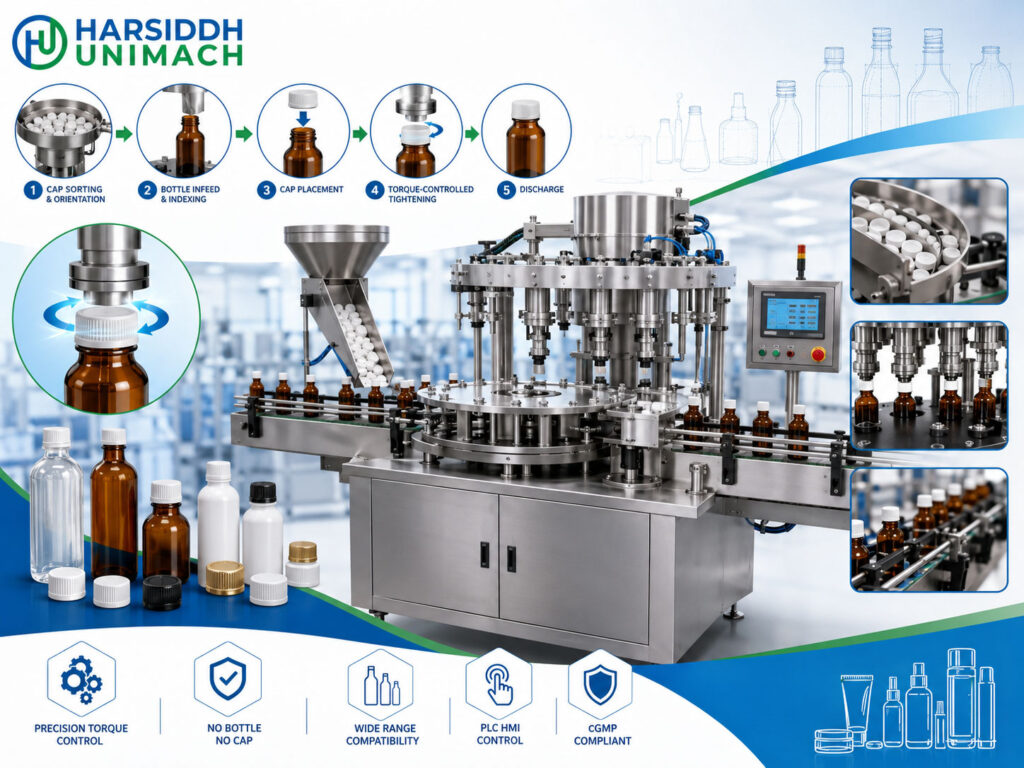
The screw cap is the most widely used closure for bottles in pharmaceutical, nutraceutical, cosmetic and food packaging. Syrups, suspensions, tonics, oral solutions, dry syrups, sanitisers and many household products are sealed with a threaded plastic or metal cap. It is simple, familiar to the consumer and easy to reopen and reclose. Behind that simple closure, though, sits a precise mechanical process. The cap has to land squarely on the bottle neck, engage the thread without crossing it and be tightened to exactly the right torque, every single time.
That is the job of the bottle screw capping machine. In this guide, we explain the working principle step by step: how caps are fed and picked up, how the capping chuck threads them on, how torque is controlled, which machine designs are available and which settings decide whether a cap seals properly or leaks. We also cover common problems and how to choose the right machine for your line.
If you are new to capping in general, start with our overview of the bottle capping machine working principle, which compares screw, ROPP, lug, crown and other capping methods. This article focuses only on screw capping.
What Is a Bottle Screw Capping Machine?
A bottle screw capping machine applies pre-threaded caps to bottles with matching threaded necks and tightens them to a set torque. The cap already has its internal thread moulded in. The machine’s job is to thread it on and tighten it, not to form anything.
This is the key difference from ROPP capping. In a ROPP machine, a plain aluminium shell is placed on the bottle and rollers form the thread into the metal against the neck. A screw capper simply rotates a ready-made cap onto the neck. For the ROPP method, see our article on the bottle ROPP capping machine working principle.
Typical closures handled by screw capping machines include:
- Plain plastic screw caps (PP, HDPE) with or without wads or liners
- Tamper-evident caps with a breakaway band
- Child-resistant (push-and-turn) caps, with suitable tooling
- Pre-threaded metal caps
- Dropper and dispensing caps that thread on
The Basic Principle in One Line
A screw capping machine places a threaded cap on the bottle neck, rotates it clockwise until the threads engage fully, and stops tightening when a set torque is reached.
Every design, from a semi-automatic bench unit to an eight head rotary machine, follows this principle. The differences lie in how caps are fed, how many bottles are capped at once and how torque is limited.
Main Components of a Screw Capping Machine
- Cap hopper – stores loose caps in bulk.
- Cap sorter or elevator – orients caps so they all face open side down. Vibratory bowls are common for small caps; elevator-type sorters are used for larger caps and higher outputs.
- Cap chute – carries oriented caps in a single line to the pick-off point.
- Pick-off station – holds the leading cap at an angle so a passing bottle (or the capping head) can collect it.
- Bottle conveyor – carries filled bottles through the machine.
- Infeed worm (feed screw) – spaces bottles to the machine pitch.
- Star wheels – transfer bottles into and out of the capping turret and hold them under the heads.
- Capping heads – each with a chuck (a cup with a rubber or polymer insert shaped to the cap) that grips and turns the cap.
- Torque-limiting clutch – magnetic, mechanical or servo-controlled, built into each head.
- Cam track or servo lift – raises and lowers the heads at the right moments.
- Bottle neck support / anti-rotation guides – stop the bottle spinning while the cap is tightened.
- Drive and control panel – main motor, gearbox, speed control, sensors and safety guards.
How a Bottle Screw Capping Machine Works: Step by Step
Step 1: Bottles arrive from the filler
Filled bottles leave the filling machine on the conveyor. On a typical oral liquid line, this could be our volumetric liquid bottle filling machine. Upstream, bottles have already been oriented by a bottle unscrambler and cleaned before filling.
Step 2: Bottles are spaced and indexed
The infeed worm separates the bottles and brings them to the correct pitch. The infeed star wheel then takes each bottle into a pocket on the capping turret. From here, each bottle travels in step with one capping head.
Step 3: Caps are sorted and fed
At the same time, the cap sorter delivers caps, all facing the same way, down the chute. A cap sensor in the chute usually stops the machine or raises an alarm if the cap supply runs low.
Step 4: Cap pick-off
In the most common rotary design, the bottle collects the cap. As the bottle passes the pick-off point, its neck catches the lower edge of the leading cap, which is held at an angle. The cap tips forward and drops onto the bottle mouth, sitting loosely on the thread.
A pressure plate or guide then presses the cap down gently so that it sits level before it reaches the capping head. This “pre-seating” step is important. A cap that sits tilted at this stage is the most common cause of cross-threading later.
(In pick-and-place machines, the head grips the cap first and carries it to the bottle instead. That method suits tall caps, pumps and triggers. See our pick and place capping machine working principle for details.)
Step 5: The capping head descends
As the turret rotates, the cam track lowers the capping head over the bottle. The chuck surrounds the cap and its insert grips the cap’s knurled sides. The bottle is held firmly in the star wheel pocket, and the neck support or gripping belt prevents it from turning.
Step 6: Thread engagement and run-down
The head spins clockwise. The cap’s thread meets the neck thread and the cap “runs down” the neck. Many machines are set so the head descends with a light spring-loaded downward force. This keeps the cap in contact with the thread start without forcing it, allowing the threads to find each other naturally.
Step 7: Torque control
As the cap reaches the bottom of the thread, the liner or wad compresses against the bottle lip and resistance rises quickly. At the set torque, the clutch slips (in mechanical and magnetic designs) or the servo stops (in servo designs). The cap is therefore tightened to the same torque on every bottle, regardless of small variations in caps or bottles.
Step 8: Release and discharge
The head rises, the chuck releases the cap, and the outfeed star wheel transfers the capped bottle back onto the conveyor. From here, the bottle usually moves on to induction sealing and labelling.
How Torque Is Controlled
Torque control is the heart of a screw capping machine. There are three common methods.
Magnetic clutch
Two sets of permanent magnets transmit rotation from the drive to the chuck. When cap resistance exceeds the magnetic coupling force, the clutch slips smoothly without mechanical wear. Torque is adjusted by changing the gap between the magnet sets. Magnetic clutches are popular because they are clean, consistent and need little maintenance.
Mechanical (friction or spring) clutch
Spring-loaded friction plates or ball detents slip when the set torque is reached. They are simple and economical but wear over time, so they need periodic checking and adjustment.
Servo torque control
A servo motor drives each head, and the controller reads motor current, which is proportional to torque. The servo stops at the programmed value. Servo heads can also follow a profile: a fast run-down, then a slow final tightening. Settings can be stored as recipes for each cap and bottle size.
Application torque vs removal torque
- Application torque is the torque applied by the machine.
- Removal torque is the torque needed to open the cap later.
Removal torque is usually lower than application torque and can change with time, temperature and liner relaxation. It often rises after induction sealing, because the foil bonds to the bottle lip. Both should be specified for each pack and checked with a torque tester during start-up and at regular intervals. The correct values depend on the cap, liner and bottle supplier’s recommendations, so always confirm them with your component suppliers.
Types of Bottle Screw Capping Machines
Semi-automatic screw cappers
The operator places the cap on the bottle and positions it under a single motorised head, which tightens the cap to torque. These suit small batches, R&D and start-ups. See the semi-automatic screw capping machine.
Single head automatic screw cappers
Caps are fed and tightened automatically, but one head handles one bottle at a time. A good fit for small and medium batches and frequent changeovers. See the Automatic Single Head Bottle Screw Capping Machine.
Multi-head rotary screw cappers
Several heads are mounted on a rotating turret. Each head caps one bottle as it travels around the turret, so output increases with the number of heads.
- Automatic Four Head Bottle Screw Capping Machine – medium output lines
- Automatic Six Head Bottle Screw Capping Machine – higher output lines
- Automatic Eight Head Bottle Screw Capping Machine – high-speed lines
Because the bottle stays in a star wheel pocket while being capped, rotary machines give very stable handling and consistent torque.
Inline (spindle) screw cappers
Bottles pass between pairs of spinning discs or wheels that tighten the caps as the bottles move along the conveyor, held by side gripping belts. These are flexible across many bottle shapes and quick to change over, but torque control is generally less precise than chuck heads. See our linear capping machine.
Combination screw and ROPP cappers
Some lines run both screw caps and ROPP caps. A machine with interchangeable heads can handle both. See the bottle screw and ROPP capping machine.
Monoblock filling and capping machines
Filling and screw capping are combined on one frame with one drive. This saves floor space, reduces transfers and is common for syrups and oral liquids. See the liquid bottle filling and capping machine (monoblock).
Choosing Between the Main Designs
| Feature | Semi-automatic | Single head automatic | Rotary multi-head | Inline spindle |
|---|---|---|---|---|
| Cap feeding | Manual | Automatic | Automatic | Automatic |
| Output | Low | Low to medium | Medium to high | Medium |
| Torque consistency | Good | Very good | Very good | Moderate |
| Bottle handling | Manual | Star wheel / guide | Star wheel pockets | Gripping belts |
| Changeover | Very quick | Quick | Moderate | Quick |
| Best for | Small batches, R&D | Small to medium batches | Dedicated production lines | Many bottle shapes |
Key Settings That Decide Capping Quality
| Setting | What It Controls | Effect If Wrong |
|---|---|---|
| Chuck insert size and profile | Grip on the cap | Cap slips in chuck, scuffed caps, low torque |
| Head height (cam or servo) | Where the chuck meets the cap | Cap missed, crushed or not fully seated |
| Downward spring force | Pressure during thread engagement | Cross-threading if too high, poor engagement if too low |
| Torque setting | Final tightness | Leaks if low, stripped threads or hard opening if high |
| Head rotation speed | How fast the cap runs down | Cap damage or incomplete tightening |
| Pick-off position and angle | How cleanly bottles collect caps | Missing or tilted caps |
| Pressure plate height | Pre-seating of the cap | Tilted caps reaching the head |
| Star wheel and worm timing | Bottle position under the head | Off-centre capping and cross-threads |
Where Screw Capping Fits in a Bottle Line
A typical oral liquid or syrup line runs in this order:
- Bottle unscrambling
- Bottle washing or air-jet cleaning
- Liquid filling
- Screw capping
- Induction sealing, for example on an automatic induction cap sealing machine
- Labelling, for example on a bottle sticker labeling machine
- Inspection, cartoning and packing
Matching the capper speed to the filler is important. A capper that is much slower than the filler causes back-ups; one that is much faster runs half empty. Conveyor buffers and controlled speeds help keep the line balanced.
Troubleshooting Common Screw Capping Problems
| Problem | Likely Cause | What to Check |
|---|---|---|
| Cross-threaded caps | Cap tilted at pick-off, bottle off-centre, too much downward force | Pressure plate, star wheel timing, spring force |
| Loose caps | Torque set low, worn clutch, worn chuck insert | Torque setting, clutch condition, insert wear |
| Over-tight caps | Torque set high | Reduce torque and verify with a torque tester |
| Torque varies between heads | One clutch or insert worn or set differently | Check each head separately |
| Missing caps | Cap chute empty or jammed, pick-off misaligned | Cap sorter, chute guides, pick-off angle |
| Scuffed or marked caps | Wrong insert, worn insert, excess speed | Fit correct insert, lower head speed |
| Bottles spinning | Weak neck support, wrong star wheel parts | Anti-rotation guides, change parts |
| Broken tamper-evident bands | Excessive torque or downward force | Torque and spring settings |
| Leaking after capping | Low torque, damaged liner, neck finish defects | Torque, cap liners, bottle quality |
Maintenance Tips
- Inspect chuck inserts regularly; they wear and lose grip, causing torque to drop gradually.
- Verify torque on every head at the start of each batch and at set intervals.
- Clean the cap sorter, chute and pick-off area to stop dust and broken caps causing jams.
- Lubricate cam tracks, bearings and gearboxes as per the maintenance schedule.
- Check star wheels and worm screws for wear, which affects bottle centring.
- On mechanical clutches, inspect friction parts and springs; on servo machines, back up recipes.
- Keep change parts for each bottle and cap size labelled and stored together.
Changeover Between Bottle and Cap Sizes
A size change on a rotary screw capper usually involves:
- Fitting the chuck inserts for the new cap
- Changing or adjusting cap sorter tooling and chute guides
- Changing the infeed worm and star wheels for the new bottle
- Adjusting the head height and pressure plate
- Setting and verifying the torque for the new closure
Colour-coded change parts, height scales and stored servo recipes all shorten changeovers and reduce start-up rejects.
Screw Capping in Pharmaceutical Production
For pharmaceutical products, the capper also supports product protection and GMP compliance. Look for:
- Contact parts made of suitable stainless steel or approved materials that are easy to clean
- “No bottle, no cap” logic and cap-presence sensing
- High-cap or missing-cap detection with automatic rejection
- Guarding with interlocks for operator safety
- Documentation that supports installation and operational qualification
Always confirm your specific requirements against your own quality procedures and the current applicable guidelines.
How to Choose a Bottle Screw Capping Machine
- Closure type – plain, tamper-evident, child-resistant or dispensing caps
- Bottle material and shape – glass or PET, round or flat
- Required output – semi-automatic, single head or a four, six or eight head rotary
- Torque control method – magnetic, mechanical or servo
- Number of formats and how often you change over
- Line integration with your filler, induction sealer and labeller
- GMP and documentation needs
Browse our full range of capping machines, the capping machines for glass and PET bottles and all capping machines on Harsiddh Engineering.
Frequently Asked Questions
What is the working principle of a screw capping machine? It places a pre-threaded cap on the bottle neck, rotates it until the threads engage and tightens it until a torque-limiting clutch or servo stops at the set torque.
What is the difference between screw capping and ROPP capping? Screw caps already have a moulded thread and are simply turned on. ROPP caps are plain aluminium shells; the thread is rolled into the metal on the bottle.
Why do caps cross-thread? Usually because the cap sits tilted before tightening, the bottle is off-centre under the head or the downward force is too high.
How many heads do I need? That depends on your required output and the speed of your filler. Single head machines suit smaller outputs; four, six and eight head rotary machines suit progressively higher outputs.
Why is removal torque different from application torque? Liner relaxation, time, temperature and induction sealing all affect how hard a cap is to open, so removal torque is checked separately.
Looking for the right screw capping machine for your bottles? Contact our team or send an inquiry with your bottle and cap samples or drawings.