
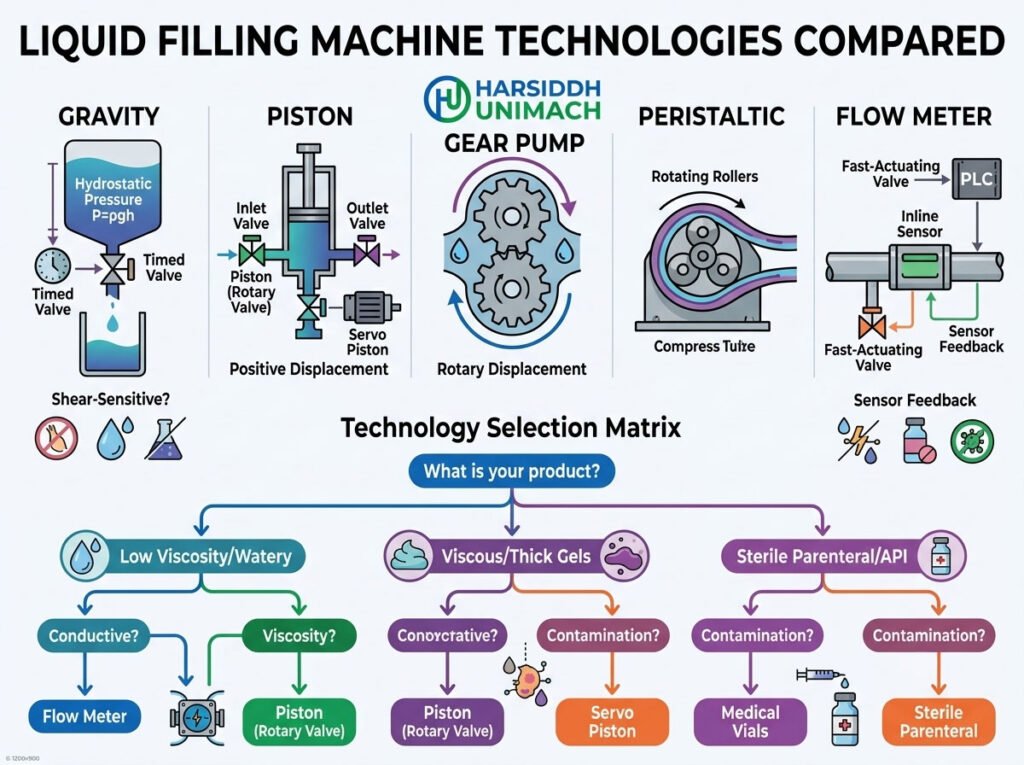
In modern liquid packaging line design, selecting the appropriate dosing mechanism directly impacts fill accuracy, operational uptime, batch repeatability, and overall Cost of Goods Manufactured (COGM). Whether you are packaging low-viscosity pharmaceutical solutions, shear-sensitive active ingredients, dense cosmetics, or aggressive industrial chemicals, deploying the wrong filling head mechanism can lead to product giveaway, container contamination, or regulatory non-compliance under cGMP, FDA, or ISO guidelines.
At Harsiddh Unimach Pvt. Ltd., we have engineered precision liquid processing and filling machinery for over three decades. This comprehensive guide breaks down the fluid dynamics, mechanical structures, operational limits, and best-use scenarios for the five core industrial filling technologies: Gravity, Piston, Gear Pump, Peristaltic, and Flow Meter filling.
1. Core Factors Influencing Liquid Filling Selection
Before evaluating individual filling mechanics, process engineers must analyze six primary fluid dynamic and operational parameters:
                  ┌───────────────────────────────────────────────┐
                  │          FLUID CHARACTERISTICS ANALYSIS       │
                  └───────────────────────┬───────────────────────┘
                                          │
        ┌───────────────────┬─────────────┴─────┬───────────────────┐
        ▼                   ▼                   ▼                   ▼
[ Viscosity Range ]  [ Shear Sensitivity ]  [ Cross-Contamination ] [ Volumetric Accuracy ]
   (cP Rating)       (Delicate API/Enzyme)     (CIP/SIP Needs)       (Target Tolerance)
- Viscosity (Centipoise – cP): Free-flowing fluids like water or solvents (~1–50 cP) behave differently under atmospheric pressure than high-viscosity gels, ointments, or pastes (up to 50,000+ cP).
- Shear Sensitivity: Delicate biological products, proteins, and emulsions can suffer structural breakdown or phase separation when subjected to high-shear mechanical displacement.
- Cross-Contamination Risk: Sterile parenteral or multi-product chemical lines require rapid Clean-in-Place (CIP), Sterilize-in-Place (SIP), or dedicated single-use pathways.
- Target Dosing Accuracy: Depending on container volume, regulatory standards require filling tolerances ranging from ±0.2% to ±1.0%.
- Foaming Tendency & Surface Tension: Surfactants and volatile liquids tend to flash or foam if introduced into containers at high velocities without submerged bottom-up filling needles.
- Particulate Matter: Suspensions containing solid particles require non-clogging valve geometry and durable fluid contact surfaces.
2. Gravity Filling Technology
How It Works
Gravity filling (or constant-head hydrostatic filling) relies on static fluid head to draw product into containers without mechanical pushing or pressurized displacement.
[ Elevated Buffer Tank (Static Head Height: h) ]
                        │
                        ▼
           Hydrostatic Pressure (P = ρ·g·h)
                        │
                        ▼
      [ Timed Solenoid / Pneumatic Pinch Valve ]
                        │
                        ▼
              Container Filling
The liquid product resides in an overhead buffer tank held at a constant liquid height (h). This static head produces predictable hydrostatic pressure (P = ρ × g × h). When a pneumatic valve or timed solenoid opens, liquid flows freely through the filling nozzle into the container beneath. Volume is calculated precisely via time-based actuation (Δt).
Strengths & Key Advantages
- Minimal Mechanical Shear: Because no rotating impellers or pistons compress the fluid, fragile products experience zero mechanical stress.
- Low Initial Capital Expenditure: Simple architecture without complex drives or intricate pump assemblies lowers initial equipment investment.
- Corrosive Chemical Compatibility: Gravity systems easily utilize non-metallic contact parts (PVDF, PTFE, polypropylene), making them suitable for aggressive acids, bleach, and harsh solvents.
Limitations
- Strict Viscosity Ceiling: Ineffective for liquids above ~500 cP; thick fluids flow too slowly under static gravity alone.
- Flow Rate Dependency: Any variance in bulk density (ρ) or buffer tank fluid level alters flow rate, requiring active level-sensing controls to maintain consistent hydrostatic pressure.
3. Piston Filling Technology
How It Works
Piston filling operates via positive volumetric displacement. It utilizes a precision-machined cylinder, a driven piston rod, and a three-way direction control valve (rotary valve or check valve).
   INLET STROKE (Suction)                 DISCHARGE STROKE (Dosing)
 ┌───────────────────────┐              ┌───────────────────────┐
 │ Product Tank ──►      │              │                       │
 │ Cylinder Fills        │              │ Cylinder Discharges ──┼──► Container
 └───────────────────────┘              └───────────────────────┘
During the inlet stroke, the piston retracts inside the cylinder, pulling product from the supply hopper through the intake valve port. During the discharge stroke, the valve rotates to close the supply path and open the discharge port; the piston moves forward, forcefully expelling an exact geometric volume of liquid into the container.
Strengths & Key Advantages
- High Volumetric Precision: Mechanical stroke limiters or closed-loop servo motors achieve dosing tolerances as tight as ±0.25%.
- Extremely High Viscosity Capability: Powerful mechanical displacement easily moves heavy pastes, ointments, creams, and chunky particulates up to 100,000 cP.
- Robust Repeatability: Volumetric delivery remains immune to minor fluid temperature shifts or viscosity fluctuations.
Limitations
- Complex CIP/SIP Disassembly: Internal dynamic seals (O-rings, piston cups) require dedicated dismantling or specialized sanitary valve blocks for thorough cleaning between batches.
- Higher Wear on Abrasive Suspensions: Particles in abrasive slurries can cause micro-scratching along the inner wall of stainless steel cylinders over time.
4. Gear Pump Filling Technology
How It Works
Gear pump filling relies on continuous rotary positive displacement. A set of interlocking gears (external spur gears or internal lobe gears) rotates inside a closely fitted housing.
                  ┌────────────────────────┐
                  │ Liquid Intake Port     │
                  └───────────┬────────────┘
                              ▼
            (  Gear A  ) ◄───   ───► (  Gear B  )
            ( Clockwise)             (Counter-CW)
                              │
                              ▼
                  ┌────────────────────────┐
                  │ Positive Discharge     │
                  └────────────────────────┘
As the gear teeth unmesh on the intake side, they create a partial vacuum that draws liquid into the pump chamber. Fluid travels around the outer perimeter of the housing within the gear pockets. When the teeth remesh on the discharge side, the fluid is squeezed out through the exit port under high pressure.
Strengths & Key Advantages
- Continuous Flow & Variable Fill Volumes: Adjusting fill volume simply requires altering the shaft rotation count via servo motor control, avoiding mechanical component replacements.
- Compact Footprint: High flow capacity relative to pump size allows multi-head filling configurations within compact machine footprints.
- Smooth, Pulse-Free Delivery: Dual-gear engagement delivers steady product flow without the hydraulic pulsing typical of reciprocating pistons.
Limitations
- High Shear Generation: Interlocking gear mesh creates high shear zones, making gear pumps unsuitable for shear-sensitive proteins, live biologics, or cell suspensions.
- Component Wear from Particulates: Solid particulates can jam or erode gear teeth surfaces, causing slip and volumetric accuracy drift over time.
5. Peristaltic Filling Technology
How It Works
Peristaltic filling utilizes external mechanical compression over a flexible elastomeric tube pathway, entirely isolating the fluid inside the tubing assembly.
                  [ Rotating Roller Assembly ]
                              │
        ──► Compression ──► [ Flexible Tubing ] ──► Displacement ──►
                              │
                  [ Curved Outer Pump Housing ]
A rotating rotor equipped with two or more rollers compresses the flexible tube against a curved outer casing. As each roller travels along the tube, it pinches it closed, trapping a discrete pocket of fluid. As the roller releases, the tube expands back to its original shape, drawing more fluid into the vacuum pocket behind it.
Strengths & Key Advantages
- Zero Cross-Contamination Risk: Liquid only contacts the interior surface of the flexible tube, making peristaltic systems ideal for sterile pharmaceutical parenterals, single-use biotech lines, and high-purity APIs.
- Rapid Product Changeover: Changing products requires only replacing or swapping the disposable tubing assembly—eliminating extended CIP validation downtime.
- Low-Shear Hydrodynamics: Gentle peristaltic squeezing preserves delicate molecular structures, delicate suspensions, and shear-sensitive biological products.
Limitations
- Tubing Fatigue & Calibration Drift: Continuous mechanical flexing causes elastomeric tubing to degrade over long shifts, requiring periodic volumetric recalibration.
- Restricted Fill Speeds at High Viscosity: High-viscosity fluids fill slowly due to the limited suction capability of tube wall elasticity during expansion.
6. Flow Meter Filling Technology
How It Works
Flow meter systems continuously monitor fluid mass or volume passing through an inline sensor pipe using Mass Flow (Coriolis) or Magnetic-Inductive (Magmeter) principles, eliminating mechanical moving parts from the fluid stream.
[ Bulk Fluid Supply ] ──► [ Inline Flow Meter Sensor ] ──► [ Fast-Actuating Valve ] ──► Container
                                    │                                 ▲
                                    └──────► [ Real-Time PLC ] ───────┘
                                              Calculates Mass/Volume
- Coriolis Mass Flow Meters: Fluid flows through vibrating tubes inside the sensor. Liquid mass creates a phase shift in tube vibration proportional to mass flow rate.
- Magnetic-Inductive Flow Meters: Conductive fluid passes through a magnetic field generated by the meter. The fluid generates a voltage proportional to flow velocity (Faraday’s Law of Electromagnetic Induction).
A programmable logic controller (PLC) processes real-time signal data from the flow sensor, closing the downstream shut-off valve as soon as the target fill mass or volume is reached.
Strengths & Key Advantages
- No Moving Parts in Fluid Path: Ultra-hygienic flow path allows rapid, non-disassembly Clean-in-Place (CIP) and Sterilize-in-Place (SIP) cycles.
- Density & Temperature Auto-Correction: Coriolis mass meters measure true weight/mass directly, automatically compensating for variations in product density, aeration, or ambient temperature.
- Instant Digital Volume Adjustments: Operators can change batch fill volumes instantly on the HMI interface without mechanical tool changes.
Limitations
- Higher Initial Capital Expenditure: Coriolis flow meters and fast-acting sanitary control valves carry higher upfront hardware costs.
- Minimum Conductivity/Flow Requirements: Magnetic flow meters require conductive liquids (20 µS/cm), while Coriolis meters require full liquid pipe priming without excessive air pockets.
7. Comparative Technology Matrix
| Parameter | Gravity Filling | Piston Filling | Gear Pump Filling | Peristaltic Filling | Flow Meter Filling |
| Primary Mechanism | Hydrostatic Pressure | Volumetric Piston Stroke | Rotary Positive Gear | Peristaltic Tube Compression | Mass/Volumetric Sensor Feedback |
| Viscosity Capabilities | Low (1–500 cP) | Very High (1–100,000+ cP) | Medium (1–10,000 cP) | Low to Medium (1–2,000 cP) | Low to High (1–25,000 cP) |
| Dosing Accuracy | ±0.5%–1.0% | ±0.25%–0.5% | ±0.5%–1.0% | ±0.5% | Up to ±0.1%–0.2% |
| Product Shear | Extremely Low | Moderate | High | Very Low | Extremely Low |
| CIP/SIP Feasibility | Simple / Standard | Complex (Requires Disassembly) | Moderate | Disposable / Single-Use | Superior (Smooth Pipe Path) |
| Particulate Tolerance | Poor | Excellent (Rotary Valves) | Poor (Gears May Jam) | Fair | Good (Coriolis / Magmeter) |
| Capital Cost Range | Economical | Moderate to High | Moderate | Moderate | High |
8. Technology Selection Matrix: Matching Your Liquid Formulation
                               ┌────────────────────────────────┐
                               │  What is your liquid product?  │
                               └───────────────┬────────────────┘
                                               │
           ┌───────────────────────────────────┼───────────────────────────────────┐
           ▼                                   ▼                                   ▼
[ Low Viscosity / Watery ]            [ Viscous / Thick Gels ]            [ Sterile Parenteral / API ]
           │                                   │                                   │
   Is it conductive or                Does it contain particulate         Is cross-contamination
   density-sensitive?                 matter or chunks?                   the main concern?
 ├─ YES ──► FLOW METER              ├─ YES ──► PISTON (ROTARY VALVE)     ├─ YES ──► PERISTALTIC
 └─ NO  ──► GRAVITY / TIMED PINCH    └─ NO  ──► GEAR PUMP / PISTON        └─ NO  ──► SERVO PISTON
1. Sterile Pharmaceuticals & Biological Parenterals
- Recommended Technology: Peristaltic or Servo-Driven Volumetric Piston (SS 316L).
- Why: Peristaltic pumps maintain complete fluid isolation within single-use tubing manifolds, preventing cross-batch contamination and simplifying regulatory cleanroom validation.
2. High-Viscosity Creams, Syrups, and Industrial Pastes
- Recommended Technology: Servo Piston Fillers with Rotary Valve Blocks.
- Why: Positive displacement forces high-density creams, ointments, and suspended slurries through discharge nozzles without cavitating or choking.
3. High-Value Chemicals, Flavors, and Density-Variable Liquids
- Recommended Technology: Coriolis Mass Flow Meter Fillers.
- Why: Real-time mass calculation compensates for density shifts caused by temperature fluctuations during production runs, preventing product giveaway.
9. Engineering Solutions by Harsiddh Unimach Pvt. Ltd.
At Harsiddh Unimach Pvt. Ltd., we manufacture customized, high-speed cGMP-compliant liquid packaging lines configured with the exact dosing tech your product requires.
[ Infeed Rotary Table ] ──► [ Bottle Washing/Air Jet ] ──► [ Dosing Station (Piston/Peristaltic/Flow) ] ──► [ Capping & Labeling ]
Our Core Manufacturing Capabilities
- Servo-Driven Dosing Technology: Replaces mechanical drive cams with independent servo motors for precise volume calibration via an HMI touchscreen interface.
- cGMP Stainless Steel Construction: Contact parts built from certified SS 316L stainless steel with Hastelloy, PTFE, or PVDF options for specialized chemical applications.
- No Container – No Fill Protection: Integrated optical sensors verify container placement before firing dosing valves, eliminating fluid spills and line contamination.
- Turnkey Packaging Integration: Seamless synchronization between filling, stoppering, capping, induction sealing, and high-speed labeling machinery.
Frequently Asked Questions (FAQ)
Which liquid filling technology offers the highest dosing accuracy?
Coriolis Mass Flow Meter and Servo-Driven Volumetric Piston filling systems offer the highest dosing accuracy, routinely achieving precision down to ±0.1%–±0.25%, depending on fluid dynamic stability and container volume.
Why are peristaltic filling machines preferred in sterile pharmaceutical filling?
Peristaltic fillers enclose the product entirely within disposable fluid tubing. Because no liquid touches metallic pump bodies, internal seals, or rotary shafts, the risk of cross-contamination is eliminated, simplifying cGMP validation.
Can gear pumps handle liquids containing solid particles or abrasives?
No. Solid particles can scratch, jam, or wear down interlocking gear teeth. Piston fillers equipped with rotary valve passages or flow meter systems are far better suited for particulate-laden suspensions.
Optimize Your Liquid Packaging Line with Harsiddh Unimach
Selecting the right liquid filling technology requires matching your fluid dynamics, line speed targets, and sanitary standards with the correct mechanical displacement method. Whether you need single-use peristaltic filling for sterile vials, servo-driven piston machinery for thick suspensions, or mass flow meter filling for large volumes, Harsiddh Unimach Pvt. Ltd. engineers tailored packaging machinery built for long-term repeatability.
Consult our engineering team or request a customized equipment evaluation today at www.harsiddhunimach.com.
- Website: www.harsiddhunimach.com
- Direct Email Inquiry: info@harsiddhunimach.com
- Core Solutions: Automatic Liquid Filling Machinery, Sterile Ampoule & Vial Packaging Lines, Capping Systems, and cGMP Turnkey Processing Plants.