
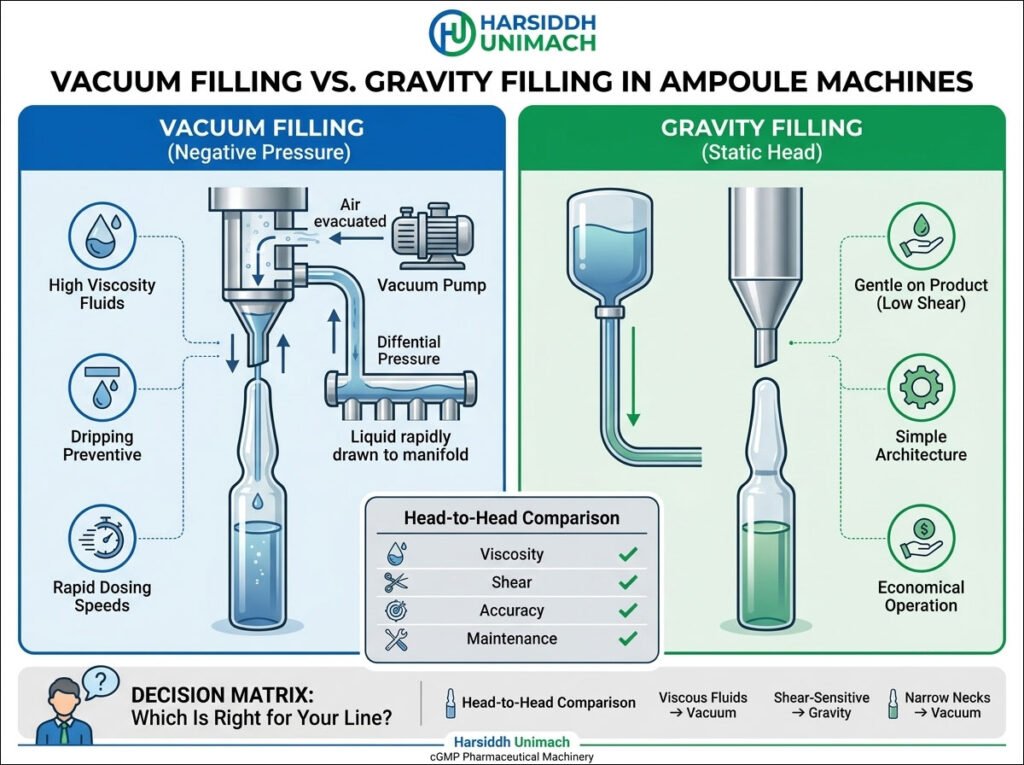
In small-volume parenteral (SVP) packaging, selecting the correct liquid dispensing technology can mean the difference between regulatory compliance and costly batch recalls. Glass ampoules are widely used for sterile, single-dose liquid injectables, sensitive serums, and volatile liquid formulations. However, optimizing your production line requires a clear understanding of the mechanical differences between Vacuum Filling and Gravity Filling mechanisms.
At Harsiddh Unimach Pvt. Ltd., we have spent over three decades engineering cGMP-compliant pharmaceutical machinery. This technical guide evaluates the core mechanics, advantages, limitation profiles, and ideal applications of vacuum and gravity filling principles for glass ampoules.
1. Understanding Ampoule Filling Mechanics
Glass ampoules differ fundamentally from standard vials and bottles. Their narrow necks, fragile borosilicate glass construction, and hermetic flame-sealing requirements create unique fluid dynamic challenges.
A successful ampoule filling process must achieve:
- Micro-level volumetric precision (often within ±0.5%).
- Zero neck contamination, which causes black spots or structural defects during the flame-sealing process.
- Strict oxygen control via pre- and post-nitrogen gas flushing.
- High operational speed without splashback or foaming.
Both vacuum and gravity filling systems aim to fulfill these criteria, but they employ opposite physical principles to manage fluid displacement.
2. What Is Vacuum Filling?
How It Works
Vacuum filling (also referred to as negative pressure filling) uses pressure differential rather than mechanical pushing or raw gravity.
[ Vacuum Pump / Venturi System ]
             │
             ▼
   Lowers Pressure in Ampoule Neck
             │
             ▼
   Creates Differential Pressure ($\Delta P$)
             │
             ▼
   Liquid Drawn Rapidly from Manifold
In an automated vacuum ampoule filling machine, a sealed nozzle lowers over the open ampoule mouth. The system evacuates air from inside the container, establishing a low-pressure zone. Fluid from an atmospheric reservoir is drawn rapidly into the evacuated space until the equilibrium level or programmed volumetric setpoint is reached.
Key Technical Advantages
- Superior Handling of Viscous Liquids: Vacuum differential easily pulls medium-to-high viscosity solutions, syrups, and suspensions into narrow-neck containers without clogging.
- Prevents Dripping & Neck Wetting: The constant negative pressure gradient draws residual drops inward toward the fluid column, minimizing liquid contact with the upper glass neck.
- Rapid Dosing Speeds: By artificially increasing the pressure gradient (ΔP), liquid displacement occurs faster than relying on natural kinetic forces.
3. What Is Gravity Filling?
How It Works
Gravity filling (or constant-head volumetric pressure filling) relies on static hydrostatic pressure.
[ Overhead Fluid Reservoir (Static Head) ]
             │
             ▼
   Hydrostatic Pressure ($P = \rho \cdot g \cdot h$)
             │
             ▼
   Solenoid/Piston Nozzle Opens
             │
             ▼
   Free-Flowing Filling into Ampoule
The liquid product is held in an overhead batch tank at a calibrated height (h) above the filling needles. When the dosing valve opens, gravity pulls the liquid through the nozzle into the ampoule. Precise volume is regulated either by timed-flow valves or through synchronized positive displacement auxiliary pumps (such as volumetric pistons or peristaltic drives).
Key Technical Advantages
- Gentle Fluid Dynamics: Because the liquid flows naturally without high pressure drops or vacuum shear, shear-sensitive biologics and delicate proteins remain intact.
- Simplified Mechanical Architecture: Systems relying on gravity or static volumetric head feature fewer pressure seals and vacuum manifolds, lowering maintenance complexity.
- Economical Operation: Eliminating continuous vacuum pumps reduces utility consumption and initial capital expenditure.
4. Head-to-Head Comparison: Vacuum vs. Gravity Filling
| Operational Parameter | Vacuum Filling Systems | Gravity / Volumetric Filling Systems |
| Primary Force | Differential Negative Pressure (ΔP) | Hydrostatic Pressure (P = rho × g × h) and Gravity |
| Viscosity Limit | High (handles thick liquids, oils, syrups) | Low to Moderate (free-flowing aqueous solutions) |
| Dosing Accuracy | High (±0.5% to ±1.0%) | High when paired with Servo Pistons (±0.5%) |
| Shear Stress on Product | Moderate to High | Low (gentle, shear-free handling) |
| Foaming Potential | Moderate (requires vacuum modulation) | Low (can be controlled with submerged bottom-up fill) |
| Neck Contamination Risk | Extremely Low (vacuum draws droplets inward) | Low to Moderate (requires precise needle retraction) |
| Maintenance & Cleaning | Requires vacuum manifold sterilization | Simple sanitary CIP/SIP design pathways |
5. Decision Matrix: Which Filling Mechanism Does Your Line Need?
Choosing between vacuum and gravity/volumetric filling depends on product formulation, batch volume, and container geometry.
                    ┌───────────────────────────────┐
                    │  What is your fluid type?     │
                    └───────────────┬───────────────┘
                                    │
            ┌───────────────────────┴───────────────────────┐
            ▼                                               ▼
  [ Low Viscosity / Aqueous ]                    [ Viscous / Thick Liquids ]
            │                                               │
            ▼                                               ▼
Does it contain shear-sensitive               Is narrow-neck wetting a critical
proteins or foaming agents?                   sealing concern?
      ├─ YES ──► GRAVITY / VOLUMETRIC METRIC        ├─ YES ──► VACUUM FILLING
      └─ NO  ──► BOTH APPLICABLE                    └─ NO  ──► SERVO-PISTON FILLING
Choose Vacuum Filling If:
- You process high-viscosity formulations: Oils, concentrated syrups, or dense parenteral solutions struggle to flow through 1mm–3mm ampoule necks under gravity alone.
- Burn-mark defects are high during sealing: If product droplets linger in the ampoule neck, the flame-sealing burner creates black carbonized spots that compromise batch sterility. Vacuum pulls residual droplets down into the main fluid volume.
- Container neck diameter is restrictive: Ampoules ranging from 1 ml to 5 ml feature narrow stems where trapped air bubbles impede gravity flow. Vacuum evacuation removes air blockages prior to fluid entry.
Choose Gravity / Volumetric Displacement If:
- You fill delicate biologics or aqueous injectables: Proteins, live vaccines, and shear-sensitive active pharmaceutical ingredients (APIs) can degrade when subjected to sudden pressure drops.
- Formulations foam easily: Under strong vacuum pressure, surfactant-heavy liquids can flash or foam, creating inaccurate volumetric fills.
- Simplicity and lower utility footprint are priorities: Gravity-fed, servo-driven volumetric piston systems eliminate vacuum pumps and exhaust filtration setups, simplifying line validation.
6. Engineering Solutions by Harsiddh Unimach Pvt. Ltd.
At Harsiddh Unimach Pvt. Ltd., we manufacture single-head lab units through high-speed 8-head industrial ampoule processing lines capable of output speeds up to 18,000 ampoules per hour.
[ Infeed Hopper ] ──► [ Nitrogen Pre-Purge ] ──► [ Precision Dosing Station ] ──► [ Nitrogen Post-Purge ] ──► [ Pre-Heating & Flame Seal ]
Key Technical Innovations Across Our Machinery
- Servo-Driven Volumetric Piston Technology: Replaces mechanical cams with independent servo drives, offering digital dosing calibration via an HMI touchscreen with accuracy up to ±0.5%.
- Integrated Nitrogen Flushing: Standard pre- and post-filling inert gas purging replaces atmospheric oxygen with nitrogen, preventing oxidation in sensitive APIs.
- Draw-off Sealing Technology: Uses synchronized LPG/Oxygen burner systems and mechanical grippers to create smooth, rounded ampoule tops.
- “No Ampoule – No Fill” Safety System: Optical proximity sensors detect missing containers at the filling index, immediately signaling the PLC to bypass dosing on that stroke, preventing liquid spillage.
- cGMP Compliance: Standard SS 316L for all product contact parts, SS 304 structural framing, and seamless cleanroom integration capabilities.
Frequently Asked Questions (FAQ)
What is the primary difference between vacuum filling and gravity filling in ampoules?
Vacuum filling uses negative pressure to pull liquid into the container, making it effective for narrow necks and thick liquids. Gravity filling relies on hydrostatic pressure and static fluid weight, providing gentle, shear-free filling for free-flowing aqueous solutions.
How does liquid in the ampoule neck affect the flame-sealing process?
If liquid droplets cling to the inner stem during filling, high-temperature oxygen/LPG sealing flames vaporize the product, leaving black carbonized spots or micro-fissures in the glass. Vacuum filling and bottom-up volumetric needles prevent this issue by keeping the glass stem dry.
Can servo-driven volumetric filling handle both open and closed-mouth ampoules?
Yes. Modern automatic servo-driven systems from Harsiddh Unimach handle both open-neck and closed-mouth glass ampoules. The system automatically opens closed ampoules, purges oxygen, dispenses the product, and flame-seals the neck in a single continuous line.
Upgrade Your Ampoule Packaging Line
Selecting the proper liquid filling principle depends on fluid viscosity, container geometry, and target line speed. Whether your facility requires negative-pressure vacuum fill tech or high-precision servo-controlled volumetric lines, Harsiddh Unimach Pvt. Ltd. engineers tailored machinery for sterile parenteral production.
Explore our full range of ampoule filling, washing, and sealing machinery at www.harsiddhunimach.com.
- Website: www.harsiddhunimach.com
- Direct Email Inquiry: info@harsiddhunimach.com
- Specialization: Automatic Ampoule Filling & Sealing Lines, Vial Filling Machinery, Injectable Dry Powder Equipment, and cGMP Sterile Processing Technology.