
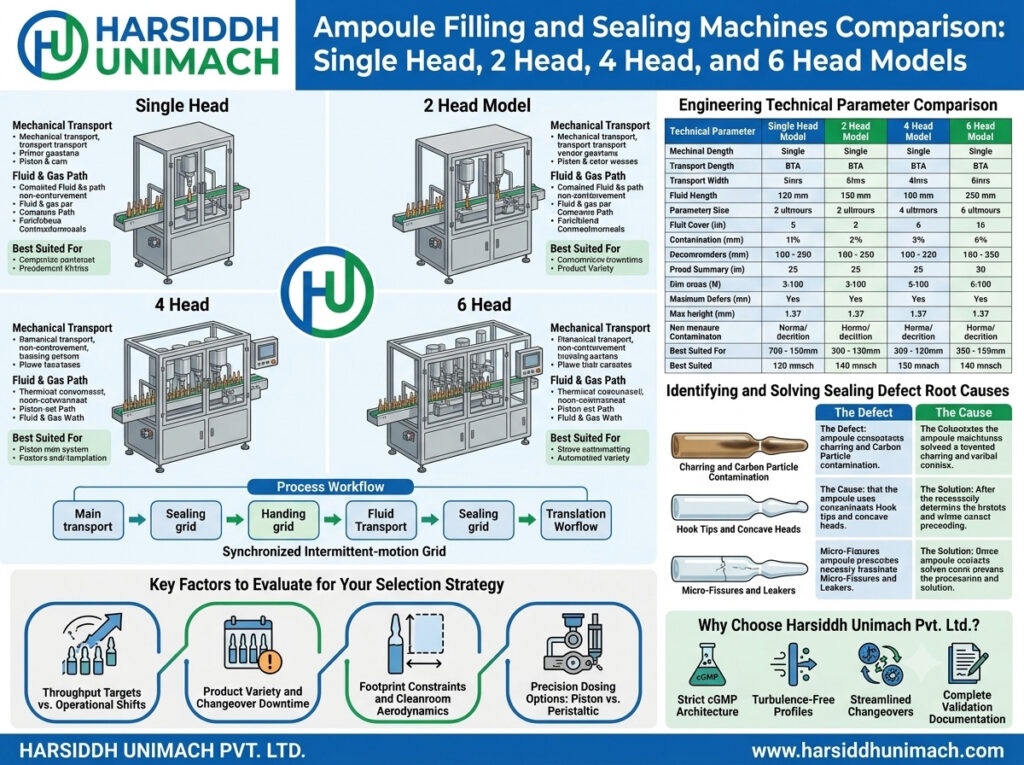
When manufacturers start looking for an ampoule filling and sealing machine, one of the first decisions is how many filling heads they need. Single head, two head, four head and six head machines all work on the same basic principle — filling liquid into glass ampoules and sealing them with a flame — but they differ greatly in output, footprint, investment and the type of production they suit best.
Choosing too small a machine limits growth and creates bottlenecks. Choosing too large a machine ties up capital, takes up valuable cleanroom space and may be inefficient for small batches. This guide compares the four most common configurations side by side and gives you a clear framework for choosing the right one.
If you’d like to understand how these machines work before comparing them, read our ultimate guide to the ampoule filling and sealing machine working principle.
What Does “Number of Heads” Mean?
The number of heads refers to how many ampoules the machine fills and seals at the same time in each machine cycle. A single head machine processes one ampoule per cycle; a six head machine processes six. Each head has its own:
- Filling needle that enters the ampoule neck
- Dosing pump that measures the volume
- Gassing needles for pre- and post-nitrogen purging (where fitted)
- Sealing position with burners and pull-sealing tongs
Because more heads work in parallel, output rises with the number of heads — but so do machine size, complexity and cost.
The Common Working Principle
Regardless of the number of heads, every model follows the same sequence:
- Infeed: sterile ampoules are fed from a hopper or tunnel.
- Transport: a walking beam or rack-and-pinion mechanism moves ampoules forward step by step.
- Pre-gassing: nitrogen displaces air inside the ampoule (for oxygen-sensitive products).
- Filling: needles dive into the ampoules and the pumps dispense the dose.
- Post-gassing: nitrogen protects the headspace.
- Pre-heating and sealing: burners soften the neck while the ampoule rotates, and tongs pull the tip to form a seal.
- Outfeed: sealed ampoules are discharged to a tray for cooling and inspection.
The differences between models lie in how many ampoules pass through each step at once, and in the engineering needed to keep more heads perfectly synchronised.
Quick Comparison Table
| Feature | Single Head | 2 Head | 4 Head | 6 Head |
|---|---|---|---|---|
| Ampoules per cycle | 1 | 2 | 4 | 6 |
| Relative output | Low | Low to medium | Medium | Medium to high |
| Typical use | R&D, pilot, very small batches | Small-scale production | Medium-scale commercial production | Larger commercial production |
| Footprint | Very compact | Compact | Moderate | Larger |
| Investment | Lowest | Low | Moderate | Higher |
| Changeover effort | Minimal | Low | Moderate | Higher (more parts) |
| Line integration | Usually standalone | Standalone or small lines | Standalone or integrated line | Typically integrated line |
| Product loss per setup | Very low | Low | Moderate | Higher |
| Best for | Development and clinical work | Start-ups and niche products | Growing manufacturers | Established high-demand products |
Actual output depends on ampoule size, fill volume, product and sealing conditions. Ask for machine-specific speed data for your application.
Single Head Ampoule Filling and Sealing Machine
Overview
A single head machine fills and seals one ampoule at a time. It is the smallest and simplest configuration, often designed as a compact benchtop or floor-standing unit.
Best applications
- Research and development laboratories
- Formulation development and stability batches
- Clinical trial supplies
- Very small commercial batches of niche or high-value products
- Training and process development
Advantages
- Lowest investment and operating cost
- Minimal floor space — fits easily into small cleanrooms or laboratories
- Very low product loss during setup, which is valuable when product is scarce or expensive
- Simple operation and quick changeover
Limitations
- Limited output, unsuitable for routine commercial volumes
- Usually not integrated with automatic washing and sterilising equipment
Examples include the Automatic Single Head Ampoule Filling & Sealing Machine and our single head ampoule filling and sealing machine. For more on compact machines, read about the working principle of a small-scale ampoule filling and sealing machine.
2 Head Ampoule Filling and Sealing Machine
Overview
A two head machine fills and seals two ampoules per cycle, effectively doubling the throughput of a single head model while remaining compact and affordable.
Best applications
- Start-up injectable manufacturers
- Small-scale commercial production
- Contract manufacturers handling small orders
- Hospital or institutional production units
- Products with modest annual demand
Advantages
- Meaningful step up in output from single head machines
- Compact design with manageable investment
- Easy to operate and maintain
- Suitable for both pilot and small commercial batches
Limitations
- Output may become a bottleneck as demand grows
- Less suited to high-volume products
See the Automatic Two Head Ampoule Filling & Sealing Machine and our two head ampoule filling and sealing machine.
4 Head Ampoule Filling and Sealing Machine
Overview
The four head machine is one of the most popular configurations in the pharmaceutical industry. It balances good output with reasonable investment and footprint, making it the workhorse of many injectable plants.
Best applications
- Medium-scale commercial production
- Generic injectable manufacturers
- Plants producing several products in moderate volumes
- Integration with automatic washing and sterilising equipment
Advantages
- Strong output for most commercial requirements
- Can run standalone or as part of an integrated ampoule line
- Good balance between capacity, cost and flexibility
- Widely proven design with readily available spare parts
Limitations
- Larger footprint and more change parts than smaller models
- Changeovers take somewhat longer because there are more heads to set up
See the Automatic Four Head Ampoule Filling & Sealing Machine and our four head ampoule filling and sealing machine.
6 Head Ampoule Filling and Sealing Machine
Overview
A six head machine fills and seals six ampoules per cycle, delivering high output for established products with strong, steady demand.
Best applications
- Large commercial production of high-demand injectables
- Manufacturers supplying tenders, institutional markets or exports
- Integrated lines with automatic washers and sterilising tunnels
- Plants consolidating production onto fewer, faster machines
Advantages
- High output from a single machine
- Lower labour cost per ampoule
- Well suited to integrated, automated lines
- Supports long production runs efficiently
Limitations
- Higher investment and larger footprint
- More heads to calibrate, set up and maintain
- Changeovers and setup losses are larger, so it is less economical for very small batches
See the Automatic Six Head Ampoule Filling & Sealing Machine and our six head ampoule filling and sealing machine.
What About 8 Head Machines?
For the highest volumes, eight head machines go one step further, often running as part of a fully integrated line. They suit large manufacturers with very high, consistent demand. Learn more in our article on why choose an automatic eight head ampoule filling and sealing machine, and see our eight head ampoule filling and sealing machine.
Open vs Closed Ampoule Versions
Each configuration is available for open (funnel-type) ampoules and for closed ampoules, which arrive sealed from the glass manufacturer and must be opened by the machine before filling. Closed ampoule machines include an extra tip-opening station that heats, cuts and removes the tip, with suction to remove glass fragments.
- Open ampoules: browse our ampoule filling machines for open ampoules.
- Closed ampoules: see the single head closed ampoule filling and sealing machine, the two head closed ampoule filling and sealing machine and the six head closed ampoule filling and sealing machine.
Features That Matter on Every Model
Whatever the number of heads, look for:
- Accurate dosing – piston, servo or peristaltic pumps with easy volume adjustment
- Diving needles – to keep the ampoule neck dry and prevent charred tips
- Nitrogen purging – before and after filling for oxygen-sensitive products
- Pull sealing – for strong, uniform seals
- Stable gas control – regulators and flow meters for fuel gas and oxygen
- No-ampoule-no-fill – to prevent spillage
- Quick changeover – clearly identified change parts for each ampoule size
- GMP construction – SS 316L contact parts and easy-to-clean surfaces
- Documentation – IQ/OQ support and calibration certificates
How to Choose the Right Number of Heads
1. Calculate your required output
Start with annual demand, divide by your planned operating hours and allow for realistic efficiency (changeovers, cleaning and breaks). This gives the number of ampoules per minute you actually need. Then add a margin for growth.
2. Consider batch sizes
Many small batches favour smaller machines with quick changeovers and low setup losses. Long runs of the same product favour machines with more heads.
3. Assess product value
For very expensive products, setup and line losses matter. Smaller machines or those with minimal hold-up volume reduce waste.
4. Check available space
Larger machines need more cleanroom space and may require integration with washers and tunnels. Make sure your facility layout can accommodate them.
5. Plan for integration
If you plan an integrated line with automatic washing and sterilisation, four head and six head machines are typically the most practical choices.
6. Think about the future
A machine that runs at full capacity on day one leaves no room for growth. Many manufacturers start with a two or four head machine and add a higher-output model as demand grows, keeping the smaller machine for small batches and development work.
For broader guidance, read how to choose the right ampoule filling machine.
Operating Cost and Maintenance Differences
Beyond the purchase price, the number of heads affects day-to-day running costs:
- Gas consumption: more sealing positions mean more burners, increasing fuel gas and oxygen use — although consumption per ampoule is often lower on larger machines.
- Nitrogen use: rises with the number of gassing needles.
- Spare parts: each head adds pumps, seals, needles and tongs that wear and need replacement.
- Calibration: every pump must be calibrated and checked for fill accuracy, so multi-head machines need more verification time.
- Labour: larger machines produce more ampoules per operator, reducing labour cost per unit.
Factoring these into your decision gives a more accurate picture of total cost of ownership.
Example Scenarios
- A university or R&D centre developing new formulations: a single head machine gives flexibility with minimal product use.
- A new injectable unit producing a few generic products: a two head machine offers an affordable start.
- A growing generic manufacturer with multiple products in moderate volumes: a four head machine balances capacity and flexibility.
- An established manufacturer supplying large tenders: a six head machine on an integrated line maximises output and efficiency.
Frequently Asked Questions
What is the difference between single head and multi-head ampoule filling machines? A single head machine fills and seals one ampoule per cycle, while multi-head machines process several at once, increasing output.
Which ampoule filling machine is best for small production? Single head machines suit R&D and very small batches, while two head machines suit small-scale commercial production.
Is a 4 head or 6 head machine better? It depends on demand. Four head machines suit medium production with more product variety, while six head machines suit higher, steadier volumes.
Can these machines handle different ampoule sizes? Yes. With the appropriate change parts, most models handle a range of ampoule sizes, typically from 1 ml to 20 ml depending on the design.
Are closed ampoule versions available? Yes. Closed ampoule machines include an additional station to open the ampoule tip before filling and resealing.
Not sure which model is right for your plant? Browse our ampoule filling machine range, contact our team or send an inquiry to discuss your requirements.