
Before a single drop of injectable product touches a vial, that vial must be free of glass particles, dust, fibres and any residue from manufacturing and transport. Vial washing is the first critical step in sterile production — and if it fails, nothing that follows can fully correct it. Particles that survive washing can end up in the final product and be found at inspection, or worse, reach the patient.
Two machine designs dominate this task: the rotary vial washing machine and the linear vial washing machine. Both clean vials inside and out with alternating jets of water and air, and both are proven across the pharmaceutical industry. But they differ in how vials move, how washing stations are arranged, how much floor space they need, how fast they run and how they connect to the rest of the line.
This article takes an engineering view of both designs — looking inside each machine, comparing them parameter by parameter and showing how to select the right one. If you want a shorter overview focused on sterile production decisions, see our companion article on which vial washer is better for sterile production.
What a Vial Washing Machine Must Achieve
Whatever the design, every vial washer must:
- Remove particles and contaminants from inside and outside the vial.
- Rinse with water of the right quality, typically finishing with Water for Injection (WFI) or purified water depending on the process.
- Remove residual water with filtered compressed air so vials enter the sterilising tunnel as dry as possible.
- Handle vials gently to avoid scratches, chipping and breakage, which create new particles.
- Deliver vials in an orderly flow to the depyrogenation tunnel.
- Use utilities efficiently, recycling water where the process allows.
A typical washing sequence alternates media: recirculated water, compressed air, fresh purified water or WFI, and a final air blow. Our guide to the sterile container washing process explains this sequence in detail.
How a Rotary Vial Washing Machine Works
Design principle
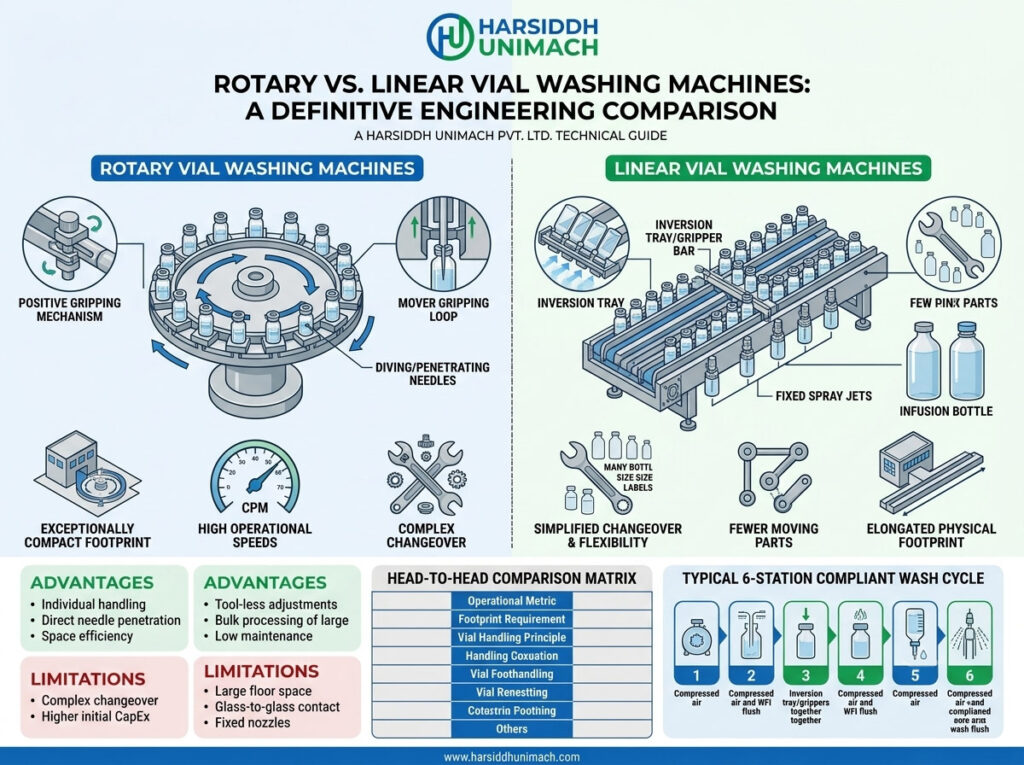
In a rotary vial washer, vials travel in a circular path. They are fed from an infeed turntable or conveyor into a star wheel or infeed worm, which positions them into grippers mounted on a rotating platform. The grippers invert each vial so its mouth faces downward.
A set of washing needles is mounted beneath the inverted vials and moves with the platform. As the platform rotates, the needles rise into the vials and deliver internal jets of water and air, while external spray nozzles clean the outside. Each vial passes through the sequence of washing stations — water, air, water, air — as it travels around the circle. Finally, the grippers return the vial upright and release it onto the outfeed.
Engineering characteristics
- Continuous motion: the platform rotates smoothly rather than stopping and starting, which reduces shocks to the vials.
- Individual gripping: each vial is held by its own gripper, giving precise control over position and inversion.
- Compact footprint: stations are arranged around a circle, so the machine occupies less floor area.
- Central drive: a single main drive synchronises the platform, needles and grippers mechanically or by servo.
Example machines include the Automatic Rotary Vial Washing Machine and our rotary vial washing machine.
Strengths
- Space-saving layout, ideal for compact cleanrooms
- Gentle, continuous handling
- Lower investment for small to medium outputs
- Simple, robust mechanical design
Limitations
- Output is limited by the number of grippers and platform size
- Fewer washing stations can fit around the circle
- Large vial sizes can be harder to accommodate in a compact rotary design
How a Linear Vial Washing Machine Works
Design principle
In a linear vial washer, vials move along a straight path through a series of washing stations arranged in a line. Vials are typically fed from an infeed conveyor and, in many designs, first pass through an ultrasonic bath, where high-frequency sound waves dislodge tightly attached particles from glass surfaces.
The vials are then picked up in rows — often by a gripper system or a walking-beam mechanism — inverted and moved step by step through successive internal and external washing stations. Needles enter the vials at each station to deliver water and air jets. After the final air blow, the vials are returned upright and transferred, usually directly, into the infeed of the sterilising tunnel.
Some linear washers are built as tunnel type machines, where washing occurs in an enclosed tunnel-like structure leading straight into the depyrogenation tunnel for a seamless transfer.
Engineering characteristics
- Row-wise processing: many vials are washed simultaneously in each station, increasing throughput.
- Intermittent motion: vials index forward from station to station, allowing precise needle entry and dwell time.
- Modular stations: additional washing stations can be added along the line.
- Direct tunnel integration: the straight outfeed aligns naturally with the tunnel infeed.
Examples include the Automatic Linear Tunnel Type Vial Washing Machine, the Automatic Linear Vial Washer, our linear vial washing machine and the linear vial washer. For a step-by-step look inside, read the definitive guide to the automatic linear vial washer process flow.
Strengths
- Higher output for medium and high-volume production
- More washing stations and longer contact time per vial
- Easy integration of ultrasonic cleaning
- Straight-line connection to the sterilising tunnel
- Well suited to a wide range of vial sizes
Limitations
- Larger footprint, requiring more cleanroom space
- Higher investment than a comparable rotary machine
- More complex mechanics, especially for row handling
Rotary vs Linear: Engineering Comparison
| Parameter | Rotary Vial Washer | Linear Vial Washer |
|---|---|---|
| Vial movement | Circular, continuous | Straight line, indexed in rows |
| Vial handling | Individual grippers | Row grippers or walking beam |
| Output range | Small to medium | Medium to high |
| Floor space | Compact | Longer, larger footprint |
| Number of washing stations | Limited by circumference | Expandable along the line |
| Ultrasonic pre-cleaning | Optional, less common | Commonly integrated |
| Contact time per station | Shorter | Longer, controllable dwell |
| Tunnel integration | Requires transfer arrangement | Direct, straight-line infeed |
| Changeover | Change grippers, star wheels, guides | Change row grippers, guides, needle sets |
| Investment | Lower | Higher |
| Best fit | Small plants, pilot lines, limited space | Commercial lines, high output |
Key Engineering Parameters to Evaluate
1. Washing efficiency and validation
Washing performance is validated by particle challenge tests, which show that the machine reduces particles to acceptable levels. Important factors include needle design and penetration depth, jet pressure, flow rate, water temperature, number of stations and contact time. Linear machines generally offer more flexibility to add stations and dwell time; rotary machines achieve good results within a compact cycle.
2. Water and air quality
Final rinses must use water of the specified quality, usually WFI for parenteral products. Compressed air used inside vials must be oil-free and filtered through sterile-grade filters. Pressure regulators and flow monitoring for each medium help keep the process consistent.
3. Water consumption and recycling
Water is a significant operating cost. Both designs can recirculate water from the final rinse for use in early washing stations, with filtration in the recirculation loop. Linear machines with ultrasonic baths may use larger water volumes, but good design minimises consumption. Ask suppliers for consumption figures per hour at your rated output.
4. External washing
Vial exteriors also carry particles that can be transferred into cleanrooms. Both machine types include external spray nozzles, and standalone external washers are available for separate processes — for example, the Automatic Vial External Washing Machine and our automatic external vial washing machine, which clean filled and sealed vials before labelling.
5. Vial size range and changeover
List all vial sizes you will run. Rotary machines need matching grippers, star wheels and guides for each size; linear machines need row grippers, guides and possibly needle adjustments. The faster and more repeatable the changeover, the more productive the line.
6. Breakage and glass handling
Glass-to-glass and glass-to-metal contact must be minimised. Look for smooth transfers, correctly designed grippers, synchronised motion and sensors that stop the machine if a vial falls or jams.
7. Materials and hygiene
Product-contact and water-contact parts should be SS 316L, with smooth, polished surfaces and good drainage. Frames are typically SS 304. Designs that allow easy access for cleaning and inspection reduce maintenance time.
8. Controls and documentation
PLC and HMI controls with recipe management, alarms for low pressure or flow, and batch reporting simplify operation and support GMP compliance. Full IQ/OQ documentation is essential for validation.
Maintenance Considerations
Long-term washing performance depends on disciplined maintenance, and the two designs have different priorities:
- Needles and nozzles: on both machines, bent or partially blocked needles reduce cleaning efficiency. Inspect them at every changeover and replace damaged ones immediately.
- Filters: recirculation, water and air filters must be monitored and replaced on schedule, since a clogged filter lowers jet pressure and can introduce particles.
- Grippers and transfer parts: rotary machines rely on many individual grippers, so worn gripper pads must be checked regularly. Linear machines need attention to row grippers, walking beams and their guides.
- Ultrasonic bath: on linear machines, transducers and bath water quality must be checked, and the bath drained and cleaned at defined intervals.
- Seals and valves: solenoid valves and seals on water and air lines wear over time and can cause pressure drops or leaks.
A preventive maintenance plan based on running hours, supported by an adequate stock of critical spares, keeps either machine performing at its validated state.
Integration with the Rest of the Vial Line
A vial washer is the first step in an integrated sterile line:
- Vial washing – rotary or linear washer.
- Depyrogenation – a sterilizing tunnel for ampoules and vials dries, sterilises and cools vials.
- Filling and stoppering – for example, a liquid vial filling machine with rubber stoppering.
- Capping, inspection and labelling.
The washer’s output must match the tunnel’s capacity and the filler’s speed. Linear washers usually align directly with the tunnel; rotary washers need a well-designed transfer. For compact plants, an integrated system such as our automatic liquid vial filling line (compact line) combines washing, sterilising, filling and sealing into one coordinated solution.
How to Choose: A Practical Decision Guide
Choose a rotary vial washer if: – Your output requirement is small to medium – Cleanroom space is limited – You run pilot, clinical or small commercial batches – Budget is a key constraint
Choose a linear vial washer if: – You need medium to high output – You want ultrasonic cleaning and more washing stations – You plan a high-speed, fully integrated line with direct tunnel infeed – You handle a wide range of vial sizes
Our guide on how to select the right pharmaceutical washing machine for your plant offers further selection criteria. You can also browse our washing machine category, the full range of vial washing machines and all washing machines on Harsiddh Engineering.
Frequently Asked Questions
What is the main difference between rotary and linear vial washing machines? Rotary washers move vials in a circular, continuous path using individual grippers, while linear washers move vials in rows along a straight line through sequential stations.
Which vial washer gives higher output? Linear vial washers generally offer higher output because they process vials in rows and allow more washing stations.
Do vial washers use ultrasonic cleaning? Many linear vial washers include an ultrasonic bath to loosen particles before jet washing. It is less common on rotary machines.
Which washer is better for small plants? Rotary vial washers are often preferred for small plants and pilot lines because of their compact footprint and lower investment.
What water is used for vial washing? Washing typically uses recirculated and purified water in early stations and WFI for final rinses on parenteral lines, followed by filtered compressed air.
Need help choosing between a rotary and a linear vial washer? Contact our team or send an inquiry to discuss your requirements.