
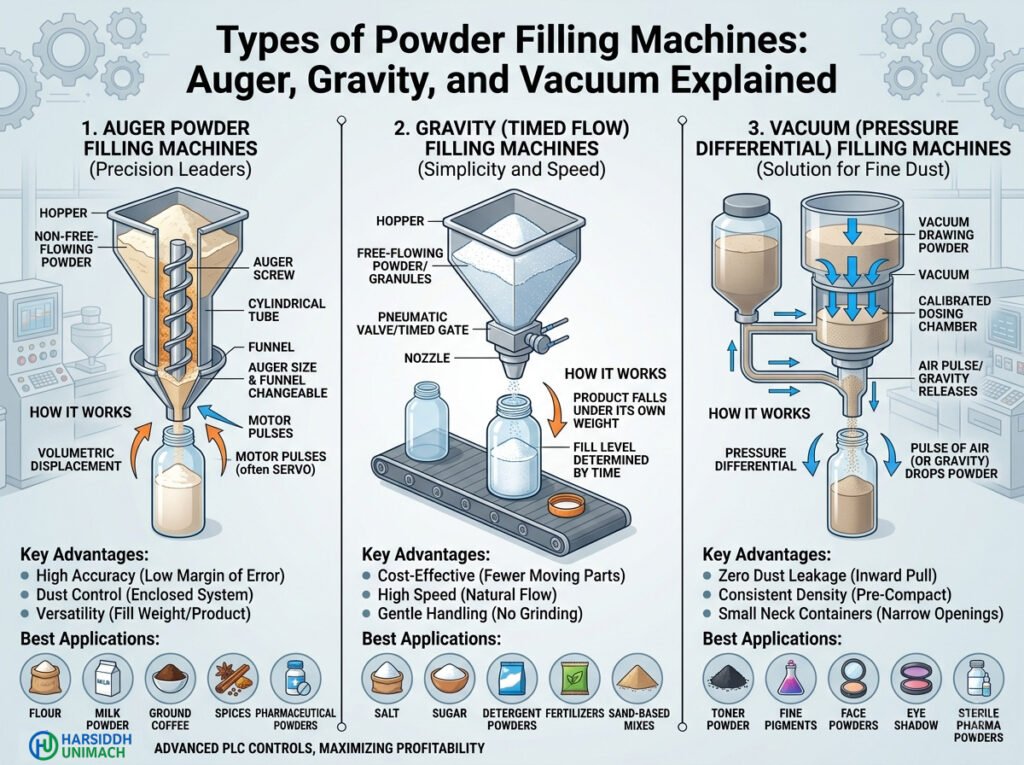
No two powders behave the same way. Sugar pours like sand, milk powder clings and bridges, antibiotic powders are fine and sterile, and detergent granules are coarse and abrasive. Because of this, there is no single “best” powder filling machine. Instead, manufacturers choose between several filling technologies, each designed to handle certain powders, doses and containers better than others.
The three most widely used technologies are auger filling, gravity filling and vacuum filling. Understanding how each one works — and where it performs best — is the key to accurate dosing, low product loss and a clean, efficient production line.
In this guide, we explain each type in detail, compare them side by side and show you how to choose the right one for your product. If you are new to powder filling, you may want to start with our introduction: what is a powder filling machine and how does it work.
Why the Type of Powder Filler Matters
The filling technology determines:
- Accuracy: how closely each container matches the target weight.
- Product range: which powders the machine can handle reliably.
- Speed: how many containers per minute the machine can fill.
- Dust and cleanliness: how much powder escapes into the environment.
- Cleaning and changeover: how easily the machine can switch between products.
- Compliance: whether the machine suits pharmaceutical, sterile or food-grade production.
Choosing a technology that doesn’t suit your powder leads to weight variation, rejected containers, dust, frequent stoppages and wasted product.
Quick Comparison: Auger vs Gravity vs Vacuum
| Factor | Auger Filler | Gravity Filler | Vacuum Filler |
|---|---|---|---|
| Dosing principle | Rotating screw (volumetric) | Gravity flow into cups or by weight | Vacuum draws powder into dosing chambers |
| Best for | Fine and cohesive powders | Free-flowing powders and granules | Fine, sterile powders and small precise doses |
| Typical uses | Pharma powders, food, supplements | Sugar, salt, granules, dry syrup | Sterile injectable powders in vials |
| Accuracy | High | Moderate to high | Very high for small doses |
| Dust control | Good | Moderate | Excellent |
| Speed | Medium to high | High | Medium to high |
| Complexity | Moderate | Low | Higher |
1. Auger Powder Filling Machines
How auger filling works
An auger filler uses a precisely machined screw (the auger) that rotates inside a vertical tube at the bottom of a hopper. As the auger turns, powder is carried downward between its flights and discharged through the nozzle into the container. Because each revolution moves a predictable volume of powder, the dose is controlled by the number of revolutions — usually counted precisely by a servo motor.
Inside the hopper, an agitator keeps the powder moving, breaks up bridges and ensures that the auger flights fill evenly. When the auger stops, the powder’s own cohesion — sometimes supported by a disc or screen at the nozzle — prevents dribbling.
Key features
- Interchangeable augers: different diameters and pitches are fitted for different dose ranges and powder types.
- Servo control: doses are set from the HMI and adjusted in fine increments.
- Single or double heads: double-head machines nearly double output on the same footprint.
- Container handling: inline conveyors for bottles and jars, or turntables for smaller batches.
- Weight feedback: some machines connect to a check-weigher that automatically corrects the auger count to compensate for density changes.
Examples include the Automatic Auger Type Powder Filling Machine and our single and double head auger type powder filling machine.
Best applications
Auger fillers are the most versatile powder filling technology and work well with:
- Pharmaceutical powders and oral powder sachets or bottles
- Protein, nutritional and herbal supplements
- Spices, coffee, cocoa, flour and milk powder
- Cosmetic powders such as talc
- Chemical powders and pigments
Advantages
- Handles both free-flowing and non-free-flowing powders
- Good accuracy across a wide dose range
- Minimal dust, since powder is enclosed until discharge
- Easy dose adjustment and recipe storage
Limitations
- Accuracy depends on consistent powder density
- Augers can wear with abrasive powders and need periodic replacement
- Very coarse or fragile granules may be damaged by the screw
2. Gravity Powder Filling Machines
How gravity filling works
Gravity powder fillers rely on the natural flow of powder under its own weight. There are two main approaches:
Volumetric cup (gravity-fed) fillers: a rotating disc carries a series of measuring cups beneath the hopper. Powder flows into each cup by gravity, and a scraper levels off the excess so each cup holds the same volume. As the disc rotates, the cup moves over the container and opens at the bottom, releasing the dose. Cup volume can be adjusted within a range by telescopic mechanisms.
Gravity net weigh fillers: powder flows by gravity — often assisted by a vibratory feeder — into a weigh bucket or directly into the container on a load cell. A fast “bulk” feed is followed by a slow “dribble” feed, which stops precisely at the target weight.
Rotary machines for dry syrup combine gravity flow with precise volumetric control and high-speed bottle handling. The Automatic Rotary Dry Syrup Powder Filling Machine and our rotary dry syrup powder filling machine are designed for this application. See our full dry syrup powder filling machine range.
Best applications
- Free-flowing granules and crystalline powders such as sugar, salt and granulated products
- Pharmaceutical dry syrup powders into bottles
- Detergent powders, seeds, grains and fertilisers
- Larger packs where weight accuracy is critical (net weigh)
Advantages
- Simple, robust and economical design
- High speed for free-flowing products
- Gentle on granules — no mechanical shearing
- Net weigh versions deliver excellent weight accuracy regardless of density
Limitations
- Not suitable for cohesive, sticky or poorly flowing powders, which can bridge or block cups
- Cup fillers are sensitive to density variation
- Fine powders can create more dust at discharge
3. Vacuum Powder Filling Machines
How vacuum filling works
Vacuum powder filling is the standard technology for sterile dry powder injections filled into glass vials. The heart of the machine is a powder wheel — a rotating drum with precisely sized dosing bores around its circumference. Each bore has a fine filter at its base.
The process works like this:
- Filling: as a bore rotates beneath the powder hopper, vacuum is applied through the filter, pulling powder into the bore and compacting it to a uniform density.
- Levelling: a doctor blade scrapes excess powder away so the dose equals the bore volume exactly.
- Transfer: the wheel rotates until the bore points downward over a vial, with vacuum maintained to hold the powder in place.
- Discharge: vacuum is released and a gentle pulse of sterile filtered air (or nitrogen) pushes the dose into the vial.
- Stoppering: the vial moves immediately to the stoppering station, where a rubber stopper is inserted.
Dose volume is adjusted by changing the bore depth, using adjustable pistons inside each bore. Because the powder is compacted under controlled vacuum, the method delivers consistent doses even for very fine powders and small fill weights.
The concept is also used in some vacuum fillers for non-sterile fine powders, where vacuum pulls powder into a dosing chamber or directly into the container to reduce aeration and dust.
Single wheel, double wheel and servo machines
- Single wheel machines suit small and medium production.
- Double wheel machines use two powder wheels for higher output, or to fill two different powders into the same vial. See the double wheel injectable dry powder filling machine with vial rubber stoppering.
- Servo-based machines use servo drives for precise wheel indexing, vial handling and stoppering, improving accuracy and simplifying changeovers. See the Automatic Injectable Vial Dry Powder Filling and Stoppering Machine (Servo Based).
- Volumetric single wheel head machines offer a reliable, economical solution for standard antibiotic powders. See the Automatic Injectable Vial Dry Powder Filling and Stoppering Machine (Single Wheel Head, Volumetric).
Explore our complete range of injectable powder filling machines.
Best applications
- Sterile antibiotic powders such as cephalosporins and penicillins
- Other sterile dry powders for reconstitution
- Fine powders where dust must be strictly controlled
Advantages
- Very high accuracy for small doses
- Excellent dust containment and sterility assurance
- Consistent compaction delivers repeatable fill weights
- Integrates directly with stoppering in a single machine
Limitations
- More complex and higher investment than auger or gravity fillers
- Requires clean, dry compressed air or nitrogen and a reliable vacuum system
- Filters in the dosing bores need careful cleaning and maintenance
Other Powder Filling Technologies
Besides the three main types, some applications use:
- Vibratory fillers: vibrating trays feed powder or granules gently into containers; useful for fragile or irregular products.
- Multi-head weighers: combine several weigh buckets to reach a target weight quickly; common for granular foods and snacks.
- Capsule and tablet fillers: specialised machines for solid dose forms, which are a separate category.
How to Choose the Right Type of Powder Filling Machine
Use these questions to narrow down the choice:
- How does your powder flow? Free-flowing powders suit gravity fillers; cohesive or fine powders suit auger fillers; sterile fine powders suit vacuum fillers.
- What is your dose size? Small, precise doses favour vacuum or auger fillers; large packs often favour net weigh gravity fillers.
- What is the container? Vials typically require vacuum powder wheels; bottles and jars suit auger or gravity fillers.
- Is the product sterile? Sterile injectable powders require vacuum-pressure machines designed for aseptic operation.
- How much dust is acceptable? Potent or expensive powders need enclosed systems with dust extraction.
- What output do you need? Consider current and future volumes, and whether a single or double head machine fits.
- How important is accuracy? Learn about industry expectations in filling machine accuracy standards in pharma manufacturing.
For a broader view of equipment selection, read our comprehensive guide to choosing the right filling machine for your production line. You can also compare all options in our powder filling machines category and the wider dry powder filling machines range.
Building a Complete Powder Filling Line
Whatever the filling technology, the filler is just one part of the line:
- Vial lines for sterile powders include vial washing, depyrogenation, powder filling and stoppering, capping with a glass vial capping machine, inspection and labelling.
- Bottle lines for dry syrup include unscrambling, air cleaning, powder filling, capping with a machine such as the Automatic Four Head Bottle Screw Capping Machine, induction sealing and labelling. A complete automatic dry syrup powder filling line brings all of these together.
Matching the speeds of all machines and planning for humidity control in the filling room are both essential for consistent results.
Frequently Asked Questions
What are the main types of powder filling machines? The three main types are auger fillers, gravity fillers (volumetric cup and net weigh) and vacuum fillers (powder wheel). Vibratory fillers and multi-head weighers are also used for specific products.
Which powder filling machine is most accurate? For small, sterile doses, vacuum powder wheel machines offer the highest accuracy. For larger packs, net weigh gravity fillers provide excellent weight accuracy. Auger fillers offer high accuracy across a wide range of powders.
Can an auger filler handle free-flowing powders? Yes, but very free-flowing powders may dribble from the auger. Special nozzle discs or screens can prevent this, though gravity cup fillers are often simpler for such products.
Why are vacuum fillers used for injectable powders? They compact powder to a consistent density for precise small doses, contain dust effectively and integrate with stoppering under aseptic conditions.
Which filler is best for dry syrup bottles? Rotary dry syrup powder filling machines or auger fillers are commonly used, depending on the powder’s flow properties and required speed.
Need help choosing the right powder filling technology? Contact our team or send an inquiry to discuss your requirements.