
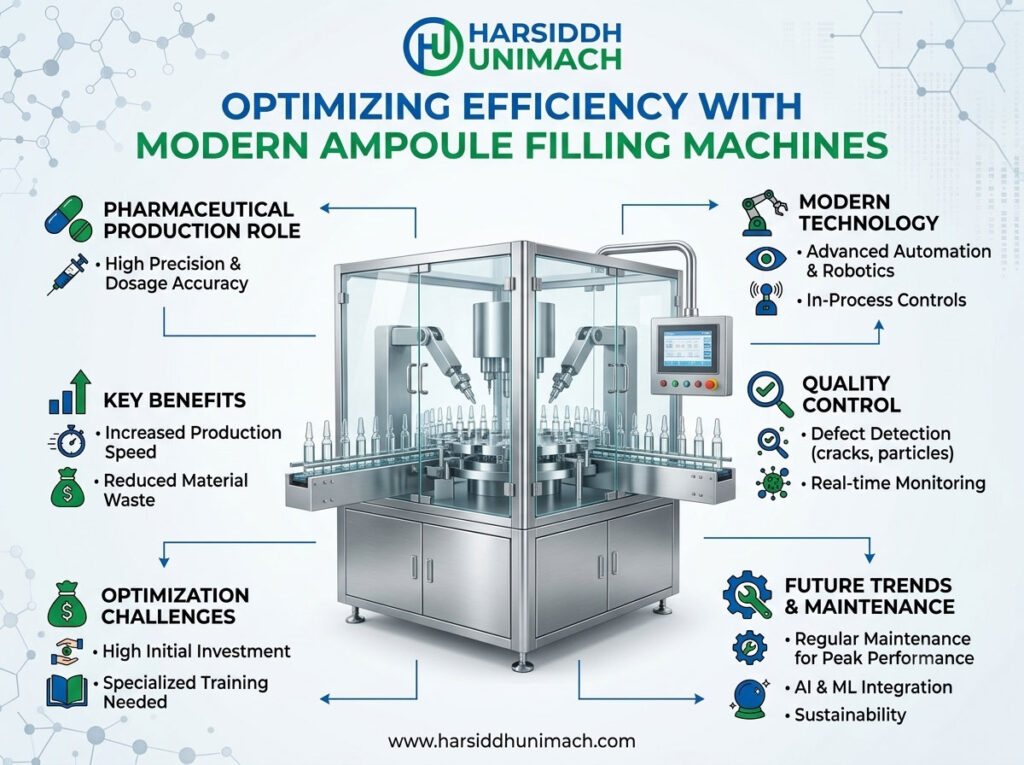
Ampoules have been used for injectable medicines for well over a century, and the basic idea has not changed: fill a glass ampoule with a precise dose and seal it with a flame so the contents stay sterile until use. What has changed dramatically is the machinery. Today’s ampoule filling and sealing machines are faster, more accurate, easier to operate and more reliable than earlier generations, and they give manufacturers far more control over efficiency and quality.
This article looks at the technologies inside modern ampoule filling machines that make that efficiency possible. We explain what each technology does, why it matters for output, accuracy and cost, and what to look for when evaluating a new machine or upgrade.
If you want practical, operational steps for getting more from an existing line, such as measuring OEE, reducing changeovers and cutting rejects, read our companion guide on how to optimize your ampoule filling line.
Where Older Machines Lose Efficiency
To appreciate modern technology, it helps to see where older machines lose time and product:
| Older Machine Limitation | Effect on Efficiency |
|---|---|
| Mechanical dose adjustment | Slow set-up, operator-dependent accuracy |
| Fixed cam motion | Limited ability to fine-tune speed and motion |
| Manual burner adjustment | Inconsistent sealing, more rejects |
| Few filling heads | Limited output per hour |
| Limited safeguards | Wasted product when ampoules are missing |
| Minimal data | Difficult to find causes of losses |
| Long changeovers | Lost production time on multi-product lines |
Modern machines address each of these points.
Technology 1: Servo-Driven Dosing
In traditional machines, dose volume is set by mechanically adjusting the stroke of piston pumps, often one at a time, and the dosing motion is driven by cams.
In servo-driven machines, a servo motor drives the dosing system. This brings several efficiency gains:
- Digital volume setting from the touchscreen, rather than mechanical adjustment
- Individual head trimming to balance fill across all heads
- Programmable motion profiles that reduce splashing and foaming, which in turn reduces neck contamination and sealing defects
- Recipe storage for each product and ampoule size, cutting changeover time
- Repeatability that reduces fill variation and overfill
Read more in servo technology in modern ampoule filling machines.
Technology 2: Peristaltic Dosing Options
Peristaltic pumps move liquid by squeezing flexible tubing with rotating rollers. The product only touches the tubing, never the pump mechanism. Advantages for ampoule filling include:
- No product contact with mechanical parts, simplifying cleaning
- Single-use or easily replaceable tubing, reducing cleaning and changeover time between products
- Gentle handling of shear-sensitive products
- Lower risk of cross-contamination in multi-product facilities
Piston pumps, on the other hand, are robust and can offer very high accuracy, especially for larger volumes. The right choice depends on the product, batch sizes and cleaning strategy. Read peristaltic vs piston pumps: choosing the right filling system for your vial line; the same principles apply to ampoules. See the Automatic Peristaltic Based Ampoule Filling Machine.
Technology 3: Multi-Head Designs
Output on an ampoule filler is largely determined by the number of filling and sealing heads working at the same time. Modern machines are available in a wide range of configurations:
- Single head closed ampoule filling and sealing machine – R&D and small batches
- Two head ampoule filling and sealing machine – small production
- Four head closed ampoule filling and sealing machine – medium output
- Six head closed ampoule filling and sealing machine – higher output
- Eight head ampoule filling and sealing machine – high-volume production
- High-speed eight head vertical ampoule filling and sealing machine – dedicated high-speed lines
Choosing the right number of heads is a key efficiency decision. Too few heads limit output; too many for the actual demand increase investment, change parts and complexity. For a detailed look at a high-output machine, read the definitive guide to the automatic eight head ampoule filling machine process flow.
Technology 4: PLC Control and Touchscreen HMI
Modern machines are controlled by a PLC (programmable logic controller) with a touchscreen HMI (human-machine interface). This enables:
- Recipe management – all settings for each product stored and recalled
- Production data – counts, speeds and stoppage information displayed in real time
- Alarm management – clear messages that help operators find and fix faults quickly
- User access levels – operators, supervisors and engineers with different permissions
- Data recording – supporting batch documentation and, where configured, audit trails
Good HMI design reduces errors, shortens training and speeds up troubleshooting.
Technology 5: Precise Sealing Control
Sealing is where many ampoule rejects originate. Modern machines improve sealing through:
- Gas and oxygen flow control with accurate regulators and flow meters
- Consistent burner positioning using scales and fixed settings for each ampoule size
- Controlled ampoule rotation during heating, for even melting and uniform tips
- Synchronised pulling (on open ampoules), separating the tip cleanly at the right moment
- Flame monitoring, on some designs, to alert operators if the flame fails
The result is more uniform tips, fewer open or fat seals and less charring, all of which improve yield.
Technology 6: Nitrogen Purging
Many injectable products are sensitive to oxygen. Modern machines can purge the ampoule with nitrogen before filling, after filling or both, displacing air from the headspace. Efficient nitrogen systems:
- Protect product stability
- Use nitrogen only when an ampoule is present, reducing gas consumption
- Are synchronised with filling and sealing so the flame is not disturbed
Technology 7: Closed and Crushable Ampoule Options
Closed ampoules
Closed ampoules arrive sealed from the glass supplier and are opened on the machine just before filling. Because the inside remains sealed until that moment, washing and depyrogenation needs may differ from open ampoules. Machines designed for closed ampoules include an opening (cutting) station before filling. See the Automatic Four Head Closed Ampoule Filling and Sealing Machine.
Crushable ampoules
Crushable ampoules are thin-walled glass ampoules inside a protective sleeve, used for products such as inhalants and certain diagnostics. They require specialised handling. See the Automatic Crushable Ampoule Filling and Sealing Machine.
Offering the right format for each product can simplify the overall process and improve efficiency.
Technology 8: Smart Safeguards
Modern machines include safeguards that prevent waste and protect quality:
- No ampoule, no fill – dosing is skipped where an ampoule is missing
- No ampoule, no gas – burners or nitrogen are controlled to avoid waste
- Low product level alarms – warning before the reservoir runs dry
- Gas pressure monitoring – stopping or alarming if pressures fall out of range
- Guard interlocks – stopping the machine when guards are opened
These features prevent product loss, reduce rejects and improve operator safety.
Technology 9: Faster Changeovers
Modern machines are designed with changeover in mind:
- Tool-less or quick-release change parts
- Colour-coded parts for each ampoule size
- Height scales and reference marks for repeatable settings
- Recipe recall for servo settings
- Easy-access designs for cleaning
On multi-product lines, these features can recover a significant amount of production time.
Technology 10: Integrated Ampoule Lines
The filler is only one part of the process. Efficiency increases when the whole line is designed to work together:
- Washing – for example, on a rotary ampoule washing machine
- Depyrogenation – in a sterilizing tunnel for ampoules and vials
- Filling and sealing
- Inspection – on a visual ampoule and vial inspection machine
- Labelling and packing
Integrated lines with synchronised speeds, smooth transfers and shared controls reduce stoppages and handling damage. Browse our injectable ampoule filling lines and all ampoule filling machines.
Designed for Operators and Maintenance Teams
Efficiency is not only about machine speed. A machine that is easy to operate, clean and maintain spends more time producing good ampoules. Modern designs help through:
- Open, accessible layouts so operators can see and reach filling and sealing stations easily
- Clear visibility of the process through transparent guards
- Ergonomic loading of ampoule infeed trays and product reservoirs
- Easy-to-remove contact parts for cleaning and sterilisation
- Drives and electrical components separated from the product area
- Lubrication points and wear parts that are easy to reach
- Maintenance prompts on the HMI based on running hours or cycle counts
These details reduce the time spent on routine tasks and lower the risk of mistakes during cleaning and set-up.
Efficiency Gains Across the Process
| Process Stage | Modern Technology | Efficiency Benefit |
|---|---|---|
| Set-up | Recipes, quick-release parts | Shorter changeovers |
| Dosing | Servo or peristaltic pumps | Less overfill, fewer fill rejects |
| Nitrogen purging | Synchronised, ampoule-present control | Lower gas use, product protection |
| Sealing | Controlled gas flow, consistent burners | Fewer sealing rejects |
| Safeguards | No ampoule-no fill, level and pressure alarms | Less product waste |
| Monitoring | HMI data and alarms | Faster troubleshooting |
| Line integration | Synchronised washer, tunnel and inspection | Fewer stoppages, less breakage |
Comparing Older and Modern Ampoule Machines
| Feature | Older Machines | Modern Machines |
|---|---|---|
| Dose setting | Mechanical | Digital, servo-controlled |
| Head balancing | Manual, time-consuming | Individual trim from HMI |
| Changeover | Long, tool-intensive | Quick-release parts, recipes |
| Sealing control | Manual burner adjustment | Controlled gas flow, fixed positions |
| Safeguards | Limited | No ampoule-no fill, gas and level monitoring |
| Data | Minimal | Counts, alarms, stoppage data |
| Dosing options | Piston | Piston, servo piston or peristaltic |
| Ampoule formats | Open | Open, closed, crushable |
How to Evaluate a Modern Ampoule Filling Machine
- Output – number of heads matched to current and future demand
- Dosing technology – servo piston or peristaltic, depending on product and cleaning needs
- Accuracy and repeatability – supported by trial data on your product
- Sealing quality – consistency of tips across sizes
- Changeover – time, tools and parts required
- Controls – recipe management, alarms, user levels, data recording
- Safeguards – no ampoule-no fill, gas and nitrogen controls
- Line integration – compatibility with washers, tunnels and inspection
- Documentation and support – qualification documents, training and spare parts
The Business Case for Modernisation
Modern machines cost more than basic designs, but efficiency gains often justify the investment through:
- Higher output from the same floor space and staff
- Lower product loss from accurate dosing and fewer rejects
- Shorter changeovers on multi-product lines
- Reduced maintenance and downtime
- Better compliance and documentation
When evaluating options, compare total cost of ownership over the machine’s life, not just the purchase price.
Upgrading an Existing Machine vs Buying New
Not every efficiency improvement requires a completely new machine. Depending on the age and condition of existing equipment, options include:
- Retrofitting servo drives or modern controls to an existing frame
- Adding safeguards such as ampoule-presence sensors and gas monitoring
- Upgrading dosing systems, for example moving to peristaltic pumps for specific products
- Replacing worn change parts with improved, quick-release designs
Retrofits can be cost-effective when the machine frame and mechanics are sound. A new machine usually makes more sense when output needs to rise substantially, when new ampoule formats are required, or when the existing machine cannot meet current documentation and data expectations. An honest assessment of the current machine helps decide which route delivers the best value.
Frequently Asked Questions
What makes modern ampoule filling machines more efficient? Servo or peristaltic dosing, multi-head designs, PLC and HMI recipe control, precise sealing control, nitrogen purging, smart safeguards, quick changeovers and integration with the rest of the line.
Is servo dosing better than mechanical dosing? Servo dosing allows digital setting, individual head trimming, stored recipes and smoother motion, which improve accuracy and reduce changeover time.
When should peristaltic pumps be used for ampoules? When easy cleaning, reduced cross-contamination risk or gentle handling are priorities, especially in multi-product facilities.
What is the difference between open and closed ampoules? Open ampoules arrive with an open neck; closed ampoules arrive sealed and are opened on the machine just before filling.
How many filling heads do I need? It depends on your output requirement, batch sizes and number of products. Matching heads to real demand avoids both bottlenecks and overinvestment.
Ready to modernise your ampoule filling? Contact our team or send an inquiry with your product, ampoule sizes and output targets.