
Liquids flow, find their own level and pour predictably. Powders do not. They bridge, cake, fluff up, settle, absorb moisture, create dust and change density as they move. That is why filling powder accurately into bottles, jars, vials or pouches requires very different equipment from liquid filling — and why choosing the right powder filling machine has such a strong impact on accuracy, product loss and cleanliness.
Powder filling machines are used to pack everything from sterile antibiotic injections and dry syrups to protein supplements, spices, coffee, detergents and agrochemicals. In this guide, we explain what a powder filling machine is, how the main types work, which parts they are built from, where they are used and how to select the right machine for your product.
What Is a Powder Filling Machine?
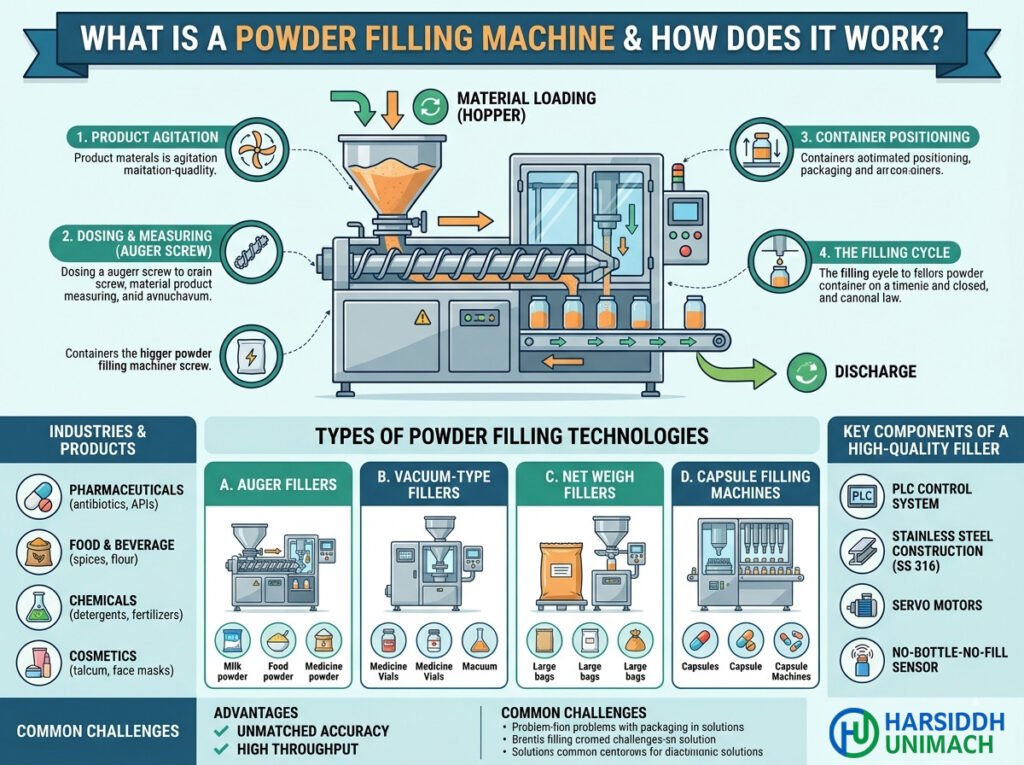
A powder filling machine is equipment that dispenses a measured quantity of dry, free-flowing or non-free-flowing powder or granules into containers. It controls the dose either by volume (using an auger, a measuring cup or a powder wheel) or by weight (using a load cell), and it delivers that dose into the container with minimal dust and spillage.
Powder filling machines range from simple semi-automatic units for small batches to fully automatic, servo-controlled machines integrated into complete lines with container feeding, capping, sealing and labelling. Browse the full range in our powder filling machines category.
Why Is Powder Filling Challenging?
Before looking at the machines, it helps to understand what makes powders difficult:
- Flowability: some powders flow freely like sugar; others are cohesive and stick together like flour or milk powder.
- Bulk density: density changes as powder is aerated or compacted, so the same volume can weigh different amounts.
- Particle size: fine powders create dust and can leak through gaps; coarse granules can jam mechanisms.
- Moisture sensitivity: hygroscopic powders absorb humidity, causing lumps and inaccurate dosing.
- Electrostatic charge: some powders cling to surfaces, funnels and container necks.
- Sterility: pharmaceutical injectable powders must be handled aseptically, without any contamination.
Each type of powder filling machine handles these challenges in a different way.
Main Parts of a Powder Filling Machine
Most powder filling machines include:
- Hopper: holds the bulk powder above the dosing system, often with a level sensor and automatic refill.
- Agitator or stirrer: keeps powder moving to prevent bridging and maintain uniform density.
- Dosing system: an auger screw, powder wheel, measuring cups or weighing system that measures each dose.
- Filling funnel or nozzle: guides powder into the container neatly.
- Container handling system: a conveyor, star wheel or turntable that positions containers under the filling head.
- Dust extraction: suction points near the filling zone to capture airborne powder.
- Control system: PLC and HMI to set doses, speeds and recipes, with servo motors on modern machines.
How Does a Powder Filling Machine Work?
The general working cycle of an automatic powder filling machine is:
- Container infeed: empty containers are fed onto the conveyor or turntable and spaced correctly.
- Positioning: sensors detect each container and stop it precisely under the filling head.
- Dosing: the dosing system measures the required amount of powder.
- Filling: the powder is discharged into the container, sometimes with the container lifted or vibrated to settle the product.
- Closing: the container moves on to stoppering, capping or sealing.
- Check-weighing and rejection: on many lines, filled containers are weighed and any out-of-tolerance units are rejected.
For a more technical explanation, see our article on powder filling machine working principle. The details differ depending on how the dose is measured, as described below.
Types of Powder Filling Machines and How They Work
There are several main powder filling technologies. Our guide to the types of powder filling machines: auger, gravity and vacuum compares them in depth. Here is how each one works.
1. Auger powder filling machines
An auger filler uses a precisely machined screw rotating inside a tube at the bottom of the hopper. Each revolution of the screw moves a predictable volume of powder downward and out through the nozzle. A servo motor controls the exact number of rotations, which sets the dose. An agitator in the hopper keeps the powder flowing evenly into the auger flights.
Auger fillers are the most versatile powder filling technology. They handle both free-flowing and cohesive powders — from fine pharmaceutical powders to food products, spices and nutritional supplements. Different auger sizes and pitches are used for different dose ranges and powder types.
Examples include the Automatic Auger Type Powder Filling Machine and our single and double head auger type powder filling machine.
2. Vacuum and pressure (powder wheel) filling machines
This is the standard technology for sterile dry powder injections filled into glass vials. A rotating powder wheel has a series of precisely sized dosing bores around its edge. As each bore passes under the hopper, vacuum pulls powder into it, filling the bore completely and compacting the powder to a consistent density. The wheel then rotates to the discharge position above a vial, where filtered compressed air gently pushes the dose out into the vial.
Because the dose is defined by the bore volume and a controlled vacuum, this method gives high accuracy even for small doses. The vials are then immediately stoppered with rubber stoppers. Machines may use a single wheel or a double wheel for higher output. Learn more in vial powder filling machine working principle, and see the Automatic Injectable Vial Dry Powder Filling and Stoppering Machine (Double Wheel Head) and the single wheel injectable dry powder vial filling and stoppering machine.
3. Volumetric cup (measuring cup) fillers
A rotating plate holds a set of measuring cups. As the plate turns, each cup passes under the hopper and fills with powder; excess powder is scraped level. The cup then opens over the container and releases its dose. Cup size can be adjusted within a range. This method is fast and economical for free-flowing granules and powders with consistent density, such as sugar, salt or granulated products.
4. Gravity and rotary fillers for dry syrup
Dry syrup powders — antibiotics and other medicines that the patient reconstitutes with water — are filled into bottles on rotary machines that combine controlled powder flow with volumetric or auger dosing. The Automatic Rotary Dry Syrup Powder Filling Machine is designed specifically for this application. Read more in dry syrup filling machine working principle, and see our dry syrup powder filling machine range.
5. Net weight fillers
Here, a load cell weighs the powder as it is dispensed — either directly into the container or into a weigh bucket — and stops the feed at the target weight. Weight-based filling compensates for density variation and is preferred for high-value products and larger packs, though it is generally slower than volumetric methods.
Powder Filling in Pharmaceutical Production
Sterile dry powder injections
Many antibiotics, such as cephalosporins and penicillins, are supplied as sterile dry powder in vials because they are unstable in solution. A typical sterile powder line includes:
- Vial washing and depyrogenation in a sterilising tunnel.
- Powder filling and stoppering on a vacuum-pressure powder wheel machine, under unidirectional airflow in a Grade A zone.
- Capping with aluminium seals, using machines such as our 1, 4, 6 and 8 head vial cap sealing machines.
- Inspection for foreign particles, cracks and dose level, using an Automatic Visual Vial Dry Powder Inspection Machine or our visual vial dry powder inspection machine.
- Labelling and packing.
Explore the full range of injectable powder filling machines.
Dry syrup bottles
For oral dry syrups, a typical line includes bottle unscrambling, air cleaning, powder filling, capping with screw or ROPP caps, induction sealing and labelling. A complete automatic dry syrup powder filling line integrates these steps, with capping handled by equipment such as a bottle screw and ROPP capping machine.
Other Industries That Use Powder Filling Machines
- Nutraceuticals: protein powders, health supplements and herbal powders.
- Food: spices, coffee, tea, milk powder, flour, sugar and seasonings.
- Cosmetics: talcum powder, face powders and dry shampoos.
- Chemicals and agrochemicals: detergents, pesticides, fertilisers and pigments.
- Veterinary products: feed additives and powdered medicines.
Factors to Consider When Choosing a Powder Filling Machine
- Powder characteristics: flowability, particle size, density, stickiness and moisture sensitivity are the most important factors. Testing your actual powder on the machine is the best way to confirm suitability.
- Fill weight range and accuracy: small injectable doses need different technology from 1 kg food packs.
- Container type: vials, bottles, jars, cans or pouches each need different handling.
- Output: match the machine’s speed to your current and future production plans.
- Hygiene and compliance: pharmaceutical machines need SS 316L contact parts, GMP design and validation documentation; sterile products need aseptic design.
- Dust control: effective extraction protects operators, prevents cross-contamination and keeps the machine clean.
- Changeover and cleaning: quick-release augers, hoppers and change parts reduce downtime between products.
- Line integration: consider how the filler will connect to capping, sealing and labelling equipment.
See our wider dry powder filling machines range for options across different industries.
Environmental Conditions Matter
Powder filling performance depends heavily on the filling room environment. High humidity causes hygroscopic powders to clump, bridge in the hopper and stick to the auger or wheel, reducing accuracy. For this reason, many pharmaceutical powder filling areas operate at controlled low relative humidity and temperature. Proper environmental control is just as important as the machine itself.
Common Powder Filling Problems and Solutions
- Inaccurate fill weights: caused by density variation, bridging or worn augers. Use agitators, maintain constant hopper levels and calibrate regularly.
- Dust in the filling area: caused by fine powders and high fill speeds. Use dust extraction, correct funnel design and controlled discharge.
- Powder on container necks: prevents good sealing. Use anti-drip devices, correct nozzle clearance and tapping or vibration to settle powder.
- Bridging in the hopper: cohesive powders form arches. Agitators and correct hopper geometry solve this.
- Product build-up on equipment: hygroscopic or sticky powders adhere to surfaces. Control humidity and follow a strict cleaning schedule.
Maintenance Tips for Consistent Accuracy
- Inspect augers and powder wheels regularly: wear on flights or dosing bores gradually changes the dose volume.
- Check vacuum and compressed air filters: clogged filters reduce suction and discharge force on powder wheel machines.
- Clean thoroughly between products: residual powder can cause cross-contamination and build-up.
- Verify fill weights every shift: weighing samples gives early warning of drift before it becomes a quality problem.
How Harsiddh Unimach Can Help
Harsiddh Unimach Pvt. Ltd. manufactures auger powder fillers, injectable dry powder vial filling and stoppering machines, dry syrup powder filling machines and complete powder filling lines with capping, sealing, inspection and labelling. Our team can help you select the right technology for your powder, container and output requirements.
Frequently Asked Questions
What is a powder filling machine used for? It is used to dispense measured amounts of powder or granules into containers such as vials, bottles, jars and pouches, across pharmaceutical, food, nutraceutical, cosmetic and chemical industries.
How does an auger powder filling machine work? A servo-driven screw rotates inside a tube below the hopper. Each rotation moves a set volume of powder, so the number of rotations determines the dose.
How is sterile powder filled into vials? Using vacuum-pressure powder wheel machines. Vacuum draws powder into precisely sized bores, and compressed air discharges each dose into a vial, which is then stoppered immediately.
Which powder filling machine is best for dry syrup? Rotary dry syrup powder filling machines or auger fillers are commonly used, depending on the powder’s flow characteristics and the required output.
Why is humidity control important in powder filling? Many powders absorb moisture, which causes clumping, poor flow and inaccurate doses. Controlled humidity keeps powders free-flowing and fills consistent.
Looking for the right powder filling machine? Contact our team or send an inquiry to discuss your requirements.