
In sterile injectable manufacturing, every decision is ultimately judged by one question: does it protect the patient? Vial washing may seem like a routine preparatory step, but it is the first line of defence against particles, residues and contamination. A vial that leaves the washer with a glass fragment or fibre inside will carry that defect through sterilisation and filling — and it may only be caught at final inspection, if at all.
When manufacturers choose a vial washing machine, the choice usually comes down to two designs: rotary and linear. Both are proven, both are used in regulated plants worldwide, and both can deliver excellent results. So which is better for sterile production?
The honest answer is: it depends on your plant. This article helps you make that decision by focusing on what matters most in sterile manufacturing — cleanliness, sterility assurance, integration, validation and long-term reliability. For a detailed look at the mechanics of each design, see our definitive engineering comparison of rotary and linear vial washing machines.
A Quick Refresher: How Each Design Works
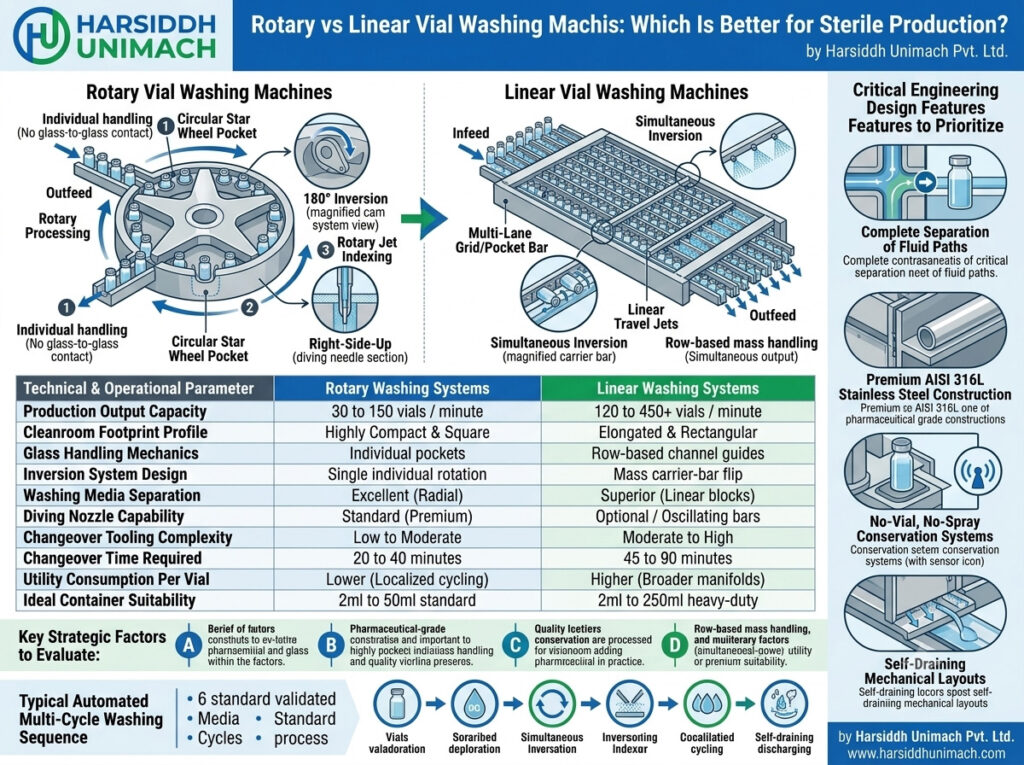
Rotary vial washers move vials in a circle. Grippers hold each vial upside down while needles rise into it and deliver alternating jets of water and air. Vials are washed continuously as the platform rotates. See the Automatic Rotary Vial Washing Machine and our rotary vial washing machine.
Linear vial washers move vials in a straight line. Vials are typically pre-cleaned in an ultrasonic bath, then inverted in rows and indexed through a series of internal and external washing stations before being discharged directly into the sterilising tunnel. See the Automatic Linear Vial Washer, our linear vial washer and the linear vial washing machine.
What “Better for Sterile Production” Really Means
Before comparing the two, it helps to define what a sterile plant needs from its washer:
- Effective particle removal – consistently reducing visible and sub-visible particles.
- Reliable rinsing with the right water quality – final rinse with WFI for parenteral products.
- Minimal new particle generation – no glass chipping or scratching during handling.
- Clean, protected transfer to the tunnel – no recontamination between washing and depyrogenation.
- Repeatable, validatable performance – the same result on every vial, every batch.
- Minimal operator intervention – fewer manual actions mean less contamination risk.
- Capacity that matches the line – no bottlenecks at the filler.
Let’s compare rotary and linear washers against each of these criteria.
1. Particle Removal Effectiveness
Linear washers have a natural advantage here. Most designs include an ultrasonic bath, which loosens particles that cling tightly to glass surfaces — something jets alone may not dislodge. Linear machines also have room for more washing stations along their length, allowing longer contact time and more wash cycles per vial.
Rotary washers achieve good cleaning within a compact cycle, using well-designed needles and a carefully planned sequence of water and air jets. For many products and standard vials, this is entirely sufficient.
Verdict: for the most demanding particle requirements, linear washers with ultrasonic pre-cleaning offer extra margin. Rotary washers perform well for standard applications.
Learn more about how linear designs support sterility in how automatic linear vial washers improve sterility in injectable manufacturing.
2. Water Quality and Rinsing
Both designs can use recirculated water for early washing stages and fresh purified water or WFI for final rinses, followed by filtered compressed air. The difference lies in flexibility: linear machines can accommodate additional rinse stations if your process requires them.
Verdict: both are suitable when correctly specified; linear washers offer more flexibility to add rinse steps.
Our guide to the sterile container washing process explains each stage of a typical washing sequence.
3. Gentle Handling and Breakage
Glass-to-glass contact and impacts generate new particles — the opposite of what washing is meant to achieve.
Rotary washers handle each vial individually in its own gripper, with smooth, continuous motion. This gives very controlled handling, especially for small and medium vials.
Linear washers handle vials in rows. Well-designed row grippers and indexing systems are gentle, but alignment and setup are critical, particularly at high speeds.
Verdict: both can be gentle when correctly designed and maintained. Rotary washers offer very controlled individual handling; linear washers require careful setup of row mechanisms.
For more on handling challenges, read challenges in high-speed vial processing and their solutions.
4. Integration with the Sterilising Tunnel
In sterile production, the transfer from washer to depyrogenation tunnel must be clean and protected, since washed vials are vulnerable to recontamination before sterilisation.
Linear washers usually discharge vials in a straight line directly into the tunnel infeed, under filtered airflow. This seamless transfer is one of their biggest advantages for integrated sterile lines.
Rotary washers need a transfer arrangement — often a conveyor or star wheel — to move vials into the tunnel. Properly designed and protected, this works well, but it adds a transfer point.
Verdict: linear washers integrate more naturally with the tunnel, simplifying contamination control. See our sterilizing tunnel for ampoules and vials and the wider sterilizers range.
5. Validation and Repeatability
Both washer types are validated through cleaning studies, including particle challenge tests, water and air quality verification, and checks on critical parameters such as pressures, flows and temperatures.
Linear washers often have more stations and parameters to qualify, but their structured, sequential design makes each step easy to define and monitor.
Rotary washers have fewer stations and a simpler cycle, which can make validation more straightforward for smaller operations.
Verdict: both can be validated effectively. Choose the design whose parameters you can control and monitor confidently. For guidance on the parameters regulators expect to see, read our article on vial filling machine validation and key parameters.
6. Operator Intervention and Contamination Control
Modern contamination control strategies aim to reduce manual interventions throughout the process.
Linear washers on integrated lines feed directly into the tunnel and filler, minimising manual handling from washing to filling.
Rotary washers on standalone setups may involve more manual loading, unloading or transfer — particularly on smaller lines.
Verdict: for highly automated sterile lines, linear washers support lower-intervention operation. Rotary washers on well-designed lines can also run with minimal intervention.
7. Output and Capacity
Rotary washers suit small to medium outputs and are often ideal for pilot plants, clinical production and smaller commercial lines.
Linear washers process vials in rows and can be extended with more stations, supporting medium to high outputs.
Verdict: match the washer to your filler’s capacity with a margin for recovery after stoppages. For high-speed lines, linear washers are usually the practical choice.
8. Footprint and Cost
Rotary washers are compact and generally less expensive — valuable when cleanroom space and budget are limited.
Linear washers need more floor space and represent a higher investment, but deliver more capacity and integration benefits.
Summary: Which Is Better for Sterile Production?
| Criterion | Rotary Washer | Linear Washer |
|---|---|---|
| Particle removal | Good | Excellent (with ultrasonic) |
| Rinse flexibility | Good | Excellent |
| Vial handling | Very controlled (individual grippers) | Good (row handling, setup critical) |
| Tunnel integration | Requires transfer | Direct, seamless |
| Validation complexity | Simpler | More parameters, well structured |
| Intervention level | Low to moderate | Low on integrated lines |
| Output | Small to medium | Medium to high |
| Footprint | Compact | Larger |
| Investment | Lower | Higher |
Our Recommendation by Plant Type
Choose a rotary vial washer if you are: – Running a pilot plant, R&D facility or clinical manufacturing unit – Producing small to medium commercial volumes – Working with limited cleanroom space or budget – Running standard vial sizes and products
Choose a linear vial washer if you are: – Building an integrated, high-speed sterile line – Exporting to regulated markets with demanding particle expectations – Producing medium to high volumes – Handling a wide range of vial sizes – Seeking maximum particle removal with ultrasonic pre-cleaning
For very small batches or manual operations, a semi-automatic multijet vial washing machine can also be a practical entry point.
Common Myths About Vial Washers
“Linear washers are always better.” Not necessarily. For a small or pilot line, a linear washer may be oversized, expensive and difficult to justify. A well-specified rotary washer can deliver fully compliant results.
“Rotary washers can’t be used for regulated markets.” Rotary washers are used in regulated sterile production. What matters is validated performance, proper maintenance and a protected transfer to the tunnel.
“More stations automatically mean cleaner vials.” Cleaning results depend on needle design, jet pressure, water quality and correct sequencing — not just the number of stations.
“Once validated, the washer will always perform.” Needles bend, filters clog and seals wear. Ongoing monitoring and preventive maintenance are essential to maintain validated performance.
Looking at Lifetime Cost, Not Just Purchase Price
A vial washer typically runs for many years, so lifetime cost matters more than the initial quotation. Consider:
- Water and WFI consumption: generating purified water and WFI is expensive, so efficient recirculation can save significant operating cost over the machine’s life.
- Compressed air use: filtered, oil-free compressed air is a costly utility; well-timed air blows reduce waste.
- Changeover time: if you run several vial sizes, faster changeovers add productive hours every week.
- Maintenance and spares: gripper pads, needles, filters, valves and ultrasonic components all need periodic replacement.
- Rejects at inspection: a washer that removes particles more effectively reduces rejects downstream — a benefit that can outweigh differences in purchase price.
- Future expansion: if output is expected to grow, a washer with spare capacity avoids a costly replacement later.
When these factors are included, the “cheaper” option is not always the most economical, and the “premium” option is not always necessary. The right choice is the one that meets your sterility and capacity needs at the lowest total cost over its working life.
Don’t Forget the Rest of the Line
The washer is only one part of sterile production. Its performance depends on the tunnel, filler and inspection equipment around it:
- An integrated system such as the automatic liquid vial filling line (compact line) combines washing, sterilising, filling and sealing for smaller plants.
- Final inspection, using a visual ampoule and vial inspection machine, confirms that washing and every downstream step have done their job — and trends in particle rejects often point back to washer performance.
- If your plant also fills ampoules, consider a matching rotary ampoule washing machine for a consistent approach across formats.
Questions to Ask Your Supplier
- What particle reduction results has this washer achieved in validation studies?
- How many washing stations and what media sequence does it use?
- Is ultrasonic pre-cleaning available or included?
- How does the washer transfer vials to the tunnel, and how is that transfer protected?
- What are the water and compressed air consumption figures at rated output?
- How long does a vial size changeover take?
- What documentation is provided for IQ/OQ?
- What preventive maintenance is required, and which spares should be stocked?
Frequently Asked Questions
Which vial washer is better for sterile production? Linear washers are generally preferred for integrated, high-speed sterile lines because of ultrasonic cleaning and direct tunnel integration. Rotary washers are an excellent choice for smaller lines, pilot plants and limited space.
Do rotary vial washers meet GMP requirements? Yes. When properly designed, validated and maintained, rotary washers meet GMP requirements for sterile production.
Is ultrasonic cleaning necessary? Not always, but it helps remove tightly adhered particles and adds a margin of safety for demanding applications.
Can a rotary washer be connected to a sterilising tunnel? Yes, using a suitable protected transfer system between the washer outfeed and the tunnel infeed.
Which washer uses less water? It depends on design and output. Both can recirculate water; ask suppliers for consumption figures at your required speed.
Need help choosing a vial washer for your sterile line? Explore our washing machines and the full range of vial washing machines, contact our team or send an inquiry.