
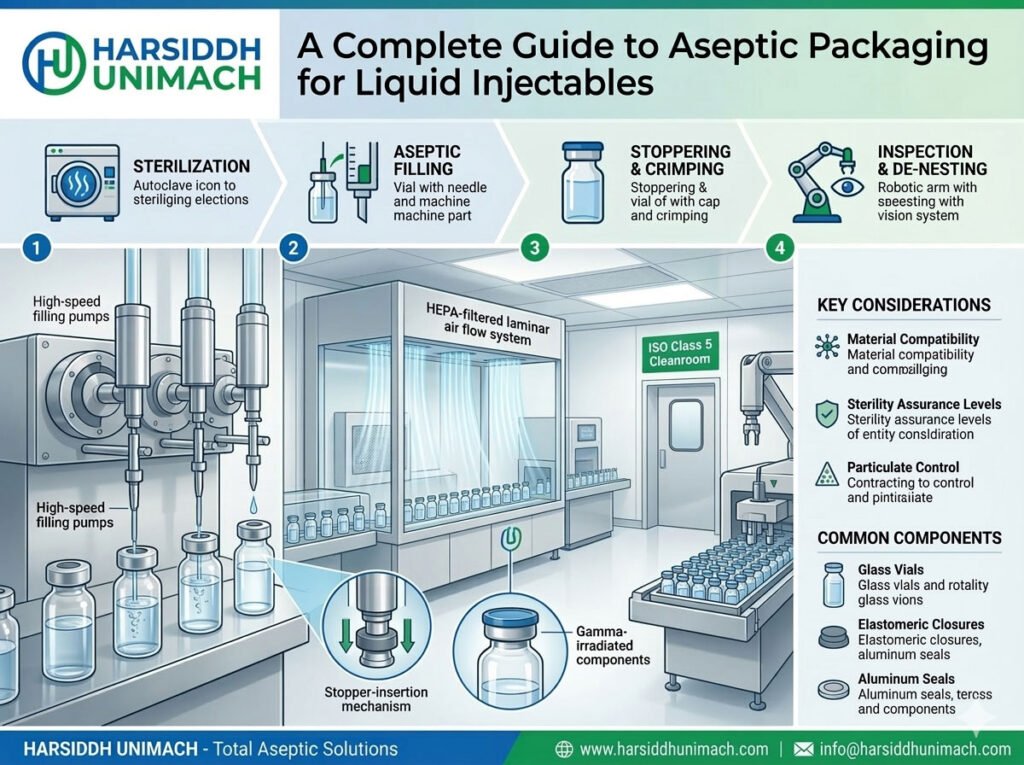
A Complete Guide to Aseptic Packaging for Liquid Injectables: Precision, Safety, and Innovation
In the high-stakes world of pharmaceutical manufacturing, “sterile” isn’t just a standard—it’s a lifeline. For liquid injectables, which bypass the body’s natural defenses and enter the bloodstream directly, the margin for error is zero. This is where aseptic packaging becomes the cornerstone of patient safety.
At Harsiddh Unimach, we have spent decades perfecting the machinery that drives these processes. From high-speed ampoule filling to sophisticated vial stoppering, our equipment is engineered to meet the most rigorous global standards. This guide provides a deep dive into the world of aseptic packaging, covering its core principles, the machinery involved, regulatory landscapes, and the future of the industry.
1. Understanding Aseptic Packaging: Definition and Scope
What is Aseptic Packaging?
Aseptic packaging is the process by which a sterile product (typically a liquid drug) is packaged into a pre-sterilized container and sealed within a contamination-free environment. Unlike terminal sterilization—where the product is sterilized after being sealed in its final container—aseptic processing handles the product and the packaging separately before bringing them together.
Why Liquid Injectables Require Aseptic Processing
Many modern medications, particularly biologics, vaccines, and complex proteins, are heat-sensitive. Terminal sterilization (using high-heat autoclaves) would destroy their molecular structure. Aseptic packaging allows these sensitive formulations to remain effective while ensuring they are 100% free of bacteria, viruses, and pyrogens.
2. The Core Components of an Aseptic Packaging Line
A successful aseptic line is a symphony of synchronized machines. For a company like Harsiddh Unimach, the goal is to provide a seamless “wash-fill-seal” workflow.
A. Container Cleaning and Preparation
The process begins with the elimination of particulates and microorganisms.
- Rotary Vial Washing Machines: These utilize multiple wash cycles (recycled water, DM water, and compressed air) to ensure every nook of the vial is scrubbed.
- Air Jet Cleaning: For smaller runs or specific container types, high-pressure air jets remove dust and foreign particles.
B. Sterilization and Depyrogenation
Once cleaned, containers must be sterilized. In liquid injectable lines, this is often achieved through a Depyrogenation Tunnel. Containers pass through intense dry heat (up to 300°C) which not only kills microbes but also breaks down pyrogens—bacterial debris that can cause fevers in patients.
C. The Heart of the Process: Filling and Stoppering
This is where Harsiddh Unimach’s engineering excellence shines.
- Ampoule Filling and Sealing: Liquid is dispensed into glass ampoules, which are then hermetically sealed using a flame. This creates a tamper-proof, 100% sealed environment.
- Vial Filling and Stoppering: For vials, the liquid is filled with high precision (often using peristaltic or piston pumps), followed by the immediate insertion of a rubber stopper.
D. Capping and Sealing
After stoppering, vials move to an Automatic Capping Machine. Aluminum caps are crimped over the rubber stopper to provide a mechanical seal and protect the sterile entry point.
3. Filling Technologies: Piston vs. Peristaltic Pumps
Choosing the right filling technology is critical for liquid injectables.
| Feature | Piston Pumps | Peristaltic Pumps |
| Accuracy | Extremely high for viscous liquids. | High, especially for low-volume doses. |
| Contamination Risk | Requires thorough CIP/SIP (Clean-in-Place). | Single-use tubing eliminates cross-contamination. |
| Material Sensitivity | May exert shear stress on biologics. | Gentle on delicate molecules. |
| Maintenance | Higher (moving parts in contact with product). | Lower (only tubing is replaced). |
At Harsiddh Unimach, we offer customized filling solutions that allow manufacturers to choose the pump technology best suited for their specific molecule.
4. The Sterile Environment: Cleanrooms and RABS
The machinery is only as good as the environment it sits in. Aseptic packaging must occur in a Grade A (Class 100) environment.
- HEPA Filtration: High-Efficiency Particulate Air filters provide a constant flow of laminar air, “sweeping” particles away from the open containers.
- RABS (Restricted Access Barrier Systems): These provide a physical barrier between the operator and the filling line, reducing the primary source of contamination: humans.
- Isolator Technology: The gold standard in modern pharma, isolators are completely sealed units that can be decontaminated using Vaporized Hydrogen Peroxide (VHP).
5. Regulatory Compliance: FDA, EMA, and WHO Standards
Navigating the regulatory landscape is perhaps the most challenging aspect of pharmaceutical packaging.
Annex 1 (EU GMP)
The recent updates to EU GMP Annex 1 have set a higher bar for “Contamination Control Strategy” (CCS). It emphasizes the need for continuous environmental monitoring and the movement toward automated, “hands-free” processing.
FDA 21 CFR Parts 210 and 211
The US FDA focuses heavily on Media Fills (Aseptic Process Simulations). Manufacturers must periodically run a nutrient broth through the machines instead of the drug to prove that the process remains sterile from start to finish.
Data Integrity
Modern machines must be 21 CFR Part 11 compliant. This means every action—from speed changes to alarms—must be logged electronically with an audit trail that cannot be deleted or altered.
6. Common Challenges in Aseptic Packaging (And How to Solve Them)
Challenge 1: Particulate Contamination
Even a microscopic glass shard can lead to a batch recall.
- Solution: Use Harsiddh’s advanced vial washing systems and integrated Vial Inspection Machines that use high-resolution cameras to detect particles.
Challenge 2: Oxygen Sensitivity
Some liquids degrade when exposed to oxygen.
- Solution: Nitrogen Flushing. Our filling machines can be equipped with pre- and post-filling nitrogen purging to displace oxygen and extend shelf life.
Challenge 3: Product Loss
With high-value biologics, every drop counts.
- Solution: Precision dosing and “No Vial, No Fill” sensors ensure that liquid is only dispensed when a container is perfectly positioned.
7. The Sustainability Shift in Pharma Packaging
While “sterile” and “disposable” often go hand-in-hand, the industry is moving toward greener solutions.
- Lightweighting: Reducing the glass or plastic content in containers without compromising integrity.
- Energy-Efficient Machinery: Newer motors and optimized depyrogenation tunnels reduce the carbon footprint of the manufacturing facility.
- Recyclable Secondary Packaging: Using biodegradable materials for the boxes and inserts that hold the vials.
8. Why Choose Harsiddh Unimach for Your Aseptic Needs?
Building an aseptic line is an investment in your brand’s reputation. At Harsiddh Unimach, we provide:
- Tailored Engineering: No two drug formulations are the same. We customize our machines to fit your specific viscosity, container size, and speed requirements.
- Global Standards: Our machines are designed to meet cGMP, FDA, and CE standards, making them suitable for export-oriented units.
- End-to-End Solutions: From rotary washers to labeling machines, we provide a turnkey solution that ensures equipment compatibility and synchronized speed.
- After-Sales Support: Sterile processing doesn’t sleep. Our technical team ensures your lines stay up and running with minimal downtime.
9. The Future: AI and Robotics in Aseptic Packaging
As we look toward 2030, the “Human-less” cleanroom is becoming a reality.
- Robotic Pick-and-Place: Robots are replacing traditional conveyor systems to move vials through the line, further reducing particulate risk.
- Predictive Maintenance: AI-driven sensors on Harsiddh machines can predict when a bearing or pump is about to fail, allowing for “planned” maintenance before a sterile breach occurs.
Conclusion
Aseptic packaging for liquid injectables is a complex discipline that sits at the intersection of biology, chemistry, and high-precision engineering. As drug formulations become more complex, the machinery used to package them must become more intelligent.
Whether you are a startup pharmaceutical company or an established global manufacturer, staying ahead of the curve requires a partner who understands the nuances of sterility. Harsiddh Unimach is committed to providing the technology that keeps your products safe and your patients healthy.
Ready to upgrade your aseptic line?
Contact the experts at Harsiddh Unimach today to discuss your project requirements.
